

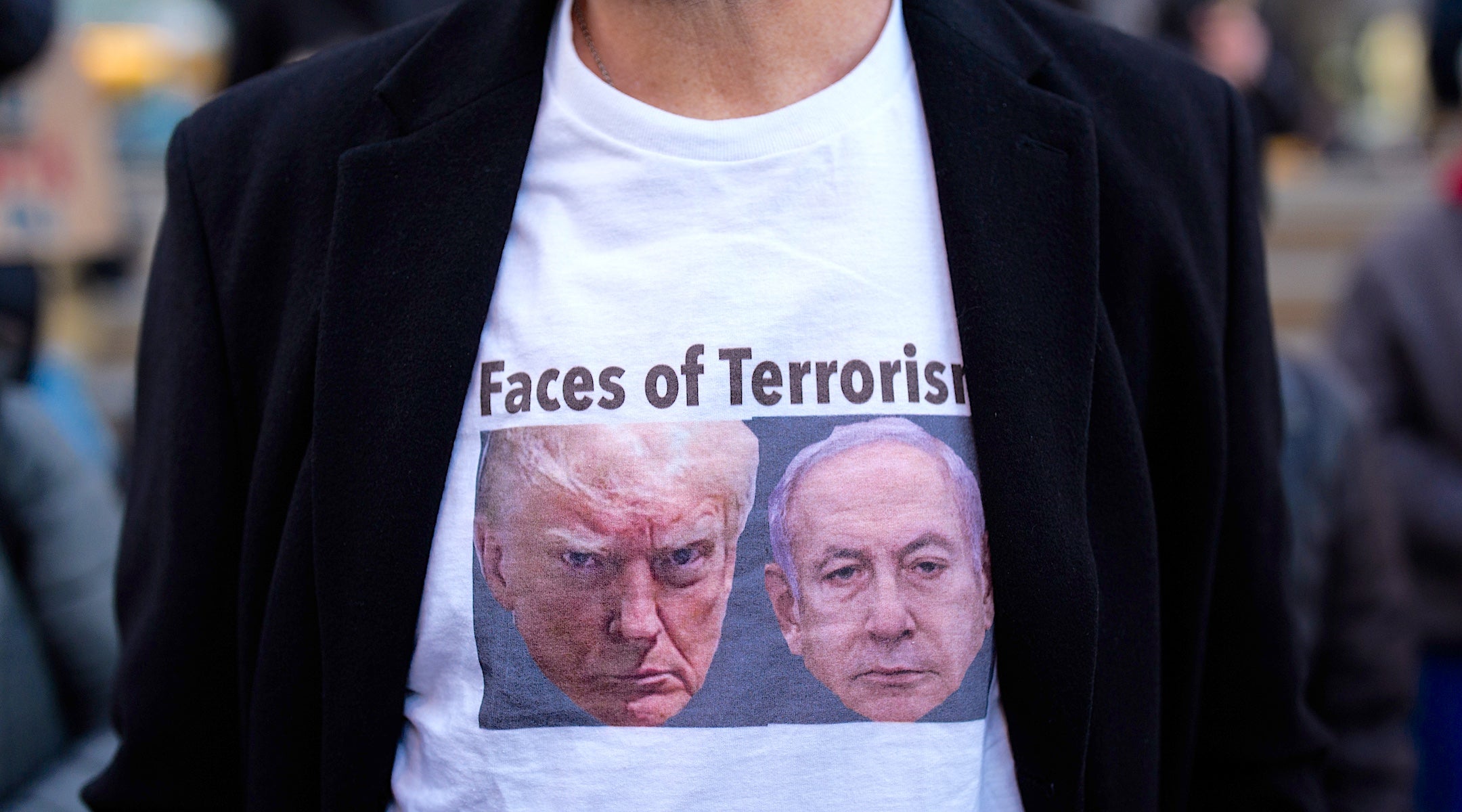
As the U.S. and Israel engage in a joint assault on Iran, accusations that Israel or Jewish influence drove America to war are resurfacing, reviving the uncomfortable narratives, conspiratorial rhetoric and fears of an antisemitic backlash that shadowed the Iraq conflict of the early 2000s.
On Sunday, the Anti-Defamation League warned on X that “antisemitic and anti-Zionist groups are framing the U.S.-Israel operation against the Iranian regime as the latest evidence of the so-called ‘Zionist war-machine’s’ efforts to co-opt American foreign policy to advance Israeli and/or Jewish interests.”
The ADL added that “Influencers who regularly traffic in antisemitic or anti-Zionist rhetoric are leveraging the U.S.-Israel operation… to promote longstanding conspiracy theories about Israel, such as blaming Israel for 9/11.”
These accusations are coming from far-right and far-left accounts as well as anti-Israel groups, such as Students for Justice in Palestine, that are inclined to discredit Israel. An SJP Instagram post read: “Imperialism and Zionism are one enemy — the common enemy of the entire region, and indeed, the people of the world.”
Such accusations are building on statements by both Democrats and Republicans that the war serves Israel’s interest more than America’s.
“A war between Israel and Iran may be good for Netanyahu’s domestic politics, but it will likely be disastrous for both the security of Israel, the United States, and the rest of the region,” said Sen. Chris Murphy, a Connecticut Democrat, in a statement. “We have no obligation to follow Israel into a war we did not ask for and will make us less safe.”
Republican influencer Tucker Carlson, who reportedly met with President Donald Trump three times in the weeks preceding the war, implied in an interview last week with US Ambassador to Israel Mike Huckabee that Trump was threatening to strike Iran at the behest of Israel — a sentiment Huckabee slammed as “offensive.”
The New York Times later reported that in one of his meetings with Trump, Carlson urged Trump to “restrain” Israeli Prime Minister Benjamin Netanyahu, and that Israel’s desire to attack Iran “was the only reason the United States was even considering a strike.”
Pop culture is also picking up on the theme. On the “Weekend Update” segment of “Saturday Night Live,” comedian Michael Che joked that while critics argued Trump lacked authorization for the war on Iran, “he actually did: Netanyahu said it was OK.”
Those accusations have gotten under Israel’s skin. On Friday, Michael Leiter, Israeli Ambassador to the U.S, slammed Carlson as “disgusting” and “antisemitic” for, among other things, suggesting that Israel had maneuvered Trump into the war. “It’s just such nonsense to say that Netanyahu is dragging President Trump. And it’s just bordering on pornography. It’s so disgusting,” Leiter told the New York Post.
“It’s an old antisemitic trope: the Jews are in control,” he continued. “America acts in its own best interest … It’s so insulting. He’s insulting to the president and downright antisemitic to the Jews and Jewish state.”
The echoes of history are striking. In the mid-2000s, controversy erupted around the claim that the “Israel lobby” and neoconservatives — a hawkish wing of the Republican Party seen as pro-Israel and dedicated to using American military might to aggressively spread democratic values — played a pivotal role in pushing the U.S. into the Iraq war. The charge gained credibility — or at least plausibility — because some of the highest profile neocons were Jewish. They included government officials Paul Wolfowitz, Richard Perle, Douglas Feith and Elliott Abrams and pundits like William Kristol, Charles Krauthammer and Norman Podhoretz.
President George W. Bush announces his $74.7 billion wartime supplemental budget request at the Pentagon as Secretary of Defense Donald H. Rumsfeld (center) and Deputy Secretary of Defense Paul Wolfowitz (left) look on, at the Pentagon, March 25, 2003. The appropriation would pay for the direct costs of Operation Iraqi Freedom and the global war against terror. (DoD photo by R.D. Ward)
The debate reached academic heights in 2007 when political scientists Stephen Walt and John Mearsheimer published a paper, which became a book, arguing that pro-Israel voices were “a critical element” in leading the U.S. to war in Iraq. Around the same time, Rep. Jim Moran of Virginia accused the American Israel Public Affairs Committee of having “pushed” the war.
Jewish groups quickly denounced these claims, warning that they risked feeding dangerous stereotypes about Jewish power.
Yet there were key differences between Iraq then and Iran now. Israel did not directly fight as a combatant in the 2003 Iraq War. While the government officially offered its support, especially for the removal of Saddam Hussein, its leadership was wary of the war, fearing it would destabilize the region and put Israel at risk of retaliatory attacks.
Moreover, during the Iraq war, the Jewish community could effectively argue that framing the conflict as a Jewish neocon conspiracy was baseless, even as some neoconservatives influenced policy. Other influential figures in the Bush administration were not Jewish, including Vice President Dick Cheney and Secretary of Defense Donald Rumsfeld.
And President Bush and his circle articulated a number of reasons why war was in America’s interests – most famously, in order to neutralize Saddam Hussein’s alleged intent to manufacture “weapons of mass destruction.”
America, still reeling from the 9/11 attacks, was also understandably concerned about a repeat. As Bush said in a 2002 speech in Cincinnati, “The Iraqi regime has plotted to develop anthrax and nerve gas and nuclear weapons for over a decade. … This is a regime that has already used poison gas to murder thousands of its citizens.” The administration made a compelling case that such concerns, if true, were directly in America’s interest, and Congress voted overwhelmingly in Oct. 2022 to authorize Bush to use military force against Saddam’s regime.
By contrast, Israel and the United States are partners in combat in the current fighting, while reports suggest Israel played a direct advocacy and operational role in the lead-up to the Iran strikes. Israeli Prime Minister Benjamin Netanyahu openly indicated that he had urged Trump — who tends not to put decision-making through a team of advisers and policy experts — to act.
“Alone among U.S. presidents that I’ve worked with,” Netanyahu said of Trump, he “took action” against the Iranian regime.
At the same Trump has offered a patchwork of justifications for the war — ranging from preventing an unnamed imminent threat to countering nuclear weapons to supporting Iranian freedom — without presenting a single, compelling case framed entirely around U.S. interests.
Moreover, Secretary of State Marco Rubio inflamed the isolationist wing of the MAGA movement when he suggested Monday that the United States joined the fight because Israel was about to attack Iran (remarks he later walked back).
The close U.S.-Israel coordination has fueled concern among analysts that conspiracy narratives, indistinguishable from traditional antisemitic tropes, could gain traction without a clearly articulated U.S. mission.
New York Times columnist Ezra Klein spoke last week with Ben Rhodes, a former deputy national security advisor in the Obama administration, about the risks. “The centrality of Israel in the operation has raised some concerns for me about what this is going to mean for antisemitism,” Klein, who is Jewish, said on his podcast. “You see the amount of talk… about Israel’s leverage over Donald Trump or that this is all just some kind of Israeli plot.”
Rhodes, whose mother is Jewish, echoed the concern, noting that even absent allegations of manipulation, the perception that the war serves Israeli interests could stoke resentment. “A lot of what we’re doing is removing threats to Israel. If it goes poorly, who is going to get blamed?” he asked.
Israel, for its part, has been vocal in rejecting such narratives. Netanyahu dismissed the claims that he pushed Trump into the war in a Fox News interview, stating: “Donald Trump is the strongest leader in the world. He does what he thinks is right for America.”
Trump has taken a similar approach. Asked Tuesday in the Oval Office if Israel had pushed the U.S. into the strikes, he said, “No, I might have forced their hands,” referring to Israel. The Iranians, he asserted, “were going to attack. If we didn’t do it, they were going to attack first. I felt strongly about that.”
Despite such denials, the narrative is gaining traction in digital media, at a time when Jewish groups are deeply concerned about Carlson’s growing influence on the right, particularly among young voters and several outsider GOP candidates and popular right-wing influencers who have pushed the “Israel First” trope.
Like the anti-Israel left, such groups seemed primed to pin the war on Israel, especially if it goes badly. Between late December 2025 and mid‑January 2026, according to an analysis by the Institute for Strategic Dialogue, Iranian state media and allied Western far‑right and conspiracy accounts aggressively amplified claims that Israel was manipulating the United States into striking Iran. ”The accounts circulated antisemitic tropes asserting covert Israeli influence over American military action,” the ISD found.

Secretary of State Marco Rubio talks to reporters ahead of briefing the Congressional “Gang of Eight” on U.S. strikes on Iran, at the U.S. Capitol in Washington, D.C., on March 2, 2026. (Nathan Posner/Anadolu via Getty Images)
The debate over the Iran operation illustrates a recurring challenge: distinguishing legitimate criticism of Israeli policy or U.S. foreign policy from conspiracy theories that echo age-old antisemitic stereotypes. It also comes with a twist unseen during the Iraq war: Global bad actors who exploit social media platforms as tools of digital warfare, using a combination of bots, spoof accounts and coordinated networks to amplify divisive narratives, spread misinformation and stoke political or social discord.
In both the Iraq war and the current Iran conflict, mainstream Jewish groups tended to support the war. In the case of Iraq, polling among Jews suggested that a majority came to oppose the war even as Jewish leaders continued to voice support. It’s too early to know where the Jewish public is on this current war.
For some Jews, no matter what they feel about the war, the unease is palpable: The historic pattern of blaming Jews or Israel for American military action is resurfacing, this time against the backdrop of a real war involving Israel at its very center, and a social media landscape where hate spreads faster than facts.
