
In 2018, as President Barack Obama struck a deal with Iran to constrain its nuclear production, American Jewish groups were divided: Those on the right excoriated the deal, saying it left Iran a major threat to Israel, while those on the left were more supportive.
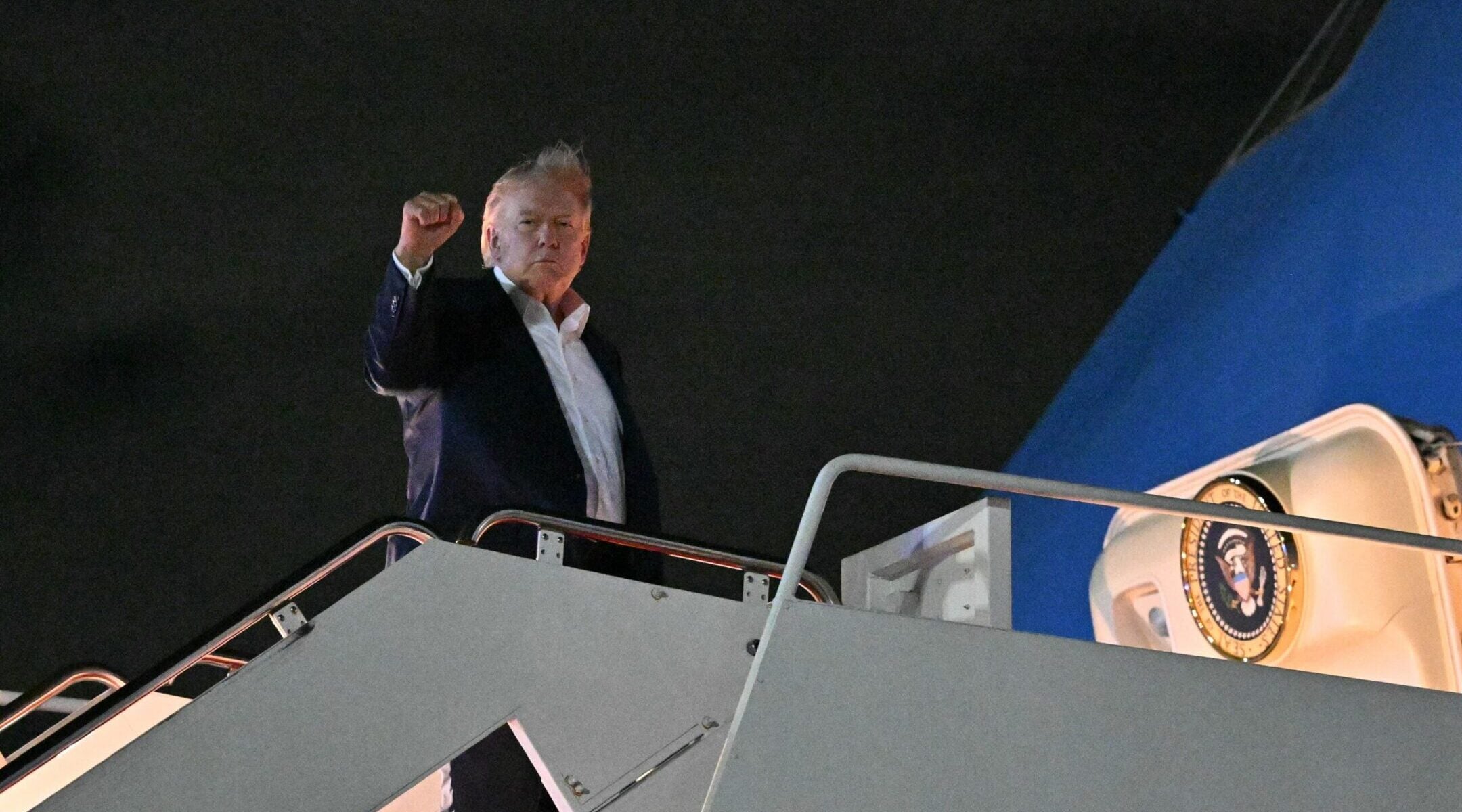
This time around, as President Donald Trump has announced a new deal with Iran after months of war that the United States fought jointly with Israel, American Jewish groups are more unified: They aren’t happy.
On the right and the left, Jewish groups are expressing concerns about the deal that Trump and Iran announced on Sunday night, even as its terms have not yet officially come into focus.
Trump has emphasized that the deal reopens the Strait of Hormuz, which Iran closed after the war began on Feb. 28. U.S. Vice President J.D. Vance also told ABC’s “Good Morning America” that the deal would include significant sanctions relief in exchange for Iran’s agreement that it would give up its nuclear weapons program.
But it’s not clear what concessions Iran has made on the nuclear front, while there are no indications other issues key to Israeli security, including Tehran’s ballistic missile program and proxy network, have been addressed. Though Israel and the U.S. undertook the war jointly in February, Israel was not a party to the negotiations and has come under repeated criticism from Trump for jeopardizing talks with Iran.
“At worst, it’s an admission of defeat by the United States,” said Halie Soifer, CEO of the Jewish Democratic Council of America, in a statement on Monday about the deal. The group was founded in 2017 as a successor to the National Jewish Democratic Council, which supported the Obama-era deal, called the JCPOA.
Soifer added, “Donald Trump was so desperate to get a deal with Iran that he was unabashedly willing to push Israel aside, demonstrating — yet again — that Trump has no loyalty or commitment to anyone other than himself.”
The right-wing Zionist Organization of America, meanwhile, expressed gratitude to Trump for taking on Iran but reacted to the deal as it had to the JCPOA, with great concern.
“We call on the administration to disclose the terms as soon as possible,” President Morton Klein said in a statement. “However, the little that we know is deeply problematic.”
Klein’s statement outlined a host of qualms based on reporting about the deal’s possible conditions, including about signs that Trump had agreed to a deal that omitted terms that Trump previously said repeatedly were essential for a U.S. agreement.
“It makes no sense for the U.S. to immediately give up its pressure on the Iranian regime — the blockade that was strangulating Iran economically — without obtaining immediate removal of Iran’s nuclear stockpile, decommissioning of Iran’s nuclear facilities, and destruction of Iran’s deadly missile stockpile,” Klein said.
The progressive group J Street opposed the war from the start and said it welcomed its conclusion. “
At the same time,” it said in a statement, “it is important to acknowledge a basic reality: This costly and illegal war achieved none of the sweeping objectives that were repeatedly invoked to justify it. … The tragedy is that diplomacy had already produced a workable framework. The JCPOA was effectively constraining Iran’s nuclear program until President Trump chose to abandon it.”
AIPAC, the pro-Israel lobby that was one of the strongest opponents of the JCPOA, has not issued a statement about the new deal. But it retweeted a comment from Florida Republican Sen. Rick Scott listing a set of objectives that it’s not clear the agreement achieves.
“Any deal we make with Iran needs to permanently end their nuclear program, end their missile program, and stop their decades-long terror funding,” Scott said.
Scott’s fellow Republican senator, Lindsey Graham of South Carolina, was among those on both sides of the aisle expressing qualms. “I am somewhat concerned that Iran’s view of the agreement seems different than what the American negotiating team is claiming,” Graham tweeted on Sunday, saying that he thought it was “imperative” that Vance present the terms of the deal to Congress for approval.
Vance said on Monday that the deal had been “digitally” signed already despite “technical things” that still needed to be worked out ahead of a ceremony planned for Switzerland on Friday. Speaking to U.S. media, he said he believed the terms were being mischaracterized and that the deal would result in an Iran without nuclear ambitions.
“If the Iranians are willing to give a long-term commitment, along with proper verification, to giving up that nuclear weapon, we’re willing to welcome them into the world economy to lift some sanctions and to turn over a new leaf in that relationship,” Vance said on “Good Morning America.”
Some Jewish groups have been more circumspect in their initial responses.
The Republican Jewish Coalition has not issued a statement on the deal, though it has retweeted Trump’s social media posts promoting it. The coalition did not immediately respond to a request for comment on Monday.
The Democratic Majority for Israel, meanwhile, urged Trump in a statement from its president, Brian Romick, to “bring in serious and experienced negotiators and technical experts to get this deal over the finish line, rather than relying on friends, family, and donors.” Romick also criticized Trump for cutting Israel out of negotiations — but he left some room for optimism.
“We continue to stand with the Israeli people who have been at war for more than two years, the people of Iran who have endured too many decades under a brutal regime and bravely demanded an end to oppression, as well as the Lebanese people who have lived under Hezbollah’s Iran-backed occupation for decades,” Romick said. “We will await the final text of this deal and hopefully bring this war to an end.”
Reporting the stories that define our era. When history unfolds in real-time, the Jewish world turns to (JEWISH REVIEW). Your support ensures we can document the complexities of war and the resilience of Jewish communities with integrity.