
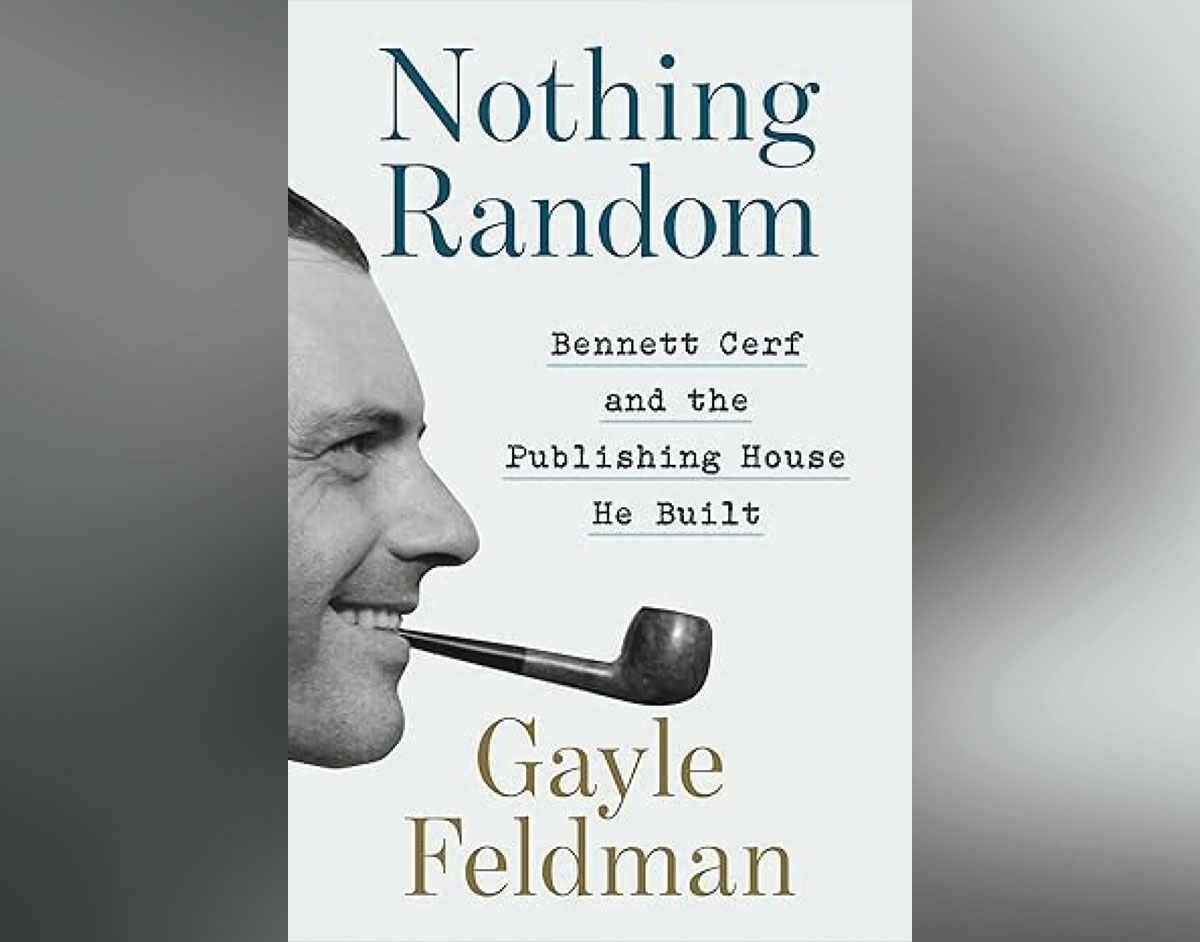
For those of a certain age, the name Bennett Cerf brings up fading memories of an owlish, avuncular man you’d see on reruns of “What’s My Line.” For many, that was all he was: funny, sophisticated and one of television’s first celebrities. In retrospect, he seems like an early incarnation of someone who was famous for being famous.
He was much more than that: As the publisher and co-founder of Random House, he was one of the most important figures in 20th-century culture and literature, publishing books by Robert Penn Warren, Gertrude Stein, W. H. Auden, Philip Roth, Ted Geisel (aka Dr. Seuss), William Faulkner and Ayn Rand, to name but a few. More importantly, Cerf and Random House took the U.S. Government to court over its classification of James Joyce’s “Ulysses” as obscene; their victory is considered a landmark First Amendment case.
In “Nothing Random: Bennett Cerf and the Publishing House He Built,” Gayle Feldman aims to present a complete portrait of Cerf; as she writes in the prologue, Cerf was “a paradox … the famous, fun loving, ultimately fleeting TV personality and the driven, dead-serious publisher-for-the ages.” She wants to give a full picture of “the only U.S. publisher ever to be a truly public man.”
And “Nothing Random” is a hefty biography; including acknowledgements, endnotes and an index, the book weighs in at a Robert Caro-linian 1,032 pages. But Cerf is such a fascinating character, and Feldman such a graceful writer, that your interest never flags.
Cerf was indefatigable, endlessly curious and the possessor of a massive Rolodex. He was a figure that spanned high and low culture; he published Pulitzer Prize-winning books while writing a series of joke books — 21, if we’re being precise. Cerf was an inveterate punster — the more they made you groan the better. You could call him the father of dad jokes.
He was not the kind of publisher that got involved in the granular work of a book; although he was a deep and sensitive reader, he was not someone who took a book apart, line by line. He loved authors and saw his job as having their backs and marketing their books as effectively as possible. The idea that literary quality could lead to “smash hits” was not universally held, but Feldman writes that Cerf “was speaking from instincts that made others liken him to a theater impresario or studio boss. Appreciating quality and popularity, he put great effort into popularizing.”
And he lived something of a charmed life. The most important thing, Feldman writes, “was never to be bored.” Cerf had an active social life outside of Random House.He was married, briefly, to actress Sylvia Sidney; his second wife, Phyllis (nicknamed “Thrup”) was the niece of Ginger Rogers. “Thrup” was the perfect partner, both at home and at work; she worked closely with Dr. Seuss and was the first publisher of Random’s children’s imprint, Beginner Books. To give you an idea of how well connected Cerf was, “Nothing Random” includes cameo appearances by Black Panther leader Eldridge Cleaver, an “interesting young producer” for daytime talk show host Mike Douglas, and future Fox News founder Roger Ailes. His social circle included members of the Algonquin Round Table, playwright Moss Hart and his wife, Kitty Carlisle, and the Marx Brothers. Edna Ferber said that the Cerfs gave “the nicest dinner parties in New York City.”
The book is filled with wonderful literary gossip and stories: A pugnacious John O’Hara trying to butter up a courtly but sozzled William Faulkner; the work behind the publication of “Atlas Shrugged” and Cerf’s unlikely friendship with the book’s author, Ayn Rand; and the time a newly signed author was invited to one of the Cerfs’ dinners. “The guest seemed perhaps 12 years old: short, terribly slim, with enormous eyes and a very high voice. [The butler] mounted the stairs in search of his mistress. ‘Mrs. Cerf, are you expecting a child for dinner?,’ he discretely enquired. [She] was puzzled, but Bennett overheard and responded, ‘Oh, that’s Truman Capote.’” And at a private lunch Cerf set up between Gertrude Stein and leading critic Alexander Woollcott Stein disagreed with the critic several times. “People don’t dispute Woollcott,” he informed her. “I’m not people,” came the reply. “I’m Gertrude Stein.”
There are also wonderful anecdotes about the famous in the Cerfs’ social circle, including the time when Cerf and George Gershwin sailed to Nassau, the Bahamas. At the hotel, Gershwin “banged out ‘Rhapsody in Blue’” at 7 a.m. to impress a girl he’d met and became “indignant” when the manager asked him to stop.
The other story Feldman wants to tell is how Cerf and other Jewish publishers including Alfred A. Knopf, Richard Simon and Max Schuster, Henry Guinzburg of Viking Press and Horace Liveright started to have their books on bookshelves beside the WASPy Duttons, Doubledays and Little, Browns. But that didn’t protect them from antisemitism – they still couldn’t belong to the Publisher’s Lunch Club, so they started the rival Book Table (much like Los Angeles’ Jewish bankers, merchants and studio moguls started the Hillcrest Country Club). Publishing was the kind of industry where a Jewish editor was advised to take a job at Harper and Row because “it’s a good time for Harper to have a Jewish editor.”
Cerf was not a religious man, but he was concerned about the safety of his Jewish authors in Europe, helping some of them emigrate to the U.S. A trip to mandatory Palestine in 1934 awakened his Jewish pride. While waiting to get a haircut at the King David Hotel in Jerusalem, he watched the barber who spoke German when a German was in his chair, French when a Frenchman took his place. When Cerf sat down, the barber spoke perfect English. When Cerf asked the barber’s nationality, he told him “I am a Jew.” Cerf “never forgot his joy ‘at the man saying [it] so proudly.’” Two years later, working with Time magazine, Cerf published “Jews in America,” a book he hoped would “squelch … a lot of the loose talk about ‘the Jewish problem.’”
Cerf’s Judaism only intersected with his business twice. In 1946, Random House was readying an anthology of modern poetry for publication, when he objected to “printing a single line” of the rabid antisemite Ezra Pound “in any new volume that bore [our] imprint,” a position that caused no small controversary. He also refused to publish Rand’s “The Fascist New Frontier,” a typically shrill tract that compared John F. Kennedy to Hitler.
Cerf was also an innovator in business. Random was one of the first publishers to take an active interest in selling the paperback reprint rights as well as film and TV rights. In 1959, it became one of the first publishers to become a publicly traded company, which gave the company a cash infusion to grow, including acquiring Knopf (the chapter on Alfred Knopf and his wife and parter Blanche is fascinating) and other imprints. It also led to Cerf selling Random House to RCA in 1965, a decision that he came to regret. He was forced out of the company he started in 1970, and died a year later
If “Nothing Random” flags as Cerf ages, the book’s epilogue turns elegiac. Feldman recounts Random House’s sale from one conglomerate to the next, until it is merged with Penguin to form Penguin Random House. She’s nostalgic for the time when publishing was a gentleman’s business and deals could be made on a handshake. Most damning, the chapter does not reference a single author, something Cerf would find unfathomable.
“Nothing Random” should appeal to readers interested in the publishing world and mid-century American culture, and a fitting memorial to its larger-than-life subject.