
Recently I heard someone say that one of the biggest challenges of our time is being forced to choose between truth and tribe. It resonated me with on a deep level. I have identified as a liberal for most of my adult life because I care about equality of opportunity, individual rights, and racial justice. But over the past five to seven years the goal posts of what it means to be both liberal and progressive have moved farther left. And Jews especially have been left behind in the Democratic party’s migration to the fringes of the left.
The equation is simple: Unquestioning allegiance to the shifting policies of the left equals acceptance in a space that defines itself as having the moral high ground. On the other hand, deviating from the script, questioning the left’s delineation of all people into oppressor or oppressed categories, or calling out bad behavior in one’s own political group usually results in being shamed, rejected, or kicked out of the group. For many of us—especially Jews, for whom questioning and pushing back on ideas is a hallmark of our faith—it’s a litmus test that is impossible to pass, and we are forced to choose between pursuing the truth or keeping our place in our tribe.
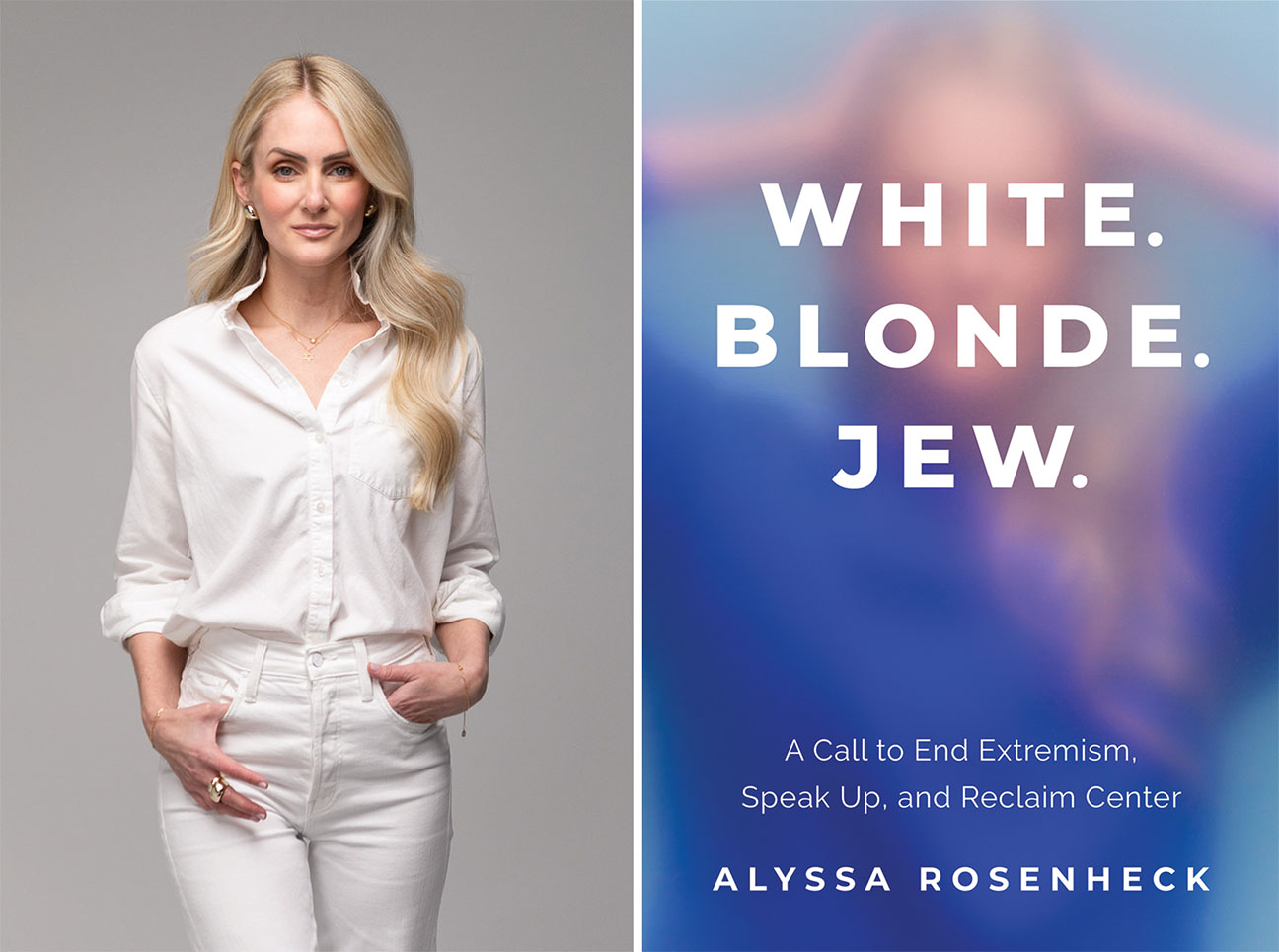
Alyssa Rosenheck’s new book “White. Blonde. Jew. A Call to End Extremism, Speak Up, and Reclaim Center” grapples with this dilemma in a way that is both fierce and vulnerable while also offering readers opportunities not just for critical reflection but also dialogue and action. For many people who have felt paralyzed by the left’s increasing silencing of criticism within its own ranks, this book offers both relief and hope. It’s almost cliché to say it, but it has to be said: Rosenheck is brave for putting a book like this one out into the world. She chooses truth over tribe and in doing so paves the way for others to do the same.
But this kind of bravery has its costs. At the end of July Rosenheck made headlines when her book launch at Bell Bird Books in Nashville was cancelled after antizionist activists pressured the book store and engaged in online harassment. As Rosenheck said in her statement on Instagram, this kind of decision forces us to ask whether we are truly living in a society that values free speech. If an author can’t express marginally controversial views without being cancelled, then we have ceased to live in a society that can be called either free or liberal.
The irony, of course, is that the cancellation of Rosenheck’s book launch proves the point of her book. And there is no doubt that she will continue to advocate for the importance of maintaining a society that preserves and values free and open debate—especially one that does not prevent Jewish voices from participating in the marketplace of ideas.
Rosenheck didn’t begin her career as an outspoken advocate for these issues. She is a bestselling author and one of Architectural Digest’s Top 50 Interior and Architectural Photographers in the United States. Her first book, “The New Southern Style,” demonstrates how art has the power to humanize our differences.
“I built my career around light,” writes Rosenheck, “using it as a mirror to reflect our humanity, our goodness.” But as the world shifted, first as she became a casualty of the DEI obsession with oppression and then after the massacre of Oct. 7, so did her lens. She says that every image “tells a story” about the one who composes or creates it as well as the “truths they decide to expose or obscure.” Every shot shows us a “world view, a message woven into the frame.”
When she saw the image of 22-year-old victim Shani Louk lying face down in the back of a white pickup truck plastered across the media after Oct. 7, Rosenheck couldn’t help but think about the photographer behind the lens. Rosenheck wondered: “Why was he spared from the massacre? Why was he granted immunity from distributing photos of international acts of terror? If neutrality was his aim, why did he continue pressing the shutter instead of alerting the authorities?” The story this image tells when we consider the framing and who is behind the camera is dark. The fact that it was disseminated so widely without being questioned is even darker.
“To tell a story through the lens,” writes Rosenheck, “you must challenge perspective, exhaust every angle, and remain relentless until the truth of the frame emerges.” I would add that it’s intellectually dishonest to do less than this. We are responsible not only for bearing witness to the images of atrocity—to the event itself—but also for considering the ethics of how the images came to be. As a former scholar of Holocaust literature, I’ve seen countless archival images of the atrocities of that time. Some were taken by the Nazis themselves, who took pride in their meticulous record-keeping and documentation of the horrors they committed; others were taken by those who liberated the camps, which raises the question of how much was known about the details of the camps before liberators arrived to bear witness. Every image tells a story from different angles if we look closely and critically. And as Rosenheck examined images from Oct. 7 carefully, it became a turning point for her.
“To tell a story through the lens … you must challenge perspective, exhaust every angle, and remain relentless until the truth of the frame emerges.”
“And when the world shifted,” writes Rosenheck, “so did I.” By the time Oct. 7 rolled around, Rosenheck had already lost a major book deal because of book bans targeting Israeli publishers and Jewish authors. The DEI initiatives and obsessions with intersectionality of 2020 and beyond had ensured that Jewish writers were seen as problematic by many publishers and media outlets. But after Oct. 7, what was formerly seen as merely problematic was now seen as completely off-limits.
Rosenheck joins a long list of Jewish writers who have been blacklisted simply because they are Jewish. Even Jewish and Israel writers who are fiercely critical of Israel are not safe. Look no further than British-Israeli writer and translator Joanna Chen, whose March 2024 essay in Guernica was pulled after members of the magazine staff resigned in protest. The essay was incredibly empathetic to both Gazan and Israeli voices in the aftermath of the massacre in Israel and the ensuing war in Gaza, but the new “left” is not looking to bridge cultural divides or foster dialogue among disparate groups. Instead, it’s about forcing one rigid, ideological agenda onto mainstream society. Anyone who doesn’t follow along may find themselves harassed, shamed, and cancelled. But Rosenheck will not follow along.
“But being human means we do not look away,” writes Rosenheck. The world might feel like competing groups obsessed with power, but “we can persist with purpose.” We can connect, instead of divide. Above all, we can continue to tell stories.
“But being human means we do not look away.”
In a recent discussion with Bill Maher, comedian Whitney Cummings expressed some of her disappointment with the way the left has silenced different viewpoints. She said, “If I overlook your bad behavior, that’s just a cult.” I thought about this as I finished Rosenheck’s book this past weekend. This is not a book that looks away. Rosenheck chooses truth, over and over again, and by doing so she gives us hope, because the more people who choose truth, the greatest chance we all have of keeping our tribe, holding it accountable, and making it stronger than before.