
The financial services company Credit Suisse had hundreds more bank accounts with Nazi ties than it had previously revealed, a new investigation reported this week.
The findings were discovered when independent investigators audited UBS, the Swiss bank that acquired Credit Suisse in 2023.
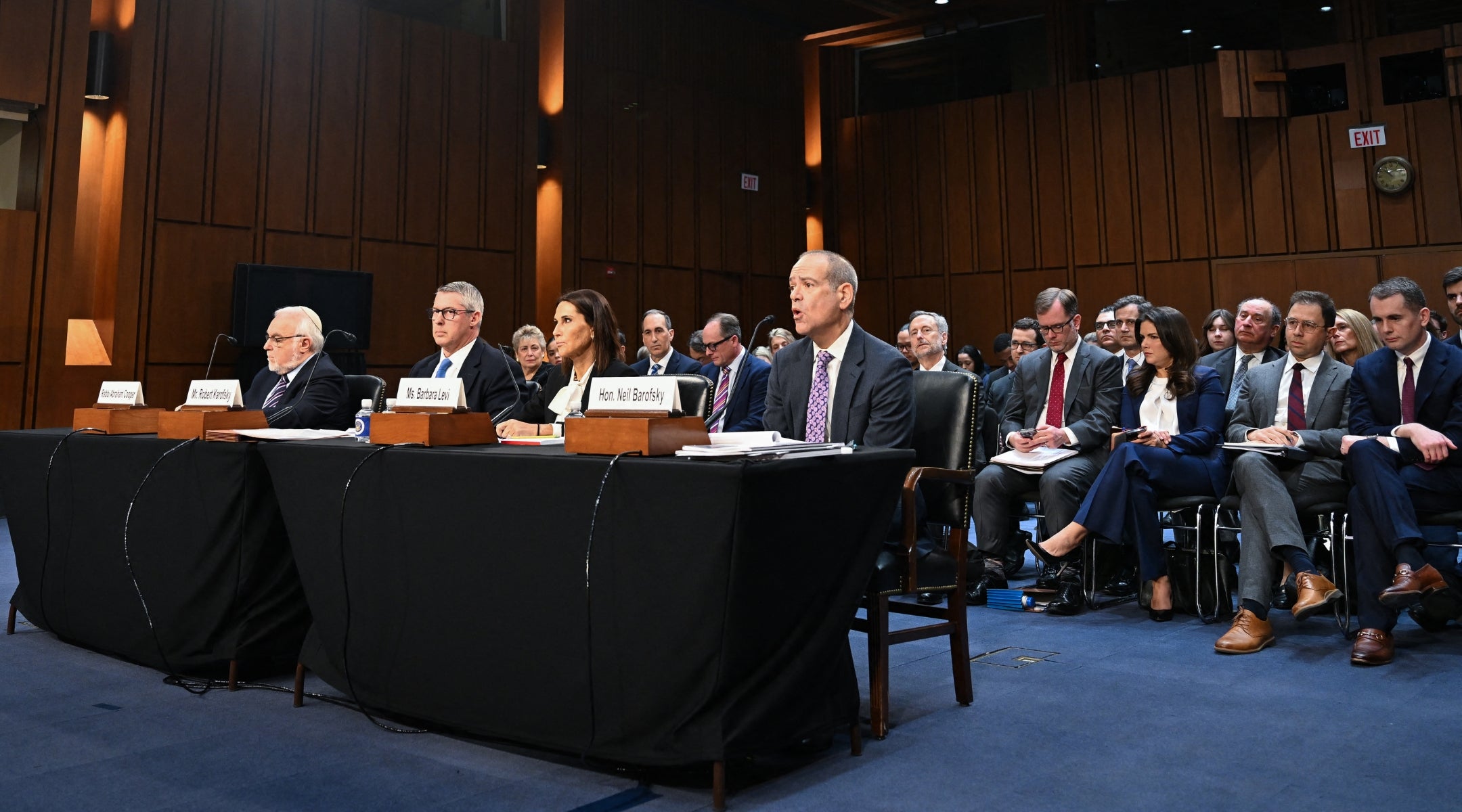
“What the investigation has found to date shows that Credit Suisse’s involvement was more extensive than was previously known, and it underscores the importance of continuing to engage in research efforts about this horrific era of modern history,” Neil Barofsky, a lawyer overseeing the inquiry, testified before the Senate Judiciary Committee Tuesday.
Barofsky’s report found 890 accounts potentially linked to Nazis: 628 individuals and 262 legal entities.
The investigation also found that Credit Suisse provided support to the “ratlines” that enabled Nazis to escape Europe and enter Argentina, opening and maintaining accounts for the Argentine Immigration Office.
Specifically, Barofsky said in his testimony, Credit Suisse provided funds “to finance bribes, obtain fraudulent travel documents, and pay for living expenses and transportation for fugitives, including perpetrators of the Holocaust.”
Barofsky’s investigation into UBS also found multiple previously unreported instances of the forced sale of property owned by Jews during the Holocaust. It also found that Credit Suisse held accounts for the German foreign office during the Holocaust, which dealt with the deportations of Jews.
Last May, Argentina declassified more than 1,800 documents related to the ratlines at the behest of the Simon Wiesenthal Center, named for the late Nazi hunter. Barofsky’s research into Credit Suisse’s involvement in the ratlines is ongoing, he said.
The findings represent a potentially explosive capstone to years of investigation into Credit Suisse’s Nazi ties.
Jewish organizations have long claimed that in addition to playing a key role in financially supporting Nazi Germany, Credit Suisse has held onto money looted from Jews long after the war. In 1999, the Swiss bank paid Jewish groups and Holocaust survivors a settlement of $1.25 billion in restitution for withholding money from Jews who had tried to withdraw their funds.
In 2020, the Simon Wiesenthal Center, a Jewish advocacy group, alleged that the bank had also hidden information about its ties to Nazis who fled to Argentina.
The bank hired Barofsky the following year to investigate its record but fired him in 2022, angering U.S. lawmakers including Sen. Chuck Grassley, now chair of the Senate Judiciary Committee. In 2023, as the top Republican on the Budget Committee, Grassley charged that Credit Suisse was obfuscating its Nazi ties, saying, “When it comes to investigating Nazi matters, righteous justice demands that we must leave no stone unturned. Credit Suisse has thus far failed to meet that standard.” Barofsky was soon rehired.
Tuesday’s hearing grew heated when Barofsky said the bank was still interfering with his investigation. He argued that his investigation could not be completed without access to 150 documents related to a 1998 restitution settlement between UBS and Holocaust survivors, which Barofsky says may contain the names of specific account holders he is investigating.
Robert Karofsky, president of UBS Americas, alleged Tuesday that giving Barofsky access to those documents could violate attorney-client privilege.
“Materials from the 1990’s are not within the scope of the Ombudsperson’s oversight, which is meant to be focused on Credit Suisse’s history and World War II-era conduct,” Karofsky said.
Still, Barofsky said, his report will be incomplete without those documents.
“I will be unable to provide assurance in my final report that the investigation has truly left no stone unturned,” he said.