

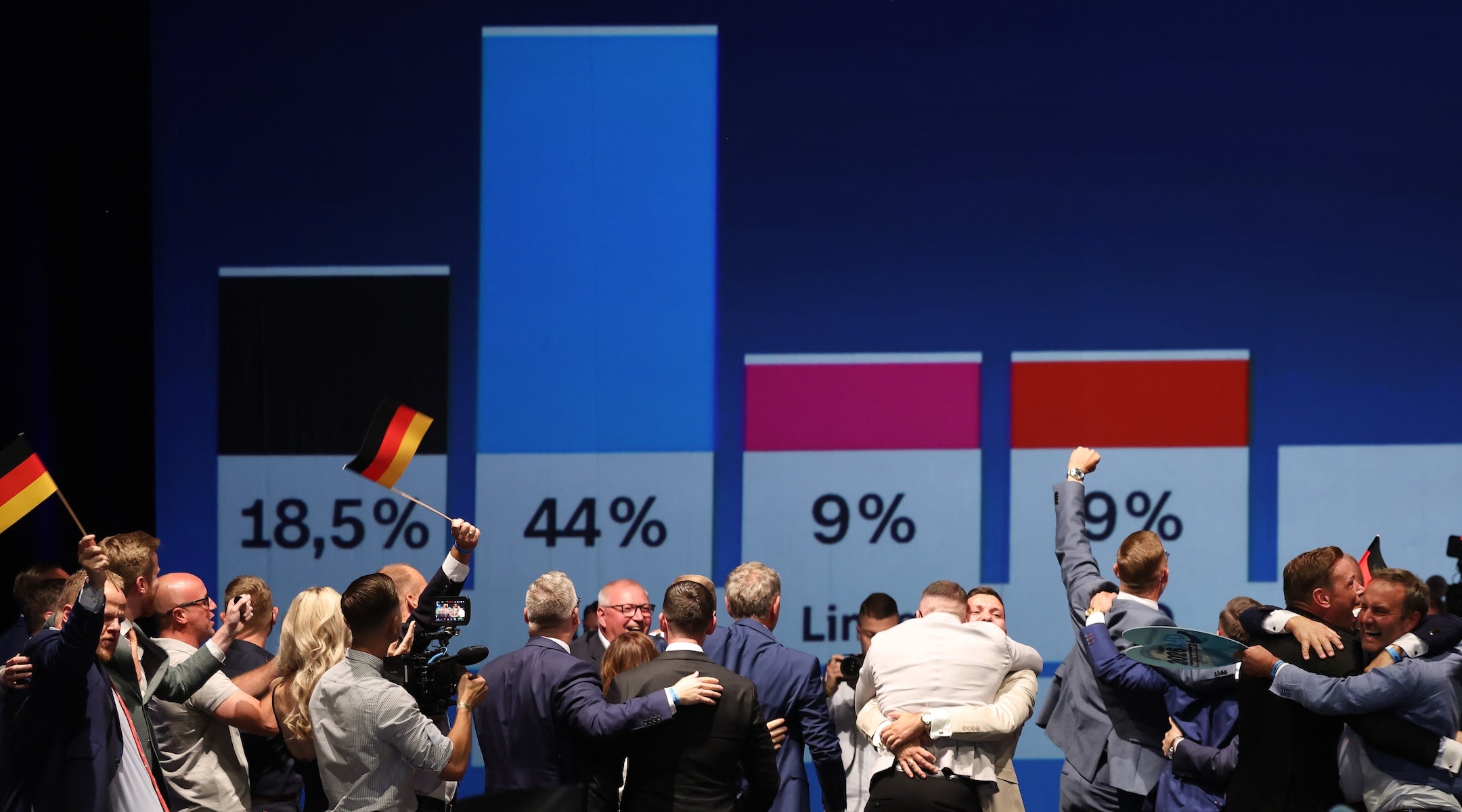
A victory for Germany’s far-right party in an eastern federal state has reverberated across the globe, exposing the widening rifts between alarmed centrist leaders and insurgent nationalist movements in Europe.
The Alternative for Germany (AfD) party won 43.8% of the vote in an election in Saxony-Anhalt on Sunday, crushing the center-right Christian Democratic Union (CDU), German Chancellor Friedrich Merz’s party, which held 17.2% support, according to preliminary figures.
The AfD is now heading toward 39 seats in Saxony-Anhalt’s 83-seat state parliament. It’s expected to fall 3 seats short of an outright majority, leaving open the question of whether it can form Germany’s first far-right state government since World War II. The party has proposed a sweeping nationalist agenda that includes deporting immigrants, defunding “anti-German art” and teaching children less about the country’s Nazi past.
Merz told reporters in Berlin on Monday he was “deeply shocked” and “unsettled” by the results, which he said rippled through the rest of the country and the world. He added that it was impossible for Germany to “go back to business as usual” after so many voters in Saxony-Anhalt chose a party that “questions the democratic institutions in our country.”
The results dealt the CDU its “most severe defeat” in decades, conceded Merz, who leads the party once headed by former German Chancellor Angela Merkel.
Merz said that he was searching for answers to “why far-right populism and far-right extremism was able to rise in such a rapid manner,” suggesting that his party may have underestimated the “fears of our population” amid economic crises and rapid technological change. He said that minorities in Saxony-Anhalt would be particularly vulnerable under an AfD government, but noted that the state would still have obligations to follow federal law, including regarding immigration policy.
Merz also directed his message to the rest of Europe, saying that Germany had a “special responsibility because of its history” to keep its political order “deeply anchored in Europe.”
Despite the scale of the CDU’s defeat in Saxony-Anhalt, Merz ruled out stepping down, saying, “Giving up is not an option.”
Though Saxony-Anhalt is one of Germany’s smallest regions, home to some 1.7 million voters, its election results quickly sent shockwaves through other European countries whose leaders, like Merz, are fighting to fend off far-right, anti-immigrant parties in national elections next year.
French Europe Minister Benjamin Haddad called the AfD’s regional win a “grave moment in Europe” and said that “nationalism and xenophobia will never be a solution.”
“We cannot forget our history,” said Haddad, an ally of centrist President Emmanuel Macron. “That is the meaning of the choices made by France and Germany.”
France’s government faces its own fears of a right-wing populist wave. Marine Le Pen, the head of the far-right National Rally, has dwarfed all other candidates in polls heading into France’s presidential election in 2027, when term limits force Macron to step down.
Across the Channel, British Chief Secretary to the Treasury Emma Reynolds said in an interview on Times Radio that the U.K.’s Labour government “will not be reaching out to a right-wing populist party.” She added that she put the AfD in “the same political bracket” as Reform UK, the far-right party that surged in local elections earlier this year.
Polish Prime Minister Donald Tusk also condemned the AfD’s victory. The far-right party has alarmed Poland, Ukraine’s neighbor, with its pro-Russia stance, as it seeks to halt Germany’s military aid to Ukraine and sanctions against Russia.
“In Poland, only idiots or traitors can rejoice at the triumph of the AfD in Germany,” said Tusk.
Meanwhile, the AfD was cheered by nationalist, anti-immigration party leaders in Spain, Portugal and the Netherlands, all of whom have sought to capitalize on economic and social grievances similar to those that contributed to the AfD’s victory Sunday.
Santiago Abascal, the head of Spain’s far-right Vox party, called the result “a great hope for Germany and for Europe.”
André Ventura, the founder of Portugal’s far-right Chega party, said that “the Germans too are opening their eyes against illegal and uncontrolled immigration, corruption, and the capture of our freedom and identity.”
And in the Netherlands, the AfD received a “Congratulations” from the far-right Party for Freedom’s leader, Geert Wilders.
While President Donald Trump has yet to officially respond to the Saxony-Anhalt election, he posted a screenshot of the results without comment on his Truth Social account Sunday night.
Trump’s post was shared by Kirill Dmitriev, a Russian presidential envoy and businessman, who said the AfD scored a “historic win” that would “put migration under control.”
Elon Musk, the billionaire and former Trump adviser who campaigned for the AfD last year, gave his support to the national party leader Alice Weidel on X, which he owns, writing “Well done” in German.
Ulrich Siegmund, the AfD’s candidate in Saxony-Anhalt who hopes to become the state premier, responded by praising Musk.
“Thank you, @elonmusk, for your support and for your clear and highly important perspective on the political developments of our time — including here in Germany,” he wrote.
As the Year Turns, Support the Journalism You Trust. JR covers the stories shaping Jewish life around the world — with the depth this moment calls for. As you reflect on the year ahead, consider a gift that keeps independent Jewish journalism strong.