
A decision to bar the “stumbling stone” memorials to victims of the Nazis has touched a nerve in one small German town, and beyond.
At issue is a motion – passed Sept. 25 by the city council of Heidenau in the former East Germany – to stop installation of such memorials in local sidewalks, calling them disrespectful, and to use the town’s North Cemetery instead.
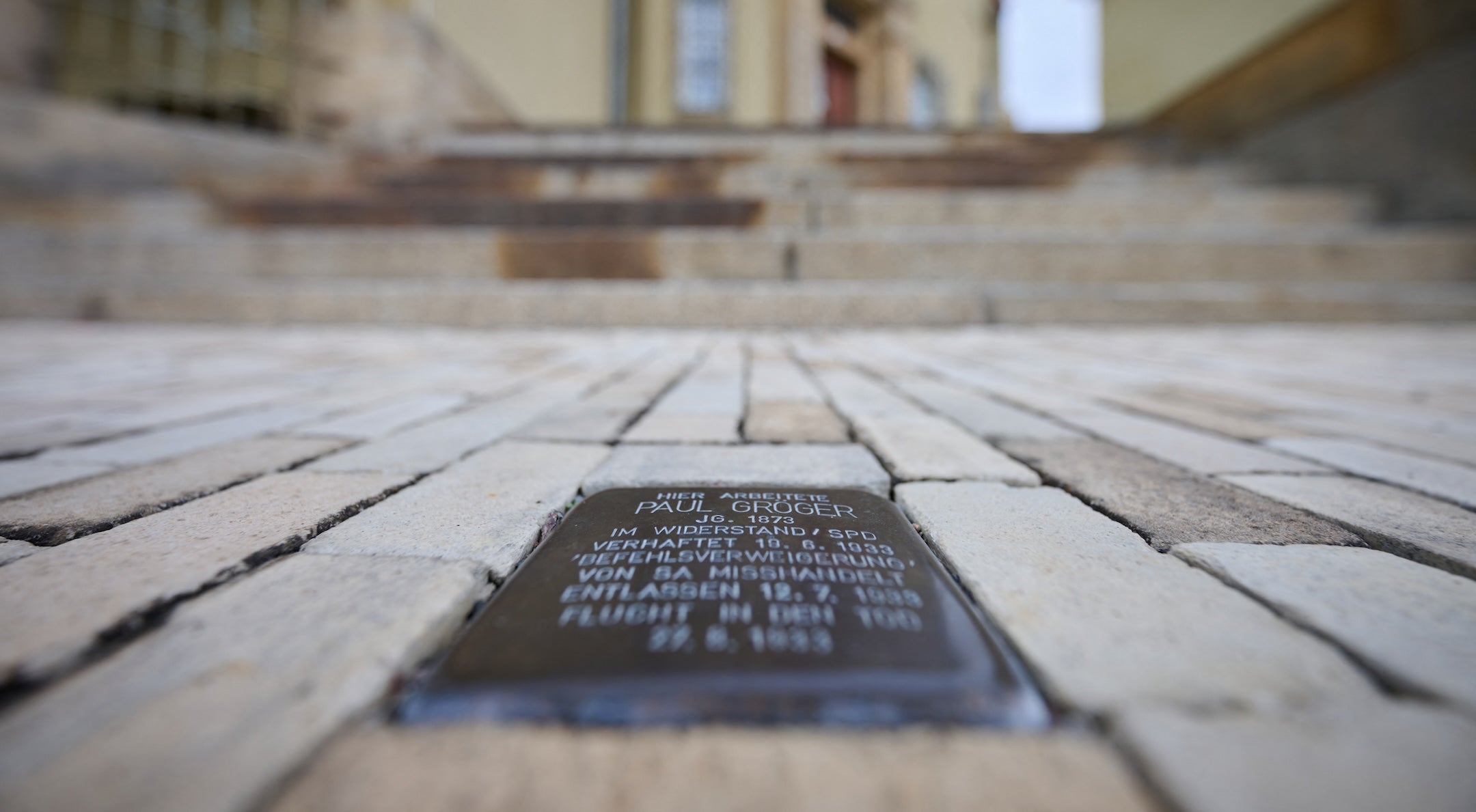
Set into the ground, the small, engraved brass “Stolpersteine,” or stumbling stones, are meant to make pedestrians stop and think about the fate of former residents. There are currently some 116,000 such stones laid in 1,860 municipalities across Europe, mostly in Germany, according to the project’s website.
A curious aspect of the Stolpersteine is that they are opposed by both Germany’s right wing, which view them as detracting from national pride, and by a vocal minority of Jews who feel they don’t do enough to uplift the memory of victims.
The effort to block the memorial stones in Heidenau was sponsored jointly by the center-right Christian Democratic Union (CDU) and the far-right Alternative for Germany (AfD) party. The town’s current mayor, Conny Oertel, is independent.
The city council’s decision comes as the AfD gains support in German elections nationwide. The party’s support for banning the project in Heidenau has sparked concern about potential moves to suppress official public commemoration of the Holocaust.
The AfD is known for challenging Germany’s culture of Holocaust remembrance in general. Bjoern Hoecke, who leads the party in the neighboring state of Thuringia, once even called Berlin’s Holocaust memorial a “monument of shame” that detracted from German pride. In protest, an artist collective built a replica of the memorial outside his home.
On the other hand, some Jews, albeit a minority, object to the memorials because they say it’s disrespectful to place them where they can be walked on and covered with leaves or trash. The stones have also been targets of vandelism, they note.
But the Heidenau motion is not for the sake of victims; rather it’s a “transparent maneuver by the extremists of the AfD” to suppress Germany’s remembrance culture, said Charlotte Knobloch, who has successfully opposed the placement of Stolpersteine in her home city of Munich, in the state of Bavaria.
“Removing places of remembrance from the cityscape, as has now happened in Heidenau, is absolutely the wrong approach,” said Knobloch, a 93-year-old Holocaust survivor, who heads the Jewish community of Munich and Upper Bavaria.
In a statement issued to the press Friday, Knobloch added that she was “appalled” that the CDU “would lend itself to supporting” the move. “The democratic center should and must find its way back to itself here and find a better solution.”
The joint opposition to the project by the AfD, the mainstream CDU and a local activist group creates a dilemma for Stolpersteine opponents like Knobloch who also abhor the AfD.
Heidenau, in the state of Saxony, is not the first town to act against the project. The city of Munich in Bavaria voted as early as 2004 not to allow the installation of the stones in public spaces, siding with Knobloch. In the city of Pulheim, in North Rhine-Westphalia, the project was blocked in 2011, but eventually the municipality reversed course and allowed the first installations to take place in 2022.
Heidenau is home to 17,000 people. Though the wartime local Jewish population was small, there are five such stones in the town already. An application for 12 more had been submitted by the Alternative Cultural and Educational Center (Akubiz), including for Fritz Goldstein and his wife Martha, who were expelled to Poland in 1938 and survived the war.
Arguing against the stones, the Heidenau motion noted that many citizens, relatives of victims, and activists actually disapprove of this form of commemoration.
Negative reactions to the decision in Heidenau were swift, both from proponents and detractors of the memorial concept itself.
In an email statement, the New York-based March of the Living educational organization called on the town of Heidenau “to reverse its decision and on Germany’s leaders and citizens to oppose every effort to hide this history.”
The city council decision “raises a deeply troubling question: Are political interests being allowed to push the memory of Nazi victims out of public life?” the statement read in part.
Like Knobloch, Munich resident Gabriella Meros doesn’t like the stumbling stones. “They are simply not a dignified way to commemorate the victims of the Holocaust,” said Meros, daughter of a Holocaust survivor and chair of the association Respect and Remember Europe.
She promotes placement of plaques on buildings instead.
But the political move in Heidenau by the CDU and AfD is “outrageous, because they’re exploiting this argument for their own purposes.”
The real problem is, she said, that the AfD “wants to abolish remembrance” itself.
In its platform, the AfD says it aims to promote “positive, identity-establishing aspects of German history.” Critics say that in practice, this could mean reducing funding for educational trips to Holocaust sites and for the memorial sites themselves.
The Stolpersteine project, initiated in 1992 by Cologne-based artist Gunter Demnig, sets engraved memorials into sidewalks in front of buildings where deported victims of the Nazi dictatorship once lived.
Usually, family members from around the world nominate sites and pay a nominal fee for materials. For many, the stumbling stones are a substitute for a grave, for ancestors whose place of death is unknown.
Israel’s Ambassador to Germany Ron Prosor wrote on X
that he was “ashamed” of Heidenau’s decision, noting that members of his own family who were forced to flee the Nazis were commemorated by the stones in Berlin.
“Every person has a name. A world. A story. It is precisely this memory that is being erased here. Whoever erases the victims from the past erases the past itself.”
As the Year Turns, Support the Journalism You Trust. JR covers the stories shaping Jewish life around the world — with the depth this moment calls for. As you reflect on the year ahead, consider a gift that keeps independent Jewish journalism strong.