

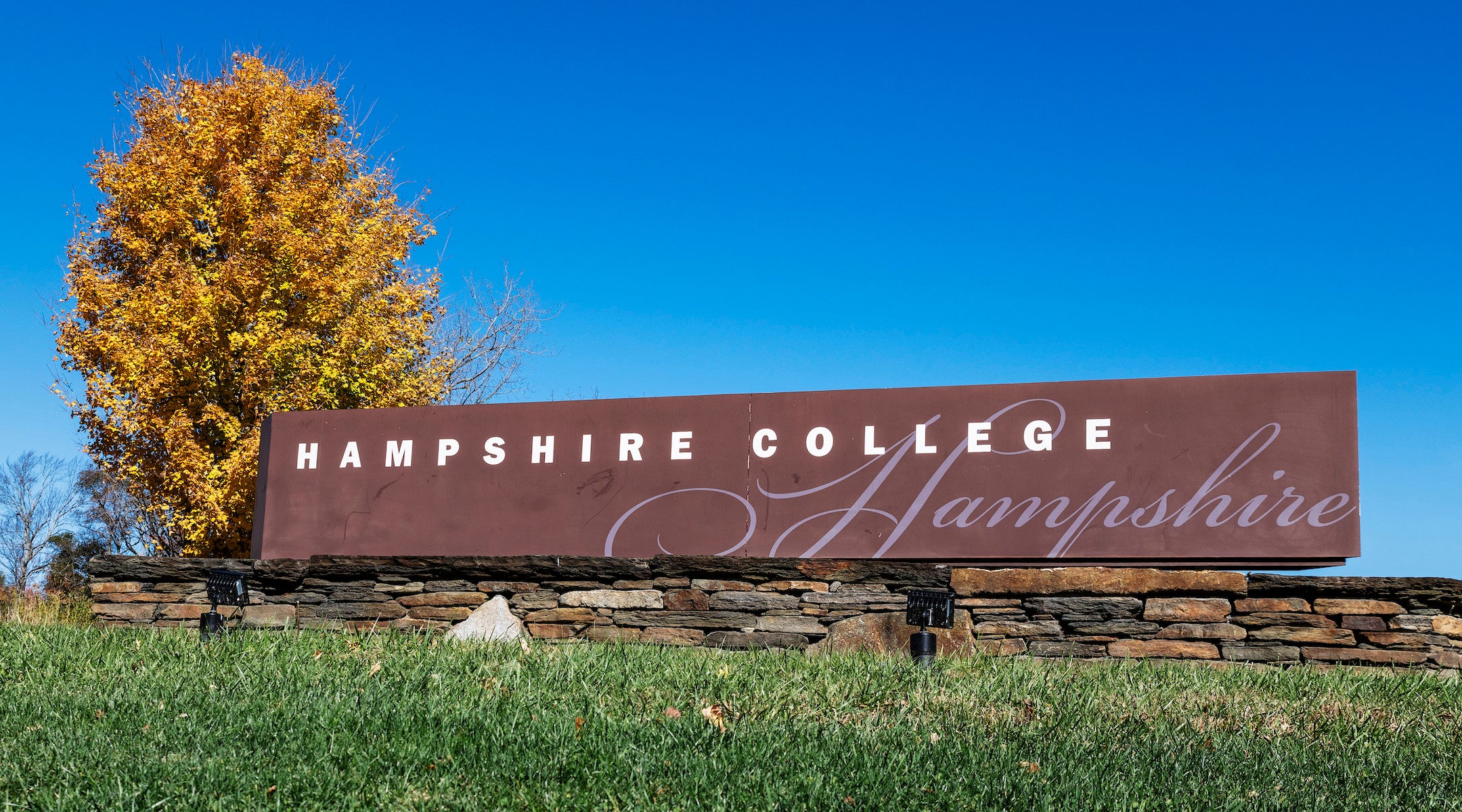
Hampshire College, the nontraditional liberal-arts school that pioneered college-level Holocaust classes and played a central role in launching the acclaimed Yiddish Book Center, announced Tuesday that it is shutter at the end of the calendar year.
The closure, which follows semester after years of financial troubles, won’t affect Yiddish Book Center, which operates on land purchased from the college in Amherst, Massachusetts.
“We are saddened by Hampshire College’s announcement,” Susan Bronson, president of the Yiddish Book Center, said in a statement. “Hampshire has been a valued neighbor for many years, and we recognize the significance of this moment for its community.”
Founded by Hampshire alum Aaron Lansky in 1980 as an effort to save Yiddish-language publications from extinction, the Yiddish Book Center purchased the land for its permanent campus space from the college in 1997. It expanded 12 years later and today owns its property outright, though the center has contracted with the college in the past to provide dorm space and other amenities for programs and conferences.
The center was at the vanguard of a larger Yiddish-interest revival that also encompassed the college, as when the two institutions partnered to offer Yiddish classes, which are popular offerings in Amherst.
“The financial pressures on the College’s operations have become increasingly complex, compounded by shifting external factors,” Hampshire’s president and board of trustees said in a statement announcing the school’s imminent closure after 61 years. They cited declining enrollment (the school currently enrolls around 750 students), mounting land debt and a lack of resources as factors in the closure.
While the Yiddish Book Center is Hampshire’s most visible contribution to Jewish culture, it is not the only one. As an undergraduate in 1973, according to the college, Lansky and some of his Jewish classmates “helped to organize the nation’s first college course on the Holocaust, ‘Thinking the Unthinkable.’”
A course description from the time notes, “The present generation of students is notably a post-Holocaust one for whom that event is remote and unreal despite the fact that it impinges on their lives and their world. It is the purpose of this course to try to learn about the Holocaust, to try to understand that which seems to defy understanding and to try to face its effects.”
Aaron Lansky speaks at a Yiddish Book Center gala, May 4, 2025. (Susan Magnano/Magnanimous Pictures)
Also involved in the founding of the course were Leonard Glick, an anthropologist of Jewish history at Hampshire, and Galina Vromen, a journalist and novelist.
“Hampshire was debatably the first college in the United States to teach a course on the Holocaust, and it happened through a student initiative,” Vromen told Hampshire’s news service last year. “I’ve always appreciated Hampshire for teaching me how to plan the steps I need to take to reach whatever goal I set for myself, how to evaluate myself along the way, and how to articulate the process to others — all extremely useful life skills.”
Via a Yiddish Book Center representative, Lansky declined to comment for this story. Hampshire currently enrolls around 325 Jewish students, more than 38% of its total student body, according to Hillel International.
Part of Amherst’s “Five Colleges” consortium, Hampshire’s focus on self-directed study made it a unique center of learning. Other notable Jewish alumni have included actor Leiv Schreiber; Stonyfield Farm co-founder Gary Hirshberg; and actor Ella Dershowitz, daughter of attorney Alan Dershowitz, who in 2009 engaged in a public spat with the college over a student activist campaign to divest its holdings from Israel.
Passover may be over, but your chance to support independent Jewish journalism isn’t. Help (JEWISH REVIEW) keep reporting the stories that define our era.