
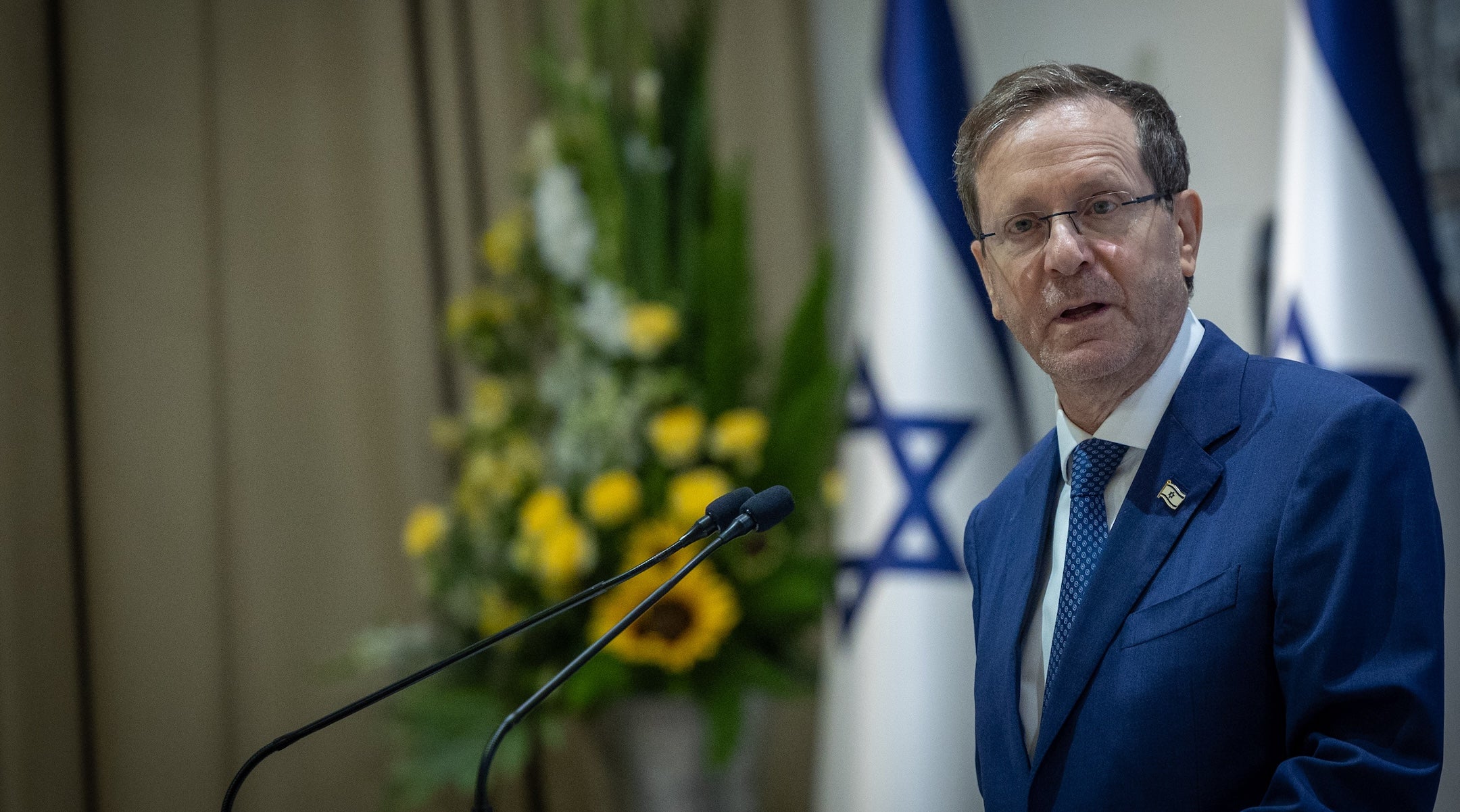
President Isaac Herzog called leaders of Jerusalem’s Kol HaNeshama Reform congregation on the eve of the Sukkot holiday to express solidarity following a string of attacks against the synagogue and took the matter up with Israel Police, his office told the Jewish Telegraphic Agency on Sunday.
The call came days after Jerusalem police arrested three minors suspected of involvement in a series of incidents targeting the congregation over recent weeks, including break-ins, vandalism and harassment.
Herzog expressed his “solidarity and support” for the congregation and stressed “the utmost importance of freedom of worship for all in Israel,” according to his office.
Oded Mazor, Kol HaNeshama’s leading rabbi, told (JEWISH REVIEW) that Herzog spoke Friday with him and the congregation’s executive director, Anna Astmaker, describing Kol HaNeshama as “an important and valued Jerusalem institution.”
Herzog “condemned the attacks and the harassment of the community,” Mazor said and welcomed the arrests.
“We thanked him warmly for the call, for his concern and appreciation, and invited him to visit our sukkah during the holiday,” Mazor said.
Herzog called Mazor again on Sunday after speaking with Jerusalem’s police commander, saying police were taking the investigation “very seriously” and examining whether someone else was behind the youths’ actions, Mazor said. Herzog’s office confirmed the follow-up call.
Police said the minors were suspected of property damage and “insult to religion,” and said they would ask a court to extend their detention, Channel 13 reported.
In August, vandals broke into the synagogue, smashed a window and tore down a Pride flag. Weeks later, on Rosh Hashanah, youths threw eggs at worshippers arriving for services after first approaching members of the congregation with comments that Debi Shoua Haim, one of Kol HaNeshama’s rabbis, said were “homophobic and bordered on harassment.”
Around Yom Kippur, the synagogue was targeted three more times. Plates and other breakable objects were thrown through a window. An intruder later broke in and tore down a Pride flag and a rainbow-colored sign reading “Love your neighbor as yourself.” And on Yom Kippur morning, two youths arrived with a large dog and, in apparent mockery, asked to arrange a bar mitzvah for the animal.
Mazor said the congregation had been receiving updates from police but had not been told which of the five incidents the three minors were suspected of involvement in or the precise allegations against them. Officers had also “made a point of checking in with us,” he said, in a bid to maintain good relations with the congregation.
Jerusalem Mayor Moshe Lion condemned the attacks and expressed support for the congregation in a private conversation with Mazor before Yom Kippur, but Mazor said he was disappointed that Lion had not spoken out publicly.
Mazor contrasted Lion’s silence with his public responses to previous vandalism of Orthodox synagogues in the city, saying it was “unfortunate” that a Reform synagogue was being treated differently, and suggested it may reflect the mayor’s political considerations, given the influence of haredi parties in Jerusalem politics.
“When there have been previous incidents of violence and vandalism against Orthodox synagogues in the city, he knew how to show up and take a stand. He knows how to speak out clearly against violence,” Mazor said. “So I’m disappointed that in this case, when it involves a Reform synagogue, things are being handled differently.”
The congregation also asked Herzog to urge Lion to speak out publicly, Mazor said.
“If the city’s leadership does not speak out against violence, then, heaven forbid, it sends a message of acceptance of that violence,” he said.
Lion’s office rejected the suggestion that political considerations explained the mayor’s failure to condemn the attacks publicly at the time. His spokesperson said the city deliberately avoided drawing further attention to the synagogue “so as not to escalate things.”
Lion contacted Jerusalem district police commander Avshalom Peled to request additional forces for the synagogue while also instructing the municipality’s policing division to increase its presence there.
He also issued a statement Sunday condemning recent violence in the city. “I strongly condemn any attack, by anyone, on what is sacred to others, their activities, customs and ways of life,” he said. His office said the statement encompassed the attacks on Kol HaNeshama, though it did not name the synagogue.
Shoua Haim echoed Mazor’s call for public statements from both the government and Jerusalem’s leadership, warning that “this incitement could get worse if we don’t all work together to stop it.”
The congregation invited Herzog to a solidarity event at Kol HaNeshama on Wednesday, organized with Jerusalem communities from across the Jewish denominational spectrum. The gathering will express support for the congregation and opposition to “violence and fanaticism,” Mazor said.
After the first attack in August, members of different congregations, including Orthodox synagogues, joined Kol HaNeshama for a Kabbalat Shabbat service in support of the congregation.
As the Year Turns, Support the Journalism You Trust. (JEWISH REVIEW) covers the stories shaping Jewish life around the world — with the depth this moment calls for. As you reflect on the year ahead, consider a gift that keeps independent Jewish journalism strong.