
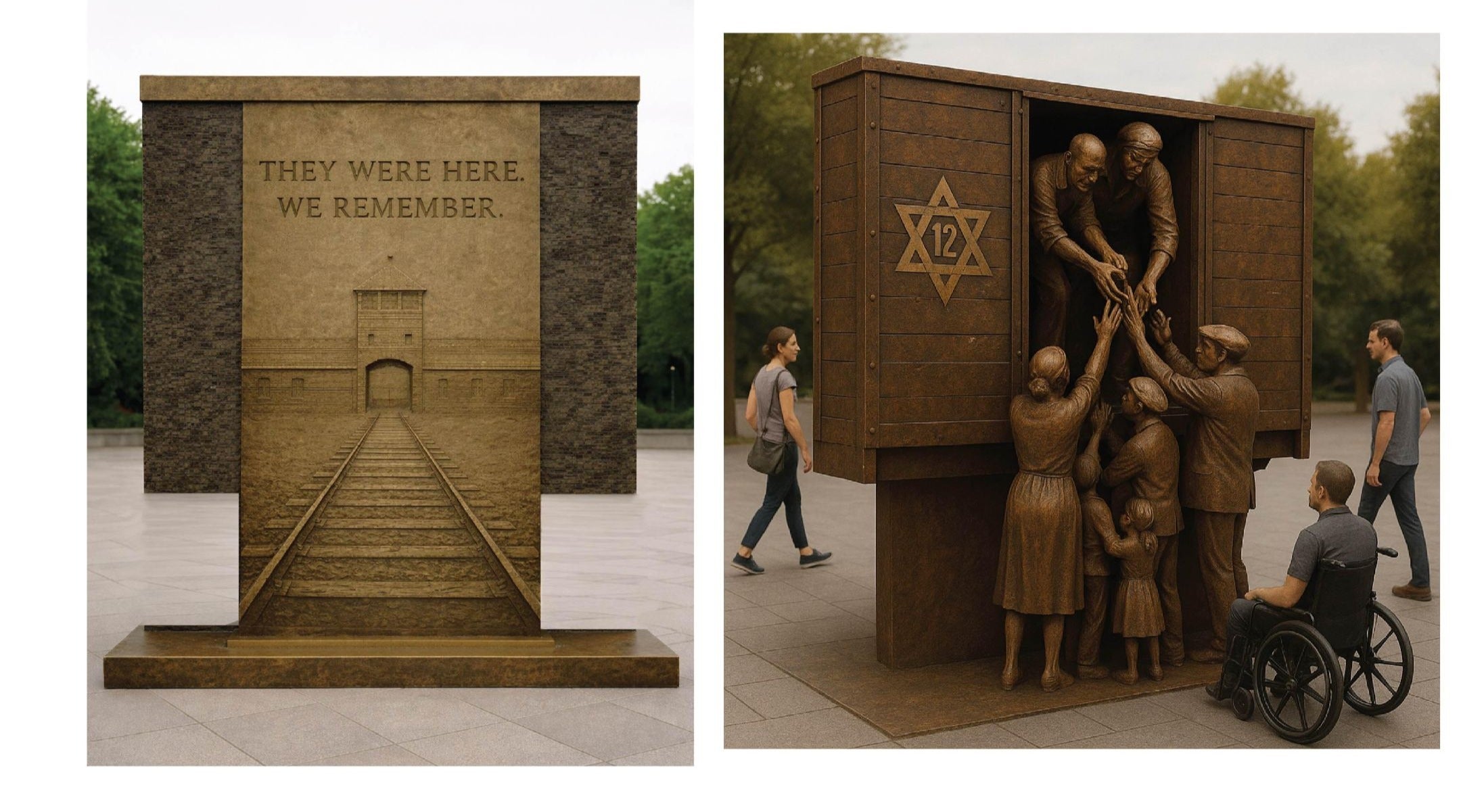
Two people lean down from an abstract version of a rail car. Their outstretched hands reach towards a family gathered around the car’s opening. The adults on the ground reach back, either to get help stepping into the car or to say good-bye.
That’s one side of the artist rendering of what will be a Holocaust monument. On the other side, train tracks lead to the entrance of the Nazis’ largest death camp, Auschwitz-Birkenau. A message across the top reads, “They were here. We remember.”
The sculpture by artists David Wilson and Stephen Hayes, called “In Transit: The Weight of Absence,” is emotional on its own. But what makes the project planned for Charlotte, North Carolina, especially noteworthy is what will be alongside it.
Charlotte is the planned home for what its organizers believe is the first memorial plaza in the United States to both honor Dr. Martin Luther King Jr. and remember the Holocaust in the same space. The Circle of Humanity: Monuments for Unity and Remembrance in Marshall Park will feature the 8-foot bronze statue of King currently in the park plus the new Holocaust monument.
Linking the two will be paved walkways, educational reflections and digital resources on the Holocaust, the Civil Rights movement and the combined history of African Americans and Jews in the U.S. School and tour groups will take part in interactive educational experiences.
To those who might wonder why these monuments belong together, Rabbi Ya’aqov Walker points to a common inheritance. “You could just describe it plainly: white supremacy in continental Europe and white supremacy in the southeastern United States,” said Walker, who is Black and serves on the project’s education committee.
The groups also share deep resilience and desire for change, he said, which led to a significant Jewish presence in the civil rights movement in the United States 20 years after the Holocaust.
“It was very prescient in their minds, from King to any major civil rights leader who was committed to nonviolence, to study and learn what the Jewish experience was, and to build relationships with rabbis as fellow spiritual leaders,” said Walker, who co-leads the Charlotte Black/Jewish Alliance.
The new monument will replace a small one dedicated in 1979 that’s hidden in overgrown foliage. Project partners include the Charlotte Black/Jewish Alliance, Mecklenburg County, Queens University of Charlotte, the Stan Greenspon Holocaust Education Center, and the Charlotte-Mecklenburg branch of the NAACP.
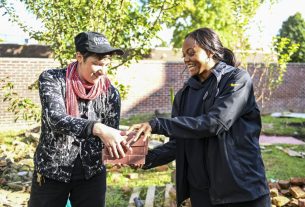
After a national search for artists that yielded 57 design proposals, a review committee narrowed the choices to eight finalists. Wilson and Hayes, who are Black and live in Durham, North Carolina, were one of two teams asked to submit their concepts. Though they had never designed a sculpture based on a Jewish theme, they were compelled by its juxtaposition to the King monument, “creating a broader dialogue about injustice, courage and the consequences of hatred,” Wilson told county commissioners during a recent public meeting.
David Wilson, left, and Stephen Hayes are the designers of “In Transit: The Weight of Absence,” the winning design for the Circle of Humanity memorial in Charlotte’s Marshall Park. (Courtesy Circle of Humanity)
Their presentation moved Commissioner Leigh Altman, who is white, to reveal that her great-grandparents and many of their children were murdered in the Holocaust. About 25 to 30 Holocaust survivors live in the Charlotte area today.
“This shared partnership for me is a reminder across one of history’s worst genocides and the worst legacy of what America has done wrong, and brought it together to find a commonality, which was a failed obligation to recognize the humanity of others and to fight for it,” she said.
The second finalist team, Miriam Gusevich and Sal Pirrone from Washington, D.C., envisioned an abstract sculpture with thousands of silver circles to represent those killed by the Nazis. The proposed structure opened to a skylight in the shape of a Star of David. Members of Gusevich’s family died in the Holocaust.
“Circle of Humanity” organizers held 12 community feedback sessions, including at synagogues, a Black church and Johnson C. Smith University, a historically Black university. About 850 community members participated. More than 100 completed written surveys on their preferences. Ultimately, a majority favored the rail car image. At one session, participants audibly gasped when “In Transit” was revealed.
It’s yet to be determined which materials will be used to render the piece. Options range from cast and fabricated metal to large-scale 3-D printing. What likely won’t change is the sculpture’s bronze hue and structure.
“The skin tones can be interpreted in many ways, and it looks very similar to an auction block” used in the trafficking of enslaved people, Walker noted. He recalled that during a feedback session at a Black church, some church members teared up to see the reminder of family separation.
Urban Design Partners in collaboration with Groundworks Studio will develop the plaza, in a design called “Woven Histories.” Potential elements include a stone walkway with a plaid design. The plaid pays tribute to the dress that civil rights pioneer Dorothy Counts-Scoggins wore on the day in 1957 when she faced down an angry white mob to become the first Black student to attend a segregated high school in Charlotte.
The plaza will include benches and may incorporate decorative stone books. Like the monument design, the concept is still open to changes based on additional community feedback. The planned budget is just under $1 million, including a $100,000 endowment for programming and maintenance. If fundraising efforts are successful and the timeline stays on track, the plaza is scheduled to open in May 2027.
Marshall Park has particular resonance as the setting. It is part of the former Brooklyn, a Black neighborhood razed in the 1960s in the name of urban renewal. More recently, Marshall Park has been a familiar site for protests and political demonstrations.
The idea for the innovative combination began with a discussion between Rev. Corine Mack, president of the Charlotte-Mecklenburg NACCP, and Rabbi Judy Schindler, Sklut professor of Jewish studies at Queens University of Charlotte and executive director of Spill the Honey, a national non-profit which produces arts and educational materials intended to empower the Black-Jewish alliance to combat racism and antisemitism.

The Dr. Martin Luther King Jr. memorial statue in Charlotte’s Marshall Park, created by renowned sculptor Selma Burke, was dedicated on April 5, 1980. (Courtesy Arrowmount School of Arts and Crafts)
“It all came out of the same conversation, looking at the Civil Rights movement, looking at the rise in racial slurs and antisemitism, and just really understanding that we have to do something to elevate the importance of not only our cultures, but what love would look like in this country,” Mack said. “I thought it was important that we went back to the root of the civil rights movement, which was us collaborating.”
She acknowledges a few phone calls from members of Charlotte’s Black community who expressed concern about the collaboration in light of the war and political divides opened after the Hamas attacks on Israel on Oct. 7, 2023. Others were unclear about the benefits of bringing the two histories together. But no vocal opposition has emerged to the project. Organizers say on-site education about the history of Black-Jewish ties in America is essential.
Charlotte has its own claims to this history. Humorist and social critic Harry Golden lived in the city and published his commentaries in The Carolina Israelite, a newspaper whose subscribers included Congressional members and well-known writers. In “The Vertical Negro Plan” in 1956, he pointedly noted that whites seemed to have no trouble standing next to Black Americans. It was only when Black people wanted to sit “that the fur begins to fly.” His tongue-in-cheek solution? Remove the seats at schools and lunch counters.
In 1971, attorney Adam Stein, father of N.C. Gov. Josh Stein, was part of the legal team who argued Swann v. Charlotte-Mecklenburg Board of Education before the Supreme Court. The case began the era of busing for school integration nationwide. Busing for that purpose officially ended in Charlotte in 2002, when the Supreme Court declined to take up a challenge to lower-court ruling recognizing local schools as adequately desegregated .
Now, supporters hope the Circle of Humanity will be a catalyst for Black-Jewish collaborations in other cities. Schindler, named after a great-aunt who was killed during the Holocaust, wants the gathering spot to be a place not only for remembrance, but for inspiration and beginnings.
“It’s really important to me that we bring joy to this work,” she said, envisioning the opening ceremony filled with klezmer music as well as both soul food and Jewish noshes. She cautions against “letting those to seek to harm us control our thoughts and our struggles and our fears. We need to celebrate our culture and who we are with pride and joy, so I pray that this will be a centerpiece for cultural celebration of all sorts.”
Reporting the stories that define our era. When history unfolds in real-time, the Jewish world turns to (JEWISH REVIEW). Your support ensures we can document the complexities of war and the resilience of Jewish communities with integrity.