
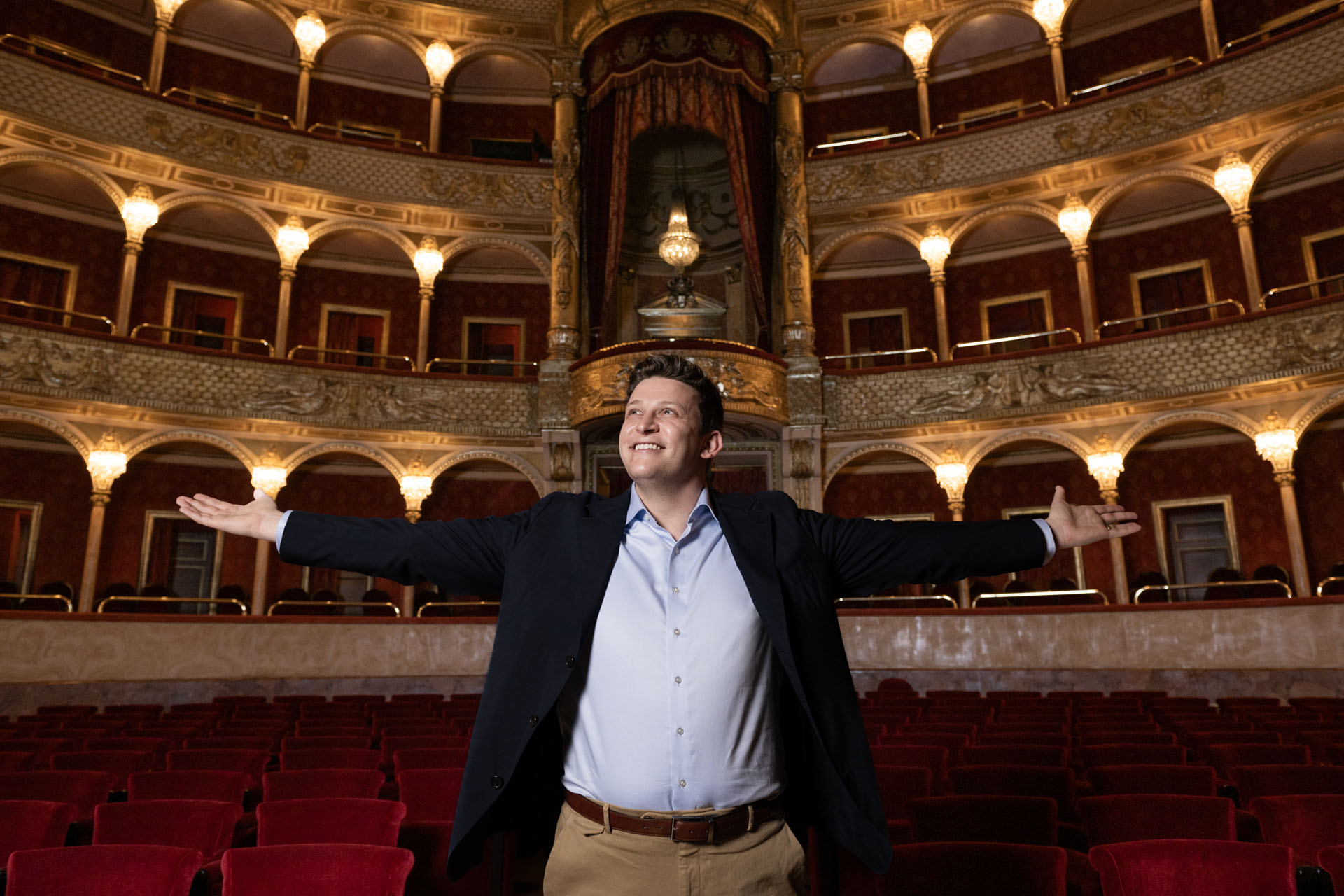
At the Goldrich Cultural Center at The Grove in Los Angeles, music will tell a story that spans generations, continents and some of the darkest chapters in Jewish history. On Nov. 4 and 5, countertenor Aryeh Nussbaum Cohen, baritone and cantorial soloist Simon Barrad, and pianist and music director Ronny Michael Greenberg will take the stage for “It’s Now or Never: Songs of Hope and Resilience,” a musical tribute to Holocaust survivor Renée Firestone. Firestone, 102, is a fashion designer and entrepreneur who for nearly half a century has dedicated herself to Holocaust education, becoming a longtime voice for remembrance. The program weaves together Yiddish songs, German lieder, jazz, musical theater and works by composers murdered during the Holocaust, alongside the world premiere of a new song cycle inspired by Firestone’s life.
But this ambitious production is also part of something larger. The three musicians are the driving force behind JIVE — Jewish Innovative Voices & Experiences — an initiative they founded to explore Jewish music beyond the familiar boundaries of synagogue music and traditional repertoire. Moving freely between classical opera, Yiddish and Ladino songs, Broadway, jazz and contemporary compositions, they are creating a musical space where different Jewish traditions and generations meet. Greenberg, who is also a creative producer, founded the nonprofit Taste of Talent, through which he develops musical projects that bring together music, culture and community. Their approach is both a celebration of Jewish musical heritage and an effort to give it new life, reaching audiences who might not otherwise encounter much of this repertoire.
The collaboration between Nussbaum Cohen and Barrad might never have happened had it not been for the pandemic. The two first met briefly at a dinner in Cincinnati in 2018, when both were performing there. A year later, when Barrad’s wife joined the Adler Fellowship program at San Francisco Opera, where Nussbaum Cohen was already a fellow, they got to know each other better.
Then came 2020. With their national and international performance contracts cancelled, the two found themselves in San Francisco with an unexpected amount of time on their hands. They began playing tennis once a week and spending time together, gradually discovering a friendship that would eventually turn into a musical partnership.
Their first opportunity to perform together came that November, at an outdoor venue. Barrad arranged a setting of Gerald Cohen’s well-known Psalm 23, familiar to many synagogue congregations, as a duet for their two voices.
“I’ve been writing music for Aryeh and me to sing since 2020,” Barrad said. “The first time we sang together was kind of magical, and we knew that we had to do more.”
The success of that first arrangement was no coincidence. Barrad was struck by the unusual musical possibilities of pairing his baritone with Nussbaum Cohen’s countertenor. “It’s rooted both in Aryeh’s extraordinary musicality and ears, listening for his collaborators, but also just in the tone of a really good countertenor that can blend so well that you almost can’t tell that two voices are singing. We become one voice.”
Nussbaum Cohen explained that their different vocal ranges allow them to play with harmonies in ways that create a distinctive sound.
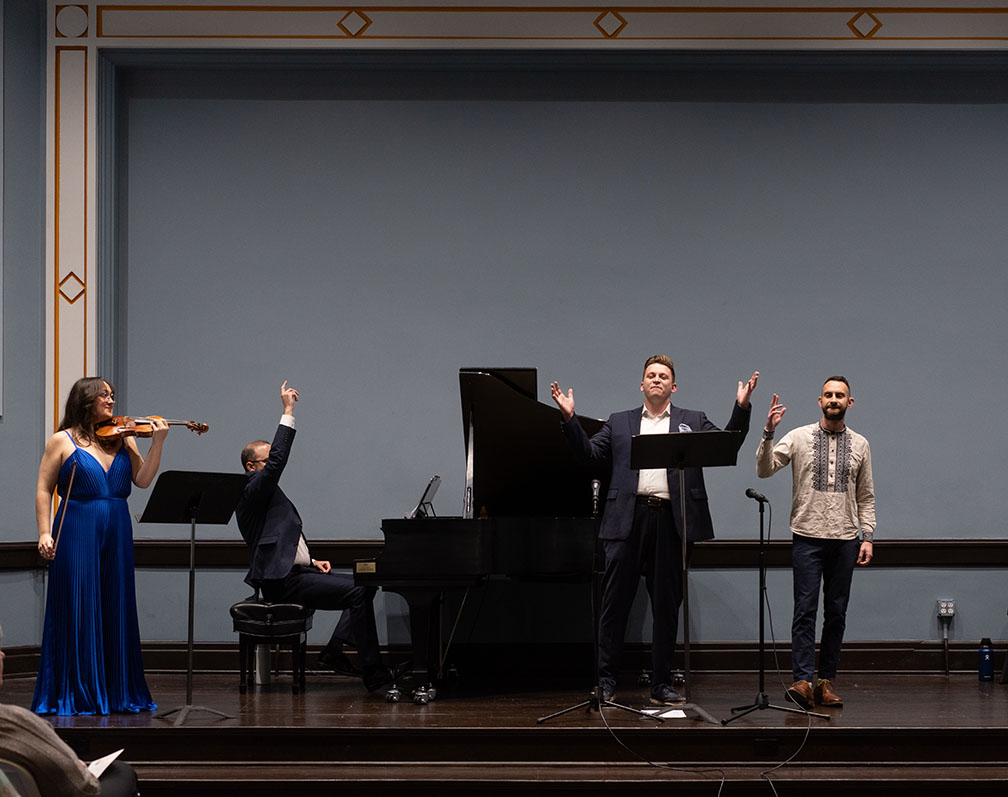
“Simon comes higher than a traditional baritone, and I come lower than a traditional countertenor,” he said. “There will be times where Simon and I sing incredible dissonances, these kinds of notes that are close together, and then resolve into singing in unison, in a way that you can’t tell that there are two of us. We just kind of become one, and it creates this beautiful, elevated sound.”
The arrangement of Psalm 23 remains a staple of their performances. “We perform it in basically every program we do,” Nussbaum Cohen said. “It’s just magical, the arrangement that Simon wrote and the way he crafted it for our voices to go together.” Looking back at how it all began, he added, “It really was bashert.”
A week before the interview, Nussbaum Cohen had returned from Beijing, where he performed Handel’s “Julius Caesar”in the Chinese premiere of the opera. Before that, he had appeared in a contemporary opera adaptation of “King Lear” in Berlin, with another production, Gluck’s “Orfeo ed Euridice,” awaiting him in Amsterdam. His career takes him to some of the world’s leading opera houses and concert halls, but there is one kind of performance that holds a particularly personal significance for him.
“I’m a grandson of survivors, and I got my start singing in synagogue as a cantor,” he said. “The thing that fulfills my musical ‘neshama’ the most is singing music like this and bringing life to a program and a story like this. It’s really the most meaningful thing of anything that I do.”
“I’m a grandson of survivors, and I got my start singing in synagogue as a cantor. … The thing that fulfills my musical ‘neshama’ the most is singing music like this and bringing life to a program and a story like this. It’s really the most meaningful thing of anything that I do.” – Aryeh Nussbaum Cohen
That connection to his Jewish heritage has accompanied him throughout his international career. Although his opera schedule often means spending the High Holy Days wherever his work takes him, he makes a point of including Jewish music in his recitals. Last year, for example, he toured eight American cities, including concerts at New York’s Carnegie Hall and Houston’s Menil Collection. Those performances gave him an opportunity to choose his own repertoire, and he made sure every program included Jewish music.
“I’m not necessarily able to be on the bimah anymore, but I bring some of that with me wherever I go,” he said. “I always bring some of that to the traditional classical world that I’m performing in.”
His appearances in Germany have carried an additional dimension. With his mother’s family originally from Germany and his father’s from Eastern Europe, Nussbaum Cohen is acutely aware of the history behind his presence on German stages. He has performed in Berlin in nearly every season of his career, and said that rather than feeling conflicted about returning to a country responsible for the murder of so many of his relatives, he sees it as an opportunity to reclaim a place that should never have been taken away.
When he first went to perform there, his sister questioned whether he felt uncomfortable singing in a country that had been so horrific to their family. His response was unequivocal.
“For me, it’s the opposite. It’s like the ultimate middle finger back at what was done to us,” he said. “Here I am with the most Jewish name you could have, and I am being hired to be Julius Caesar or to play these big heroic roles. It doesn’t matter that I’m Jewish. I’m the best person to do the job, and I’ll be given the applause like anyone else would. For me, it’s so gratifying to reclaim what should have never been taken from us and our place in that society.”
After his grandfather died, Nussbaum Cohen reclaimed his German citizenship, partly to make working in the country easier. “It’s the least they can do, to give me back the passport that was taken from my grandfather and his parents and everyone else.”
His most recent visit to Berlin, however, was different. For the first time, he brought his 18-month-old son with him.
“It was really emotional in a way that I hadn’t expected,” he said. “Seeing my beautiful little Jewish boy bringing smiles to people around the streets and just sharing his spirit, his soul, in this place was very emotional and very gratifying.”
“It’s Now or Never: Songs of Hope and Resilience,” will be performed Nov. 4 and 5 at 7:30 p.m. at the Goldrich Cultural Center, home of Holocaust Museum LA, at The Grove (100 The Grove Drive, Los Angeles). Tickets ($54 adults, $45 seniors and $27 museum members) are available through the museum’s website.