

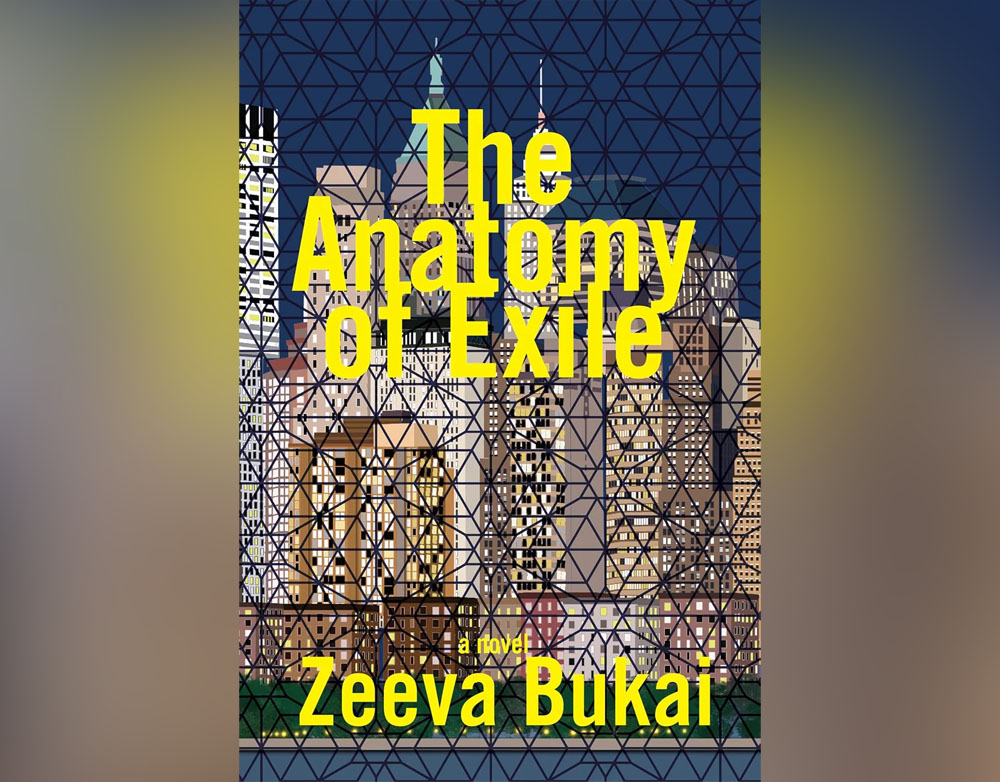
The story at the heart of The Anatomy of Exile by Zeeva Bukai (Delphinium Books) harks back to the Six-Day War in 1967 and the Yom Kippur War in 1973, an era when the wars that Israel was forced to fight had beginnings and endings that were measured in days. But we are reading her first novel in the shadow of October 7, and we come to her book with the knowledge that, in truth, our problems are deeply rooted in history and extend far into the unknown future.
Tamar learns that her sister-in-law, Hadas, has been killed in circumstances that suggest a terrorist attack, a bullet in her chest. Hadas is more than an in-law; she is Tamar’s “dearest friend… the family peacemaker…the light they congregated around.” It was Hadas who introduced her to Tamar’s husband, Salim. Only days before her death, Tamar and Hadas had donated their blood together, dug trenches in the streets of Tel Aviv, and rolled bandages at Tel-Hashomer. Now the war was over, but Hadas was dead.
Bukai was born in Israel and raised in New York City, earned an MFA at Brooklyn College, and now on the staff SUNY Empire State University. Her stories have been published in McSweeney’s, Lilith, the Jewish Quarterly, and other anthologies and periodicals. The Anatomy of Exile is her first novel, but she writes with elegance, passion, insight and sheer suspense as she tells a tale that is at once, a mystery, a love story, and a historical drama.
She introduces us to Tamar at the very moment when she learns that her sister-in-law, Hadas, has been killed in circumstances that suggest a terrorist on a suicide mission, a bullet in her chest on a bus from Haifa. Hadas is more than an in-law; she is Tamar’s “dearest friend…, the family peacemaker…the light they congregated around.” It was Hadas who introduced her to Tamar’s husband, Salim. Only days before her death, Tamar and Hadas had donated their blood together, dug trenches in the streets of Tel Aviv, and rolled bandages at Tel-Hashomer. Now the war was over, but Hadas was dead.
We also discover that Tamar’s marriage is mixed in the sense that she is the child of Polish Jews and Salim is a Jewish refugee from Syria. Hadas and Salim were smuggled across the Golan Heights and “placed on a kibbutz in the Galilee where no one spoke Arabic so they would learn Hebrew.” Salim himself allows us to see the ironies that afflicted a Mizrahi Jew in the Jewish homeland: “In Damascus, Salim fought boys who’d called him yahudi maloun, a dirty Jew, and in Israel, aravi misriach, a stinking Arab.” And when Tamar tells her mother about his proposal of marriage, she replies: “You’re killing me with this Arabische Yid.”
Bukai tells a cracking good story. But one of her most impressive qualities as a writer is her genius for both clarity and complexity. The author leads us across decades of time and lifetimes of experience as we witness the events that knitted Tamar, Salim and Hadas into a family. At the same time, we see, hear and even smell the landscape on which the Jewish state was built and in which they met the fate that is starting point of her deeply suspenseful book.
Thus, for example, a village called Kafr Ma’an emerges as a clue to the death of Hadas, but it also serves to place the events in the landscape of history. Before 1948, it had been an Arab village, but the Arab residents sought refuge in the West Bank when the fighting started. After statehood, it was the site of a farm where Tamar and Hadas volunteered during the harvest, and Salim’s army unit provided security during their visit. Tamar recalls that it was at Kafr Ma’an that Hadas “appeared most at home, her beauty almost incandescent as she filled a basket with oranges, sprigs of rosemary and wild thyme.” Shortly before her death, however, she had referred to the village as “Kfar shedim, kfar gagooim, village of ghosts, village of longing.”
A death in the family, as we see in Bukai’s novel, is a seismic event in the lives of the survivors. Salim, for example, goes “from a man in full control of his emotions to someone at the mercy of them.” The family ricochets from Tel Aviv to Brooklyn, and when Tamar asks her adolescent daughter why she never brings home her friends, the girl answers: “Who would want to meet a bunch of refugees.” Her own three children seem to slip away: “Their ability to assimilate…, to sing ‘This Land Is Your Land’ with the same feelings as ‘Hatikvah,’” writes Bukai, “made her aware of how powerless she was against the lure of America.”
Tamar feels that she is powerless, too, against the forces that followed her from Israel to America – “hope and regret, shame and guilt, a Gordian knot of hopeless love.” So was Tamara’s sister-in-law, and so is Tamar’s daughter, all of them in an exile so deep and so expansive that it transcends mere borders. As the title suggests, exile is not only the historic plight of the Jewish people but also the fate that threatens Jewish men and women as individuals – and not only Jews, but Arabs, too. So we discover when we first encounter a man named Daoud in Israel and a man named Faisal in America, each one a new complication and a crucial figure in the fate of Tamar’s extended family.
The final section of The Anatomy of Exile is titled “Pilgrimage,” as if to suggest that Tamar’s return to Israel in 1973 may turn out to be a round-trip and not a return. “The war’s over,” Tamar’s daughter, Rachel, tells her over the phone. “Come home already.” But the passions that we first encountered in the opening pages are not yet played out. The land of Israel will be the scene of yet another crisis that can be approached as an historical event, a twist of fate, and the vagaries of love and death in a human life. Kfar Ma’an is gone.
“The only trace of it was in the blood-soaked ground,” Bukai concludes, “and in the memory of all those who once lived there.”
A secret, as Isaac Bashevis Singer observed, struggles to reveal itself. The same can be said of The Anatomy of Exile, which tantalizes the reader with secrets that sometimes are, quite literally, matters of life and death. But the reviewer should not tell the author’s secrets. Bukai herself rewards her readers with the truths that explain not only the death of the doomed Hadas but the fate of a Jewish family and, in a larger sense, the Jewish people.
Jonathan Kirsch, an author and publishing attorney, is book editor for the Jewish Journal.