

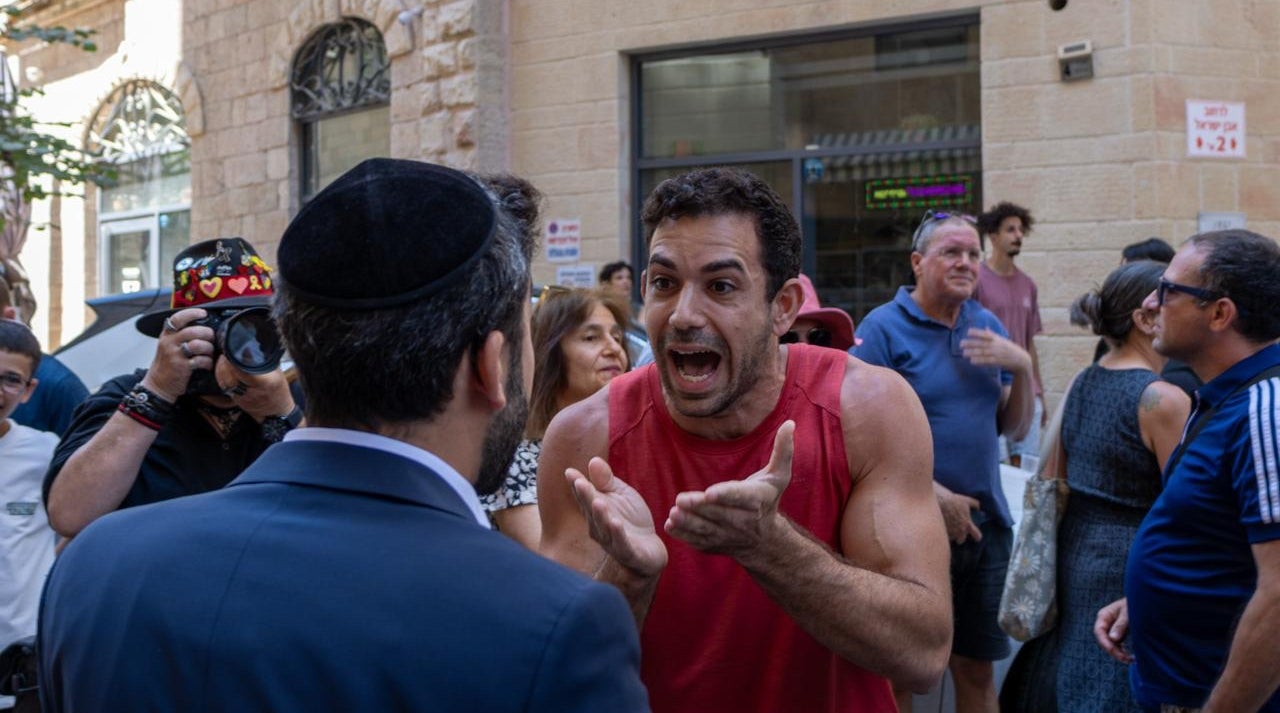
JERUSALEM — By mid-morning on Saturday, the alleys surrounding Cafe Basimta were filled with haredi Orthodox demonstrators protesting the cafe’s decision to open on Shabbat.
It was the sixth consecutive Shabbat that the small cafe off Agrippas Street had faced demonstrations, with no sign of change.
Israeli police were out in force after demonstrators broke through the barricades last weekend.
Close to 100 restaurants, bars and coffee shops in Jerusalem open on Shabbat, according to Laura Wharton, a Jerusalem city council member from the Democrats party who founded Shabus, a cooperative that runs buses on Shabbat. Only one, Basimta, has drawn a crowd.
Basimta, which opened at the end of May, is new, Wharton said, whereas the others have been open for decades. The cafe sits near what she called the undeclared border between the city’s haredi neighborhoods and the rest of the city.
Agrippas Street runs along the Mahane Yehuda market, where almost every business closes for Shabbat. The cafe also opened its doors during the period when haredi yeshivas are on break, so teenagers who make up the bulk of the protestors have more free time to demonstrate.
“There have been weeks when the average age was probably about 16 there,” Wharton said..
The cafe is not only a flashpoint in the long-running fight between secular and religious Israelis over the character of the holy city. It has become the most visible front in a hot summer of protests and riots across Jerusalem, over a light rail line and extending forced army conscription to yeshiva students, both opposed by the Haredi community.
For six years, hardline haredi demonstrators who say the light rail was planned without accounting for the community’s sensibilities have fought construction through Bar-Ilan Street, a haredi thoroughfare, breaking into work sites and pulling down fencing. The vandalism and delays have cost an estimated 400 million shekels.
The light rail project is going ahead despite years of obstruction, Wharton said, and Saturday is the one day there is no work at the site to disrupt, freeing up protesters to target the cafe.
Nationally, 44% of Israeli Jews identify as secular and 16% as haredi, according to figures provided to the Jewish Telegraphic Agency by the Jerusalem Institute for Policy Research. That breakout is vastly different in Jerusalem, where among the city’s Jewish residents, 46% identify as haredi and 25% as religious-Zionist, while 13% identify as secular, according to the institute.
That arithmetic, which speaks to the struggle over the city’s identity, is what non-haredi Jerusalemites say is really at stake in an alley off Agrippas Street.
Avi Dabush, a rabbi who directs Rabbis for Human Rights and is running for the Knesset as part of the left-wing Democrats party, said the cafe was symbolic of the larger national issue.
“It’s kind of an example for the battle that we are doing about the identity of Israel right now,” said Dabush, who was raised in the religious-Zionist school system. He was there on Saturday along with Yair Golan, who leads the Democrats party, for whom the cafe has become an issue ahead of the Oct. 27 election.
“We are in the midst of elections,” Dabush said. “So it’s part of it.”
Outside Cafe Basimta Saturday, demonstrators took turns screaming at each other in the alleys. The haredi teens, dressed in their black Shabbat best, yelled “One who desecrates the Sabbath, his sentence is death,” a verse from Exodus. They also shouted “stop destroying Jerusalem,” while at other times they gathered in circles to sing Shabbat hymns.
Secular Israelis shot back with a slew of chants, of which “enlist!” appeared to be the most popular. They also shouted, “Only cowards send children,” and carried signs reading “Haredim for our coffee,” a play on a Hebrew word that means both ultra-Orthodox and devoted.
Haredi children followed and tried to defend older members of the community during altercations. Lior Leon, a Jerusalem tour guide, blamed the adults. “The problem is not the kids, they push them,” he said.
The confrontations have grown more aggressive since the protests began in early July. Before dawn on July 25, someone threw a bag of feces at the entrance, and on Thursday, Israel Police announced the arrest of a 15-year-old boy.
On Saturday, the (JEWISH REVIEW) reporter at the scene was spat on by a demonstrator, as were other journalists, and Orthodox residents of the buildings lining the alley threw bags of water down at counter-demonstrators until police shouted a warning that they would be arrested.
Israel Police said in a written statement to (JEWISH REVIEW) that officers acted where they identified people “attempting to instigate violence or disrupt public order.”
Cafes and restaurants are granted an exemption from the city’s prohibition on businesses opening on the Shabbat. Yohanan Weitzman, a Jerusalem city council member from the haredi Agudat Yisrael faction, told (JEWISH REVIEW) that there was an unwritten status quo governing which businesses and cafes open in the city, which Basimta had violated. It “is not the desire of either party, but it is a necessary compromise to prevent conflicts,” Weitzman said.
There has been widespread violation of those agreements and a failure to enforce municipal bylaws, he said. Opening the cafe was “the straw that broke the camel’s back.”
The protests are organized by the Committee for the Sanctity of Jerusalem, which acts for the Edah HaChareidis, the anti-Zionist body that includes some of the city’s most militant Hasidic groups. Demonstrators are summoned by pashkevilim, the broadsheet notices pasted on walls in haredi neighborhoods with the time and place of each week’s protest.
Haredi groups who are more involved in Israeli society have been unsettled by the protests. “I am strongly opposed to any kind of violence,” Eliezer Rauchberger, the deputy mayor who heads Jerusalem’s Degel HaTorah faction, the Lithuanian stream that sits in Mayor Moshe Lion’s coalition, said in a written statement. Asked which haredi groups were organizing the protests and which rabbis stood behind them, he declined to answer.
One haredi demonstrator, who asked to be identified only by his first name, Avraham, told (JEWISH REVIEW) the protests would not stop until the cafe closes. “We want it gone,” he said. “It is desecrating our Sabbath.”
Wharton said a Supreme Court ruling exempts entertainment, food service and sports from the city’s Shabbat closures, which is why three of Jerusalem’s four cinemas and its municipal swimming pools operate on Saturday. Basimta, she said, is running legally.
The cafe’s ownership by a sect of Jews who have embraced Christian beliefs has also stirred some opposition. Or LeAchim, an anti-missionary organization, told (JEWISH REVIEW) it is pursuing municipal channels to have Basimta shut, arguing it lacks a valid business license. Wharton said the only substantive complaint concerned tables and chairs placed outside without a permit, and that the furniture has since been brought inside.
Yoel Ben David, who runs the cafe, told (JEWISH REVIEW) in July that the municipality and police had been “incredibly supportive,” and that city officials asked him to bring the tables in as a compromise, which he accepted.
Wharton said the effort to shut the cafe had backfired. Basimta has been doing record business, boasting lines of customers from the moment it opens until it closes.
Ben David is a member of the Jews for Jesus community, which owns and operates the cafe, as (JEWISH REVIEW) reported last month. The revelation cost him support from some Israeli institutions, but it has not thinned the crowds, and demonstrators told (JEWISH REVIEW) it is not what they care about.
For Liora Bamberger, who lives in one of the high-rise buildings encircling the Basimta courtyard, the fight has taken away the one quiet morning of her week.
“The only day in the week that we have a little bit quiet,” she said, before pausing. “Not anymore.”
Bamberger, who observes Shabbat, said the cafe should be allowed to open and that she did not expect this to end well. “When you have extremism, it’s not gonna end,” she said. “It’s gonna be a boom.”
Asked whether she found common ground with the demonstrators, she said she found it with everyone.
“This is the problem.”
Reporting the stories that define our era. When history unfolds in real-time, the Jewish world turns to (JEWISH REVIEW). Your support ensures we can document the complexities of war and the resilience of Jewish communities with integrity.