

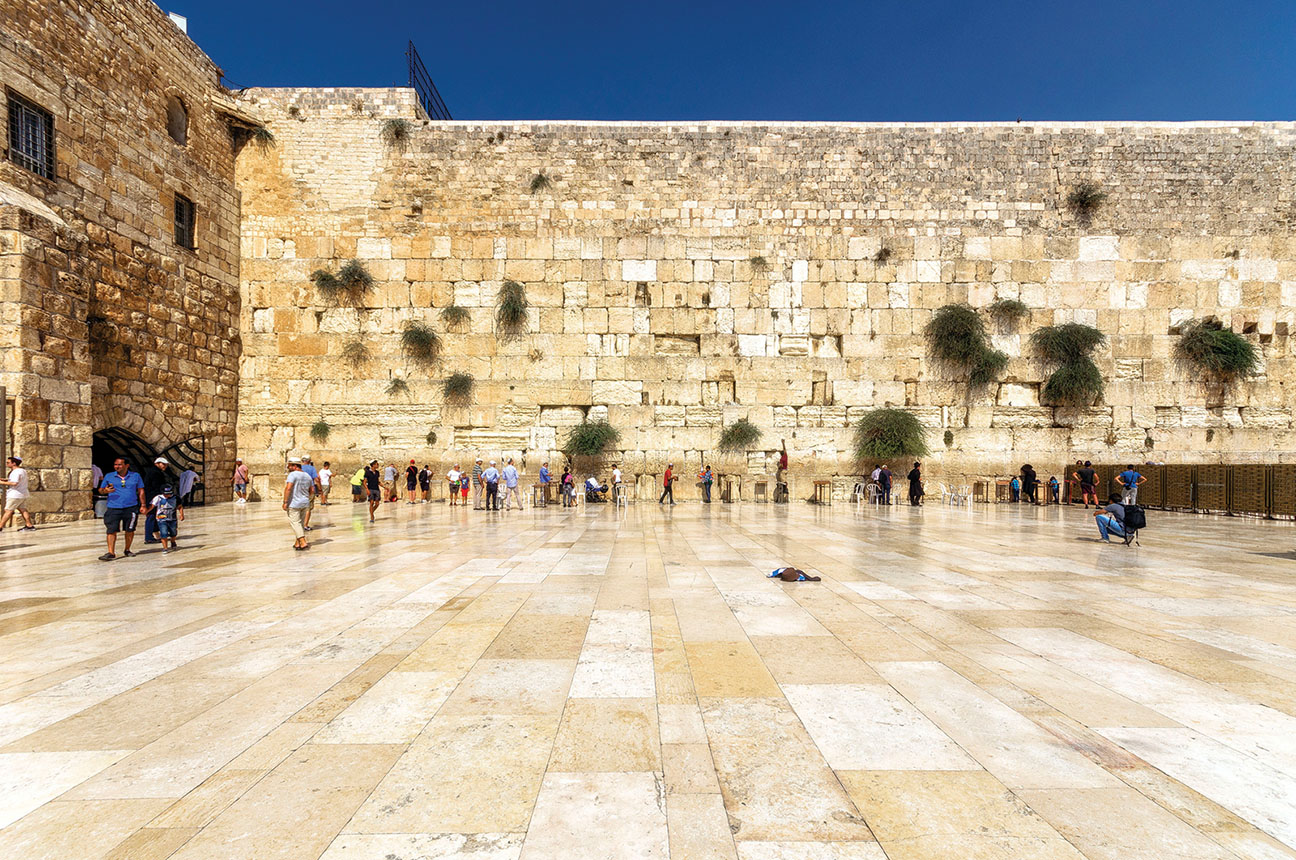
“Many people today believe,” Guy Rogers observes in his “For the Freedom of Zion: The Great Revolt of Jews against Romans, 66–74 CE,” “that the fate of humanity itself will be decided at the site of the destroyed Temple. Visitors to the Western Wall today are immediately aware that they are visiting not just another tourist site; they are at an active religious shrine and are witnesses to expressions of piety that are sometimes intended to have consequences for all of humanity.”
This Tisha b’Av, as we mourn over the Temple once more, it is an occasion to consider what resonance the remnants of the Temple structure hold for us today.
Ruminating on contemporary synagogues in light of the role of the ancient Sanctuary in Jerusalem, the late British chief rabbi Lord Jonathan Sacks observed in his book “Community of Faith” that in our tradition, “the largest place of prayer is not a synagogue at all. It is the open space in front of the Kotel Hamaaravi, the Western Wall, symbol and vestige of the Temple that twice stood and was twice destroyed. Since then, for the most part, Jews have not tried to rival its splendour. They built synagogues, battei knesset, houses of worship. But often they were small, modest and unspectacular.”
In considering why this might be, Rabbi Sacks raises multiple possibilities. The first is the lack of communal funds necessary to construct elaborate structures. The second – related to the first – was centuries of subjugation and persecution in Christian and Muslim countries, which precluded the building of sanctuaries that might rival those of the other faiths. Additionally, it might have been “simply that experience had taught them that, during the long night of exile, no place of residence was secure.”
While there might be truth in all of these historical considerations, Rabbi Sacks concludes that the most compelling factor was that: “After the destruction of the Second Temple Jews lived by an ancient and fundamental insight, that God does not live in buildings but in the human heart. When He commanded the Israelites to construct the tabernacle, He said, ‘They shall make Me a sanctuary that I may dwell in their midst’ (Exodus 25:8) – in their midst, not its midst. The Shekhinah, God’s indwelling presence, was in a people not a place. The traces of His spirit are to be found in human lives. What in other faiths was achieved through architecture – visible symbols of the order and majesty of creation – was achieved in Judaism through the life of the holy community, constructed according to the plans of the Torah. The rabbis carved, polished and engraved its teachings as if they were the stones of a great edifice, and so they were, but it was a living one built out of words and deeds.”
That is to say that the empty space of the Western Wall plaza is, in essence, a call for each of us to commit not to complex structures, but to community and covenant.
“Through families, associations and communities,” he continued, “a civilization passes on its values from one generation to the next in the most vivid and comprehensible way, through patterns of behavior learned and internalized until they become, in Alexis de Tocqueville’s phrase, ‘habits of the heart.’”
That which the Roman conquerors thought they had accomplished – destroying the connection between the Jewish people and their God through the Temple – was no victory at all.
As Rogers puts it in “For the Freedom of Zion,” “What Titus, Vespasian and Domitian failed to understand was that the divine presence lived on in something that was much harder to destroy: a book that ancient Jews believed had been written by God himself.” It is the study of that book, the recitation of prayers drawn from it, and the performance of its many commandments that the unbreakable bricks of Jewish living have been built. These no enemy can destroy, no empire can conquer.
Synagogue attendance is, no doubt, a vital element of Jewish observance. Along with it comes the reminder of the emptiness of the Wall’s plaza – that the eternal vitality of the Jewish people emerges from God’s Word as reflected in our words, deeds and hearts, as our sinews and souls connect heaven to earth.
Rabbi Dr. Stuart Halpern is Senior Adviser to the Provost of Yeshiva University and Deputy Director of Y.U.’s Straus Center for Torah and Western Thought. His books include the newly released “Jewish Roots of American Liberty,” “The Promise of Liberty: A Passover Haggada,” “Esther in America,” “Gleanings: Reflections on Ruth” and “Proclaim Liberty Throughout the Land: The Hebrew Bible in the United States.”