

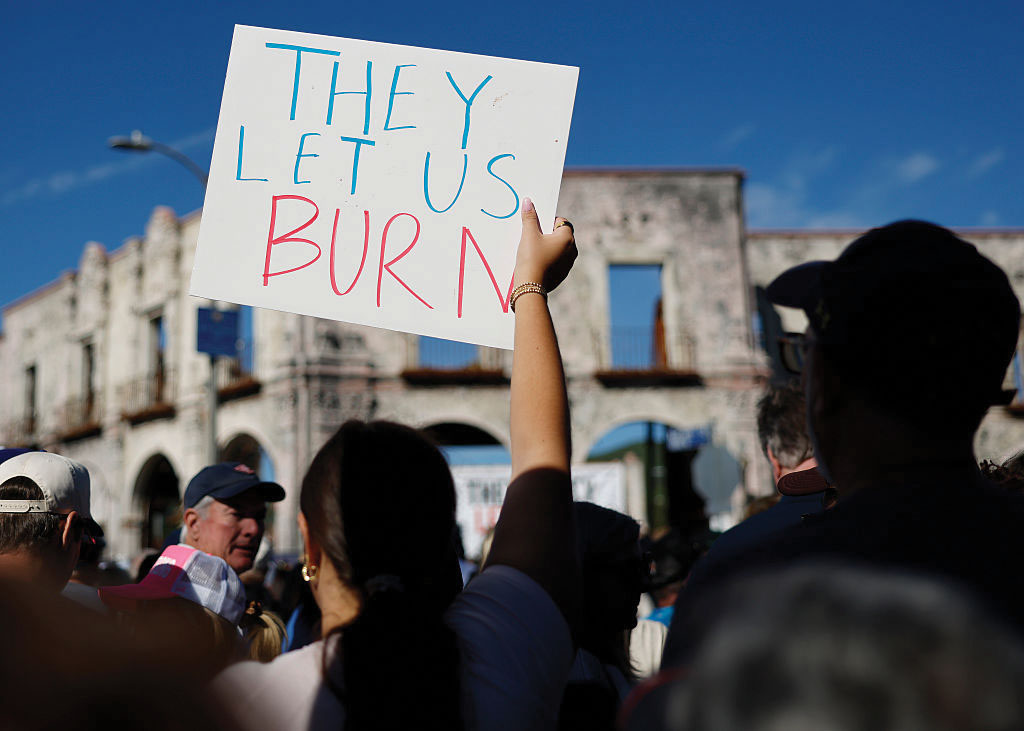
“They let us burn.”
The phrase appeared across black T-shirts handed out at a rally in Pacific Palisades on Jan. 7, marking one year since the Palisades Fire tore through the community. The rally, titled “They Let Us Burn,” was organized by Jeremy Padawer, a Pacific Palisades resident and toy industry executive. Addressing a crowd gathered at the edge of the burn zone, Padawer introduced himself as a citizen rather than a political figure.
“California leadership at the city and state level failed,” Padawer said. “They let us burn one year ago in ineptitude, gross negligence, lack of proper planning, lack of resources, lack of people and purposeful policy that let it burn.”
The Palisades Fire burned 23,448 acres over 31 days and caused an estimated $25 billion in damage, making it the most destructive wildfire in Los Angeles history. The fire killed 12 people, destroyed 6,837 structures, damaged another 1,017, and forced the evacuation of more than 100,000 residents across Pacific Palisades, Topanga and Malibu.
In a statement released on the anniversary, Mayor Karen Bass acknowledged the scale of loss. “One year ago, the City of Los Angeles faced the most destructive wildfire in our history,” Bass said. “Twelve lives were tragically lost, thousands of homes were destroyed, and too many families remain displaced.”
The statement did not address criticism surrounding evacuation alerts, water access or permitting delays. It also did not reference that Bass was in Ghana during the fires, or include figures on destroyed and damaged structures or the estimated $25 billion in losses tied to the Palisades Fire.
Rick Caruso, a real estate developer and Bass’s opponent in the 2022 mayoral election, issued a series of public statements around the anniversary criticizing city leadership and outlining recovery work carried out through his organization, Steadfast LA.
Caruso alleged that an after-incident report had been altered by city officials to “protect leadership.”
“Finally, it’s real. Firegate. There’s a real cover up in the city of Los Angeles,” Caruso said. “We need an independent commission to come in, just like we did years and years ago with the Warren Christopher Commission…none of this has been easy, and we’ve had to contend with insurance payouts, permitting delays, bureaucracy, and red tape.”
Kehillat Israel: A Community Still Displaced
Beyond political criticism, the anniversary also underscored how daily life across the Palisades remained unsettled.
Kehillat Israel in Pacific Palisades remained standing after the fire, though smoke damage and an already underway renovation left the building unusable for much of the year. The congregation spent the year displaced, holding services and lifecycle events across Los Angeles County.
Synagogue leadership said approximately 250 Kehillat Israel families lost homes in the fire. All three members of the clergy team lost their homes, including Associate Rabbi Daniel Sher.
Sher said the one-year mark did not feel like closure. “This didn’t feel like a yahrzeit,” he said. “This felt like partway through the year. The red tape and bureaucracy, no matter the justification at its start, can feel like quicksand.”
In a four-part reflection shared on social media over the anniversary week, Sher described displacement as a prolonged state rather than a temporary interruption.
Sher said children processed loss unevenly over time. “The kids do not grieve in one big conversation,” Sher said. “They do it in tiny bursts.”
Frustration had not eased because many residents remained stuck in what he described as an “arrested” state, unable to move forward due to unresolved logistics.
“We as a state have to figure out how to make sure that when people do move back to these homes, they can have insurance,” Sher said. “Any of the infrastructure that had been ignored for 80 plus years in the Palisades needs to be brought completely up to date.”
“Fast track all of it,” Sher said. “Get rid of the red tape. Get us to the space where we can start to be the doers and not be stuck in protocols.”
Eaton Fire: Pasadena and Altadena One Year Later
While residents along the coast marked the anniversary of the Palisades Fire, communities to the east reflected on the Eaton Fire, which struck Pasadena and Altadena around the same time.
The Eaton Fire burned 14,021 acres in the Pasadena foothills and Altadena area, killed 19 people, destroyed 9,418 structures, damaged another 1,071, and caused an estimated $27.5 billion in losses, ranking it as the second most destructive wildfire in California history.
The fire destroyed the Pasadena Jewish Temple and Center, though thirteen Torah scrolls were removed before the structure was fully lost. The night before the anniversary on Jan. 6, 2026, Rabbi Joshua Ratner addressed a crowd of hundreds gathered on the site where the sanctuary had stood since 1941.
“PJTC never has been defined by walls,” he said. “It is defined by our congregants and by the strength of our shared purpose.” Leaders said rebuilding plans were underway, with design and construction expected to conclude in advance of a targeted reopening by the High Holy Days of 2028.
Altadena resident Tannis Mann, who lost her home, said she never received an official evacuation alert.
“I actually never received the evacuation alert to my phone,” Mann said. “Without people texting me, I wouldn’t have necessarily known as quickly as I should have.”
Mann said some residents returned to their neighborhoods, but owners of standing homes faced another set of challenges.
“With the neighbors and friends that I know whose houses did survive, I actually think it’s a lot more difficult to navigate the situation with the standing home,” Mann said.
Mann, her fiancé, and their dog moved about 20 minutes away. Even a year later, she said her attachment to the land remained.
“I feel very protective over my piece of land,” Mann said.
Homes Still Standing, Lives Still Stalled
While entire neighborhoods were lost in the fires, some residents said homes that remained standing created a different kind of uncertainty.
Malibu resident David Levy said the passage of a year had not brought relief.
“No, not really going great,” Levy said. “Just to give you an idea, we’re still fighting the insurance companies.”
Much of Levy’s neighborhood in Carbon Beach remained empty. “Basically on my block, I’m one of three people that are living here,” he said. “No repairs have started.”
Insurance payments had fallen far short of costs. “They’ve provided less than 20% of what the cost is to repair things here,” Levy said. “The people who lost their home got paid out in full, period, right away. But the people who have suffered with damage have barely gotten anything.”
Levy said his home remained unsafe. “My home survived the fires, but that’s ridiculous,” he said. “I have a house that still has lead contamination.” The equipment in his home office recording studio is corroding and unusable from the soot. Levy said the anger surrounding the fires persisted because the same disputes remained unresolved.
“There’s no end in sight,” he said. He said a major question among neighbors is about not just whether rebuilding made sense, but whether to stay in California at all.
“How can you justify keeping your life in a place where there’s no insurance or really terrible insurance?” Levy said. “When a disaster happens and they don’t pay, what do you do?”
The one-year mark, he said, did not represent any kind of positive milestone.
“I don’t think anybody’s going to really be fairly compensated at the end of this.”