

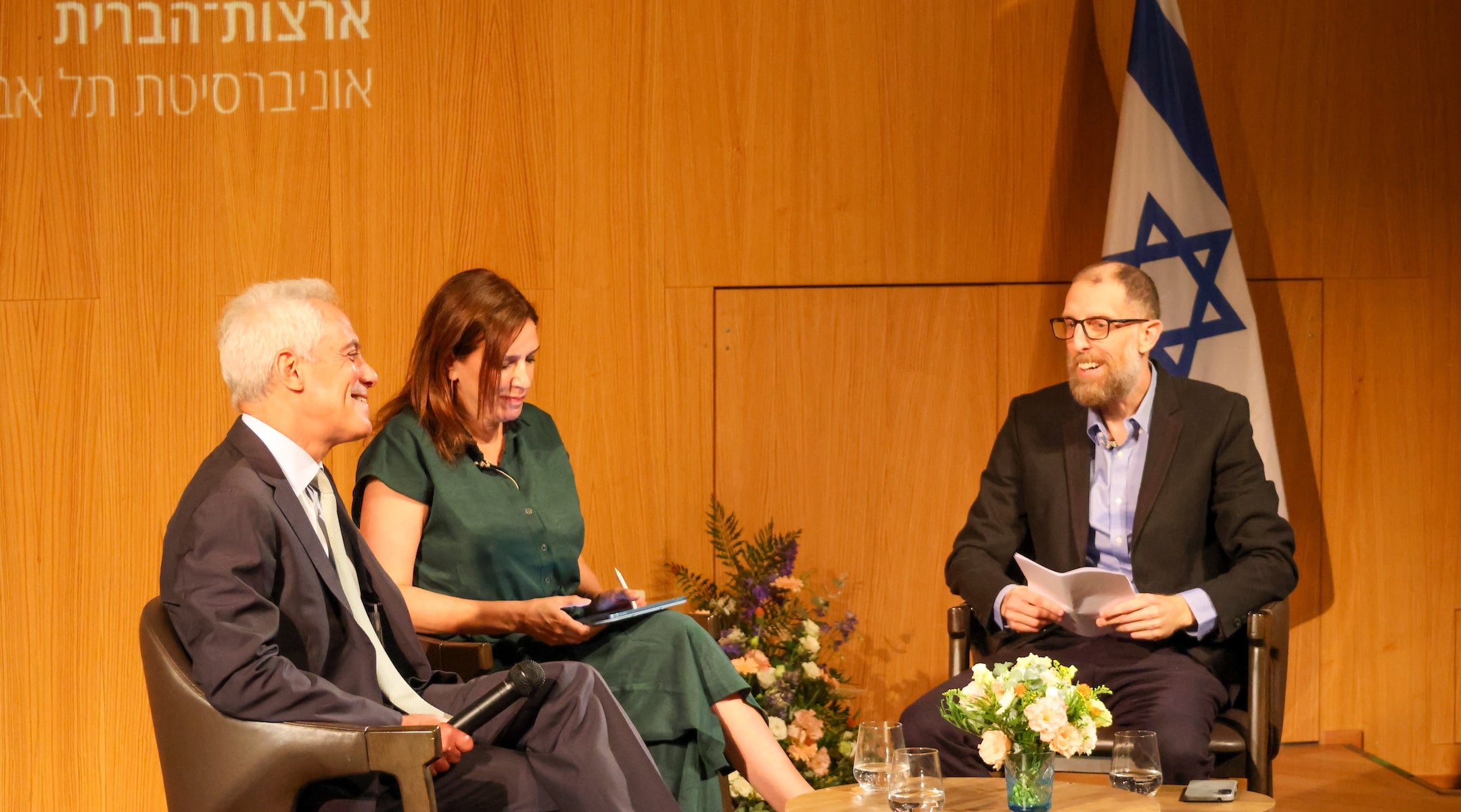
TEL AVIV — Pausing as he looked out at the packed hall at Tel Aviv University, Rahm Emanuel offered his audience a warning about what he was about to say.
“Hold your applause, because you may not like this,” he said, before laying out his proposal for U.S. sanctions targeting Israelis who attack Palestinian civilians and property, Israeli officials who voice support for that violence, and companies and banks that support “illegal settlements.”
The crowd applauded anyway — three separate times.
Under a 2017 law, Israel bars foreign nationals who publicly call for boycotts of Israel or its settlements from entering the country. Emanuel issued his call for sanctions from a stage in Tel Aviv, a measure of how far Democratic politics on Israel have shifted since Hamas’ Oct. 7, 2023, attacks.
Widely viewed as a possible contender for the 2028 Democratic presidential nomination, Emanuel, a former congressman, White House chief of staff, Chicago mayor and U.S. ambassador to Japan, and one of the most prominent Jewish figures in American politics, arrived in Israel on Sunday. His speech Wednesday afternoon, billed as “An Honest Conversation: The U.S.-Israel Relationship, Where It Stands Today and The Road Ahead,” was the keynote of the visit, and was meant to signal the need for a “fundamentally new and different approach” to the U.S.-Israel alliance, as he put it.
Whether Emanuel’s critique will land with the Israeli establishment, or with the ruling coalition, remains to be seen. Emanuel made a point of avoiding Israel’s elected officials during his visit, including Prime Minister Benjamin Netanyahu, saying he did not want to interfere with elections set for the fall. He did meet with President Isaac Herzog, who is appointed by the government, as well as visit hospitals in Tel Aviv and Nablus that partner with each other.
But it was clear that it was resonating with attendees. Moti Porath told the Jewish Telegraphic Agency that he believed Emanuel correctly diagnosed the ailment at the heart of the Israeli government, a leader who has become an outcast abroad but remains too skilled a politician to easily dislodge.
Porath, who splits his time between Newton, Massachusetts, and Tel Aviv, and who attended the Massachusetts Institute of Technology at the same time as Netanyahu, said he recognizes the prime minister as a singularly talented political operator. “He’s a fantastic politician,” Porath said. “Maybe he’s a manipulator.”
To the attendees who spoke with (JEWISH REVIEW), Emanuel’s message was not anti-Israel but pro-Israel, in Porath’s telling, what a good friend is obligated to do when the other is acting out of line. Emanuel put it similarly from the stage, “True friends tell each other the truth.”
Porath said he hopes the United States and Israel can once again find “a common political vision,” but that doing so will require tough love from America’s next president.
The event was hosted by Tel Aviv University’s Center for the Study of the United States and moderated by its founding director, Yoav Fromer, alongside Yael Sternhell, the professor who heads the university’s American studies program. Organizers solicited questions from students in advance and said more than 100 were submitted.
But with a university audience likely to skew liberal, attendee Yoam Barash said the program would have benefited from a right-wing voice to push back on Emanuel’s comments, since most Israeli voters lean right. A February poll by the Midgam Institute for Israel’s Channel 12 news found 68% of veteran voters and 75% of those voting for the first time identify as right-wing. “Why didn’t they bring somebody from the right?” Barash asked.
Barash is the uncle of Daniel Barash, a managing director at the public affairs firm SKDK who helped organize the event He attended with Hannah Winkler, a friend from his army days and now a doctor in the Tel Aviv area. She said she pins her hope not on the U.S.-Israel alliance but on a left-wing victory in the upcoming elections. “Without that, I have no hope,” she said.
Told that some attendees had wanted a more politically diverse lineup, Fromer defended the format. “This is academia,” he said. “The goals here are very different than they would be on a political panel.”
At the same time, Fromer echoed the attendees’ view that Emanuel’s message was that of a friend rather than an adversary. “To say to someone, look, I’m trying to save you, if you don’t change your behavior, you’re going to self-destruct — that’s someone who cares,” he said.
The stakes, in his telling, are high for Israel and for the university. “Israelis have become pariahs. We used to be admired, the most admired,” he said, echoing Emanuel’s own warning from the stage that Israel’s leadership has turned it into a “territorial pariah.”
The damage is not merely reputational, he argued. “It’s not just feeling bad. It has practical implications,” he said, speculating about investment and capital that will stop flowing, students and tourists who will stop coming, Israelis who will lose their jobs.
During the anti-Israel protests that swept U.S. campuses in 2023 and 2024, ties with Israeli universities, including Tel Aviv University, were frequent targets of divestment demands. Emanuel himself warned in his speech that Israel’s scientists face exclusion from international research networks and that its artists and academics are being shut out of exhibits and conferences.
Inside the hall, at least, the message was received. “Most of the people in this room are quite sympathetic to what you have to say,” Barash told Emanuel on stage. “That is not the case across Israel.”
Reporting the stories that define our era. When history unfolds in real-time, the Jewish world turns to (JEWISH REVIEW). Your support ensures we can document the complexities of war and the resilience of Jewish communities with integrity.