
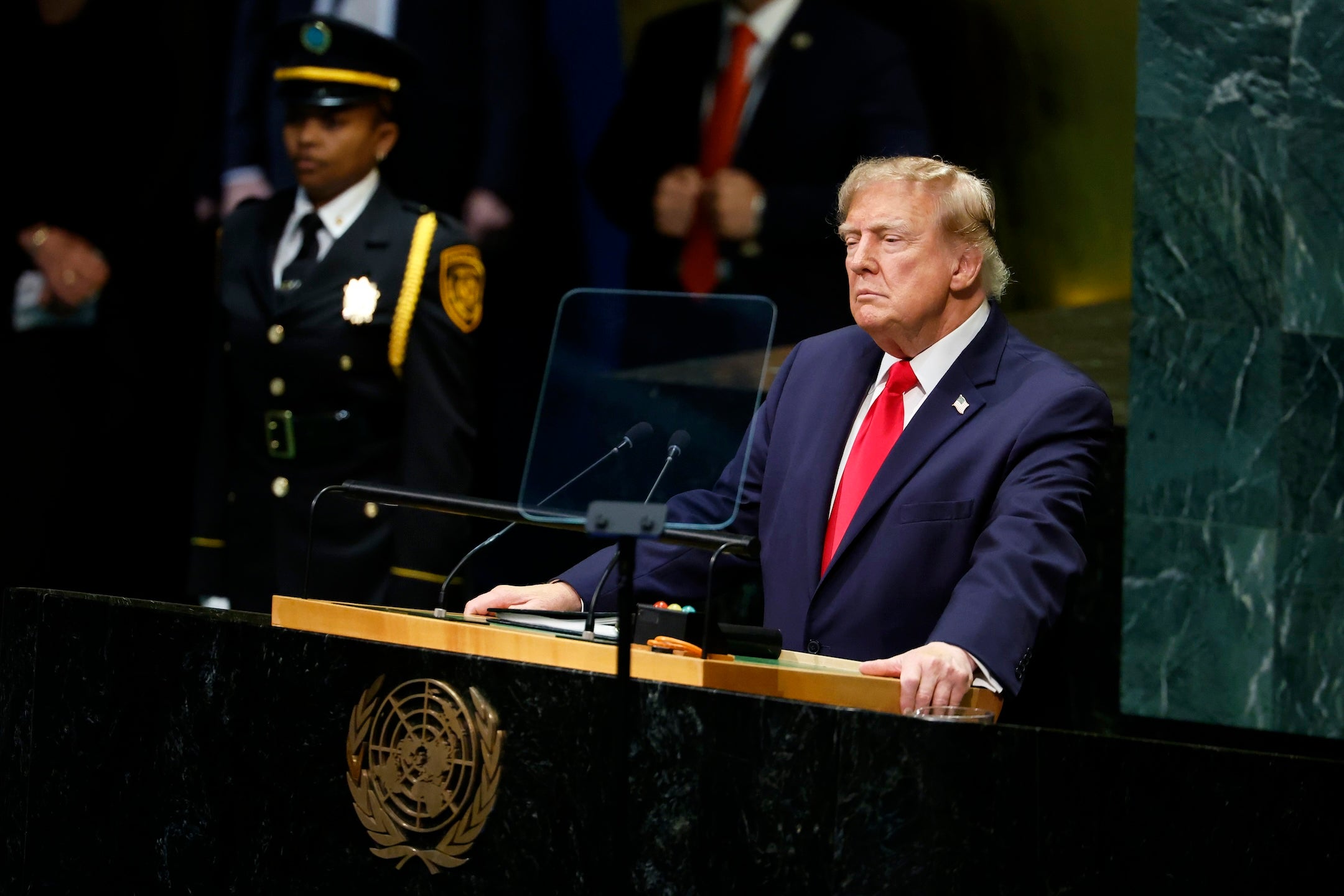
U.S. President Donald Trump called upon nations to stay united in their pressure on Iran’s economy, as he addressed the United Nations General Assembly in New York on Tuesday.
Indeed, Trump showed no sign of walking down from the military conflict he began with Tehran in February amid criticism that the U.S. is not accomplishing its goals, though he did hold out the prospect of a negotiation solution later this fall.
“I have a big decision to make: Will a deal be made with Iran that lets them rebuild and create a far greater country than it ever was before?” Trump asked. “Or do I annihilate the Islamic Republic and do it quickly, never giving them a chance to destroy people and countries again?”
Despite these threats, the president expressed his belief that the two countries will “make a deal, right after the election because it doesn’t make sense for them not to,” referring to the House and Senate elections on Nov. 3.
During a bilateral press conference with Ukrainian President Volodymyr Zelenskyy, Trump confirmed that envoys Steve Witkoff and Jared Kushner participated in a three-hour meeting with the Iranian delegation on Tuesday.
“It went very well,” Trump said. “It was a very good meeting. It’s potential greatness or obliteration. It could be a great country.”
Trump said in his speech at the General Assembly that Iran was likely waiting for the results of the midterm elections to make a deal.
Stressing that he “gave absolutely no credence” to the election when making decisions on Iran, Trump maintained that the regime is “weak and desperate.”
Despite Trump’s characterization of Iran as weak, Tehran has largely succeeded in disrupting commercial shipping through the Strait of Hormuz, a crucial route for global energy supplies.
Trump continued to maintain that he “will never allow Iran to have a nuclear weapon,” slamming the regime’s leaders for their repeated refusal to make deals and their focus instead on making missiles capable of hitting Europe.
“Iran’s goal was to complete their mad dash to a nuclear bomb from behind this conventional ballistic missile shield,” he added. “After giving Iran every chance for a deal, I took action.”
He linked the fight against Iran with the Hamas invasion of southern Israel nearly three years ago, reminding the world that the two wars are connected.
“In two weeks, we will mark the third anniversary of the Oct. 7 terror attack in Israel, where terrorists funded by Iran tortured, mutilated and killed 1,200 very innocent civilians, including dozens of Americans and many babies — little, tiny, beautiful babies,” Trump said.
The State Department has said an estimated 1,200 people were killed in the attack, including at least 843 civilians and dozens of Americans.
“Iran’s supreme leader celebrated that massacre and called it a service to humanity,” the president continued. “The same regime slaughtered over 72,000 of its citizens this year. Recently, 10,000 were killed for protesting.”
Death toll estimates from Iran’s crackdown on anti-government protests have varied widely, and neither Trump’s figure of 72,000 people killed by the government this year nor his figure of 10,000 protesters killed has been independently verified.
While Democrats have argued that Trump hasn’t accomplished strategic goals in the conflict, the president cited a list of accomplishments thus far in the war. He said that all 159 Iranian naval ships are lying at the bottom of sea, with the air force destroyed, radars gone, missile capacity reduced and inflation devastating the country.
The president also commended the U.N. Security Council “for voting overwhelmingly to pass a resolution condemning Iran’s despicable terrorist attacks on commercial ships,” while calling upon nations to remain “united in maintaining pressure” on Iran’s economy.
Trump described the dangers posed by Iran to the world as “a reality that far too many preferred to ignore.” He declared that there is no greater threat in the world than “the No. 1 sponsor of terror, the Islamic Republic of Iran,” which he accused of “spreading death and carnage and chaos across the entire Middle East and beyond.”
The president noted that just a year ago, when he addressed global leaders at the same assembly, the war in Gaza “was still raging brutally.” Hostages taken by Hamas on Oct. 7, 2023, remained “deep in Hamas tunnels and there was no end in sight.” But on the sidelines last year, he said that steps taken “changed everything.”
“A few weeks later, we ended the war in Gaza saving untold thousands of lives,” Trump said. “We also brought home all remaining hostages, both living and dead — every single one of them. Everyone thought it was a miracle that we were able to do so, and people celebrated in the streets.”
He then expressed his gratitude to the U.N. Security Council for its unanimous endorsement of his 20-Point Gaza Peace Plan and for approving the Board of Peace tasked with managing those efforts. Israel rejected the plan this summer, arguing that it did not provide sufficient guarantees of Hamas disarmament.
Nonetheless, Trump recognized the nearly 30 countries that have joined the board and contributed billions of dollars to relief funds. Trump also thanked nations that have contributed police and troops to the region.
He also boasted of the U.S. having invested $1.5 trillion this term in the military, a sum he described as “more than ever before.” Denying reports that the country was running low on weapons, Trump declared that the country has “more munitions than we could ever possibly think of using.”
“I do not believe in letting problems fester,” Trump said. “So while others have talked, I have acted.”
As the Year Turns, Support the Journalism You Trust. JR covers the stories shaping Jewish life around the world — with the depth this moment calls for. As you reflect on the year ahead, consider a gift that keeps independent Jewish journalism strong.