

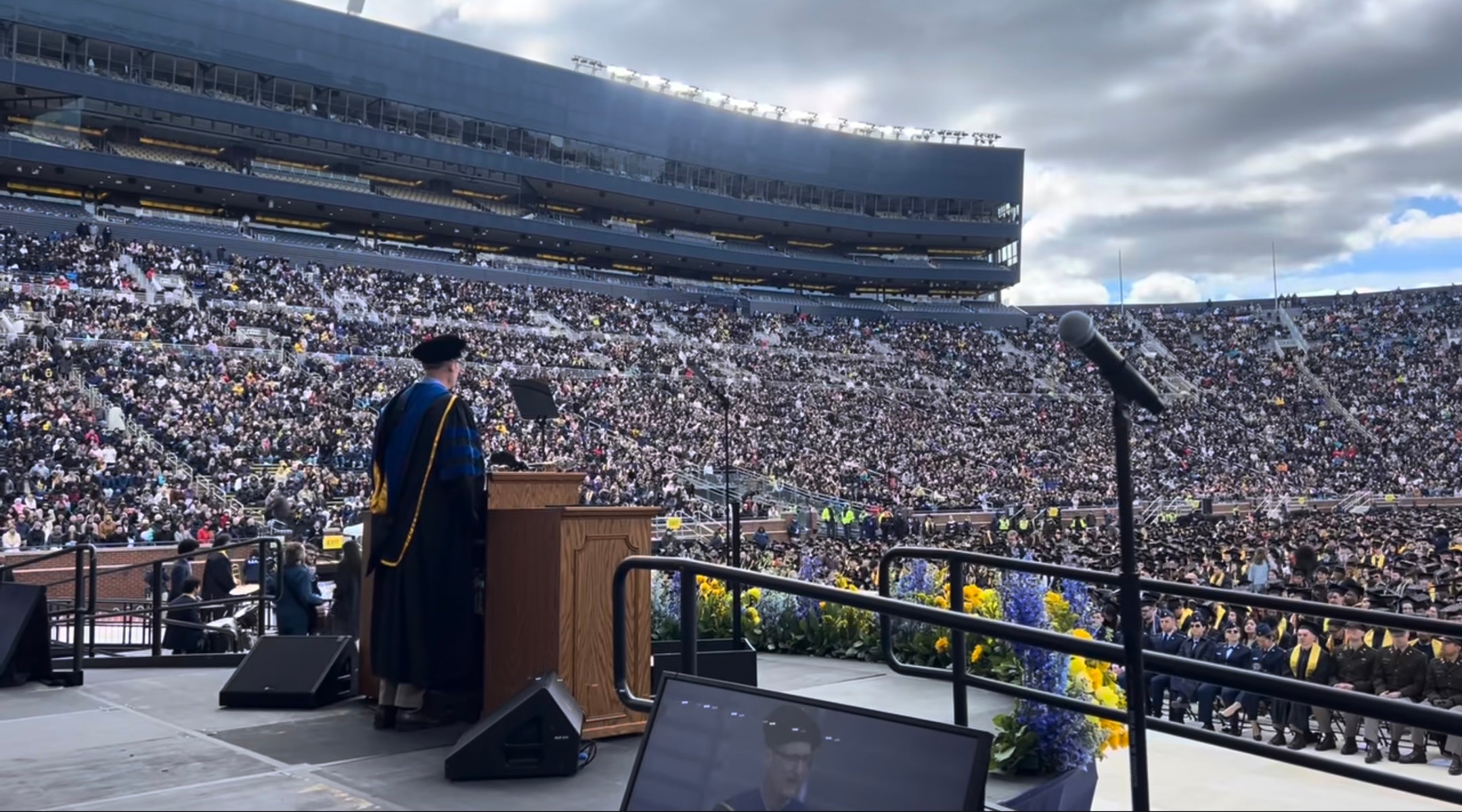
The University of Michigan has issued a formal apology after its faculty senate chair went off-script to praise pro-Palestinian student protesters during last weekend’s commencement address.
Derek Peterson, who also praised the memory of the school’s first Jewish professor in his speech, had drawn criticism from Michigan Hillel and from major organizations including the American Jewish Committee.
Now, a growing chorus of faculty members have signed a letter pushing back on the school president’s apology. On the right, Florida GOP Sen. Rick Scott has urged the federal government to stop funding the public university over the incident, writing, “If this is what Americans are paying for, it’s time to cut them off COMPLETELY.”
“At today’s U-M spring commencement ceremony, our outgoing Faculty Senate Chair made remarks regarding the Israel-Palestine conflict that were hurtful and insensitive to many members of our community,” Michigan’s interim president, Domenico Grasso, wrote in his letter on Saturday. “We regret the pain this has caused on a day devoted to celebration and accomplishment. For this, the university apologizes.”
Peterson, a history and African-American studies professor who is finishing a stint as faculty chair, had structured his commencement speech around pioneers in university history.
“Sing for Moritz Levi, the first Jewish professor at the University of Michigan. Appointed professor of French in 1896, he was to open the doors of this great university to generations of Jewish students who found in Ann Arbor a safe haven from the antisemitism of East Coast universities,” Peterson told the crowd at Michigan’s football field, to applause.
Shortly after, Peterson added, “Sing for the pro-Palestinian student activists who have, over these past two years, opened our hearts to the injustice and inhumanity of Israel’s war in Gaza.” Those remarks also received loud applause.
Michigan, like many campuses, was host to a critical mass of pro-Palestinian encampments and other forms of student protest. The tenor of such actions in Ann Arbor has escalated: Protesters have also cut down peonies at the university arboretum and vandalized the home of a Jewish university regent. Recently the attorney who defended the university’s encampment participants from some state-level charges received the Democratic Party’s nomination for a seat on the university’s board of regents.
Peterson’s comments, Grasso said, “were inappropriate and do not represent our institutional position,” which he said was “institutional neutrality.” (Many universities have adopted a stance of neutrality in recent years as they have sought to navigate tensions around Israel.)
Grasso added, “Commencement is a time of celebration, recognition and unity. The Chair’s remarks were expected to be congratulatory, not a platform for personal or political expression.”
Michigan Hillel also condemned Peterson’s speech on Sunday, in similar language.
“Commencement is a celebration of every graduate. It is not a stage for political statements that alienate the Jewish community,” the Hillel wrote on Instagram. “Michigan Hillel is deeply troubled that this occasion was used in that way.” The chapter also said it would “look forward to productive conversations” with Michigan administrators.
AJC head Ted Deutch, a Michigan alum, accused Peterson of choosing to “hijack a unifying moment to inject his anti-Israel politics.”
On campus, however, an open letter rebuking Grasso and defending Peterson’s speech had been signed by more than 1,100 faculty members, staff and students in less than 24 hours.
“His celebration of the students who engaged in those protests clearly connected to his discussions of past efforts by students to target injustice,” the letter said of Peterson, citing his linking of the protesters to Moritz Levi. The letter also claimed that Grasso’s apology itself violated the university’s “institutional neutrality” policy.
“Many members of our community have family members who have been killed, whose houses have been destroyed, and whose lives have been transformed by Israel’s conduct of the war in Gaza,” the letter reads. “To many, protesting against the war was a central part of their University experience, and one that was an expression of the values of free speech and humanism that our institution supports when it is at its best.”
The reactions to Peterson’s speech were “totally predictable,” Karla Goldman, a Judaic Studies professor at Michigan who researches the university’s early Jewish life, told the Jewish Telegraphic Agency.
“Why throw a grenade?” Goldman said. “It’s not that what he said is terrible. I don’t find what he said terrible. But you could predict what the result was going to be. So my question would be, to what end?”
Goldman said she could understand why Peterson’s brief remarks had linked Moritz Levi to pro-Palestinian protesters.
“I get the trajectory of what he’s saying: People that higher education couldn’t see, eventually they were able to see,” she said.
Commencement ceremonies have been a frontier for tensions over Israel since Oct. 7, but it has typically been students, not faculty, raising the issue. In 2024, many college graduations featured pro-Palestinian demonstrations, including at Michigan. Last year, multiple schools disciplined students who made pro-Palestinian comments in their speeches in contravention of university policies. Some schools have done away with student speeches in an effort to stem disruptions.
Passover may be over, but your chance to support independent Jewish journalism isn’t. Help (JEWISH REVIEW) keep reporting the stories that define our era.