
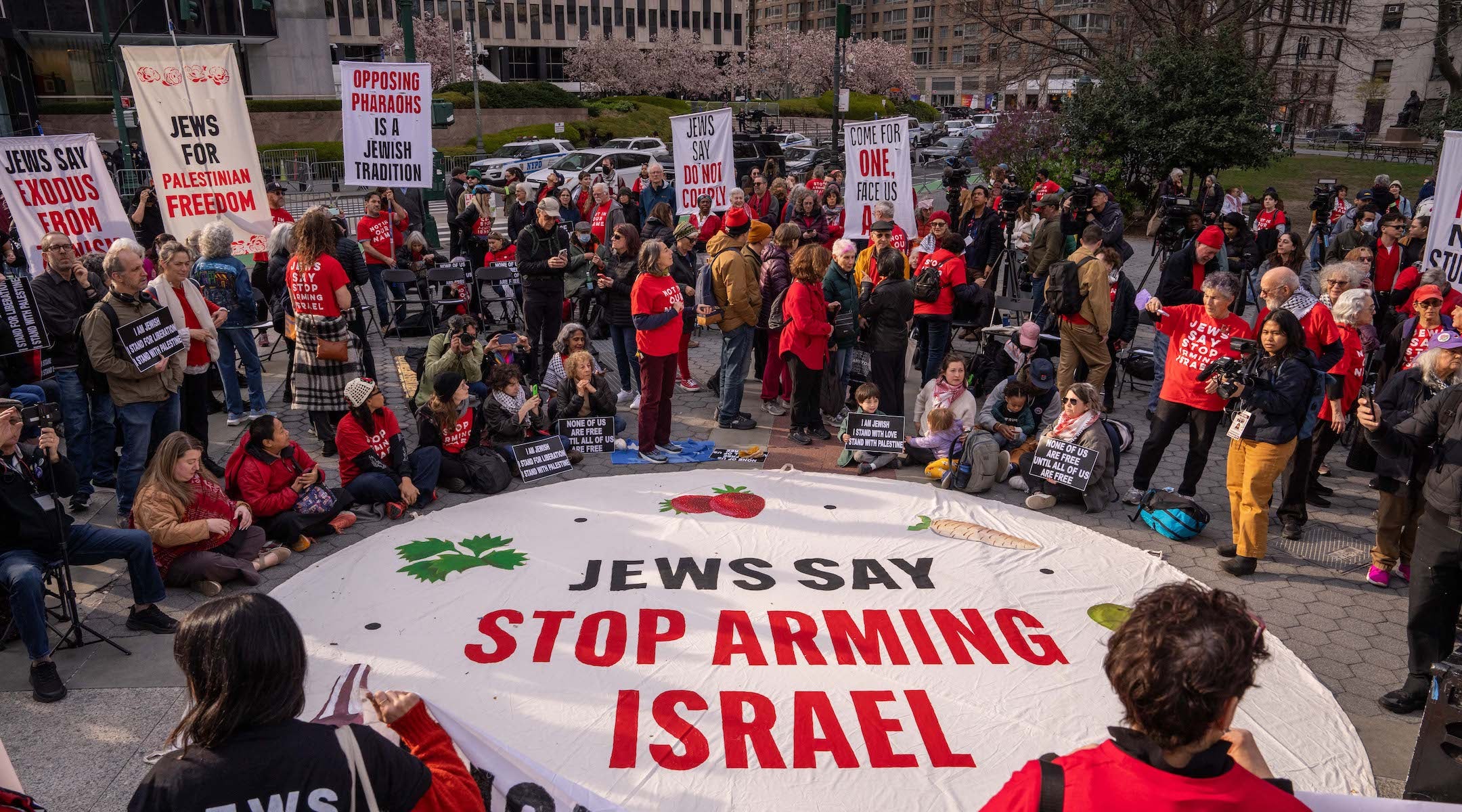
A survey showing that only around one-third of American Jews identify as Zionists set off shockwaves in the Jewish world last week, triggering speculation about what could have caused so many Jews to spurn a label once thought as nearly synonymous with Jewish identity.
From his home in Israel, Robbie Gringras had a different reaction.
“I wasn’t surprised,” he said about the survey, conducted by Jewish Federations of North America. “I have a feeling many more of these pieces are now going to come out.”
Together with Abi Dauber Sterne, Gringras runs For The Sake of Argument, an organization that consults on how to hold “healthy arguments” focusing on Judaism and Israel. A few months ago the two embarked on a project few other Jewish groups would attempt: interviewing dozens of Jewish American anti-Zionists directly about what turned them away from Israel.
Avowed anti-Zionists make up a relatively small portion of American Jews, according to the JFNA study: 7% overall, and 14% among Jews ages 18-35. But they shared a consistent story, according to Gringras and Sterne’s findings, which they are releasing on Thursday.
“Throughout all the answers to this question we heard an unmistakable theme: These people report that they reached their rejection of Israel in response to the behavior of Jewish Israelis and Jewish Americans,” Gringras and Sterne write.
Gringras said he understands that the takeaways might be disconcerting to Jewish leaders, who might be drawn to the theory that Jewish anti-Zionists have taken that stance as a result of ignorance, or because of the influence of non-Jewish progressives with no attachment to Israel. But he said he believes the findings can have a positive impact on those who encounter them.
“I have a lot of faith in people who confront things and think about them,” Gringras told (JEWISH REVIEW). “So the moment that the leadership is thinking about this, is confronting it, then good things will happen.”
Gringras and Sterne are not alone in trying to more deeply understand how contemporary Jews think about Zionism — which the JFNA survey shows does not have an agreed-upon definition — and what Jewish anti-Zionists more specifically are thinking.
Robbie Gringras, co-founder of For the Sake of Argument (Screenshot via YouTube)
Brandeis University researcher Matt Boxer said he felt “vindicated” by JFNA’s survey. He’s embarked on his own, very similar, multi-year survey project asking American Jews to define Zionism, supported in part by the Anti-Defamation League, where Boxer is a former fellow.
When Boxer first distributed his own survey in 2022 with open-ended responses, he received negative feedback from all corners, even death threats, in a sign of just how sensitive even raising the subject can be.
“I’ve had people tell me I’m an antisemite just by asking the questions, by having people tell me what these things mean,” he said. “And I’ve had people telling me I’m committing genocide against Palestinians.”
Even so, turnout was strong. More than 1,800 American Jews, from all over the world, submitted usable responses on whether they describe themselves as a Zionist or anti-Zionist, and what they thought the terms meant. Some synagogues and similar Jewish spaces circulated the survey within their communities. The results, which Boxer first presented in 2024, largely mirrored JFNA’s own findings this week (a study which Boxer had also consulted on, and which was led by one of his former graduate students).
“It’s so much deeper than we’ve left room for in our discourse,” Boxer said. He described what he called “the ‘Rashomon’ effect,” a reference to the classic 1950 Japanese film in which the same event is retold from drastically different points of view. The same thing has happened with Zionism, he said: Every Jew has their own definition.
“We’ve made this out to be a binary: If you’re Zionist you’re good, if you’re anti-Zionist you’re bad,” he said. “But it’s so much more complicated than that.”
Boxer is currently polishing off a new paper based on the data, exploring the Jews — including many self-declared Zionists — who described Israel as an apartheid state.
In 2024 Boxer’s senior colleague, the social researcher Janet Aronson, surveyed 800 Jewish anti-Zionists. “It’s not a group that we just want to dismiss out of hand,” said Aronson, who heads Brandeis’ Jewish Studies center and has conducted population studies for local Jewish federations for years.
Referring to the combined number of declared anti- and non-Zionists found in the JFNA survey, she added, “I think 15% is a lot of people.”
The push for more and higher-quality dialogue with Jewish anti-Zionists comes as the larger Jewish world is grappling with the seeming collapse of the Zionist consensus, expressed in everything from reactions to Oct. 7 to the election of Zohran Mamdani as mayor of New York City. Some Jewish leaders are calling to extend olive branches to Jewish anti-Zionists, while others want to close the big tent to them.
Those who do engage with Jewish anti-Zionists, these researchers say, will likely encounter a group of people who are very knowledgeable about Judaism and often grew up in Zionist spaces. That stands in contrast to what they say is a common misconception of the population: that Jewish anti-Zionists don’t know or don’t care about Judaism and other Jews.
For example, the Movement Against Antizionism, a new advocacy group founded by the McGill University doctoral student Adam Louis Klein, defines Jewish anti-Zionists as “those who seek safety or acceptance by echoing the accusations leveled against their own people.” The group draws a historic line connecting the Hellenistic Jews of the Maccabee era, through Jewish Soviet Bundists, to the modern-day anti-Zionist group Jewish Voice for Peace — all Jews that it says identify not with their own people but with antisemites in their broader society.
The researchers studying Jewish anti-Zionism don’t see things quite the same way. While none of the studies claims to be representative of the Jewish anti-Zionist population, 40% of Aronson’s respondents either worked, or had previously worked, in Jewish organizations — echoing the profile of the day school and camp alums who founded the activist group IfNotNow a decade ago. Many of them became involved in anti-Zionist minyans or similar upstart Jewish spaces that reject Zionism — a growing rallying cry among left-wing Jews.
“Those are people who we would expect to be current and incoming leaders of the Jewish community,” Aronson said. “What does it mean for the Jewish community when they say, ‘We’re not going to be part of these Jewish institutions, we need to start our own’? What a loss to the Jewish community, this pipeline of leadership and energy.”
Most of Gringras and Stern’s interviewees, likewise, “talked of a childhood and Jewish education that embraced the centrality of Israel,” the report states. “Their Israel journeys did not begin with an ideological rejection of Zionism. Yet nearly all of them underwent a paradigm shift, and now see Israel through primarily anti-Zionist eyes.”
First-person accounts from the report describe painful breaks with the Jewish community. They shared stories of being cut off by family members for asking their opinions about Israel’s human rights record, or of being rebuked by rabbis for suggesting that post-Oct. 7 donations should be directed to Israeli healthcare services rather than the military.
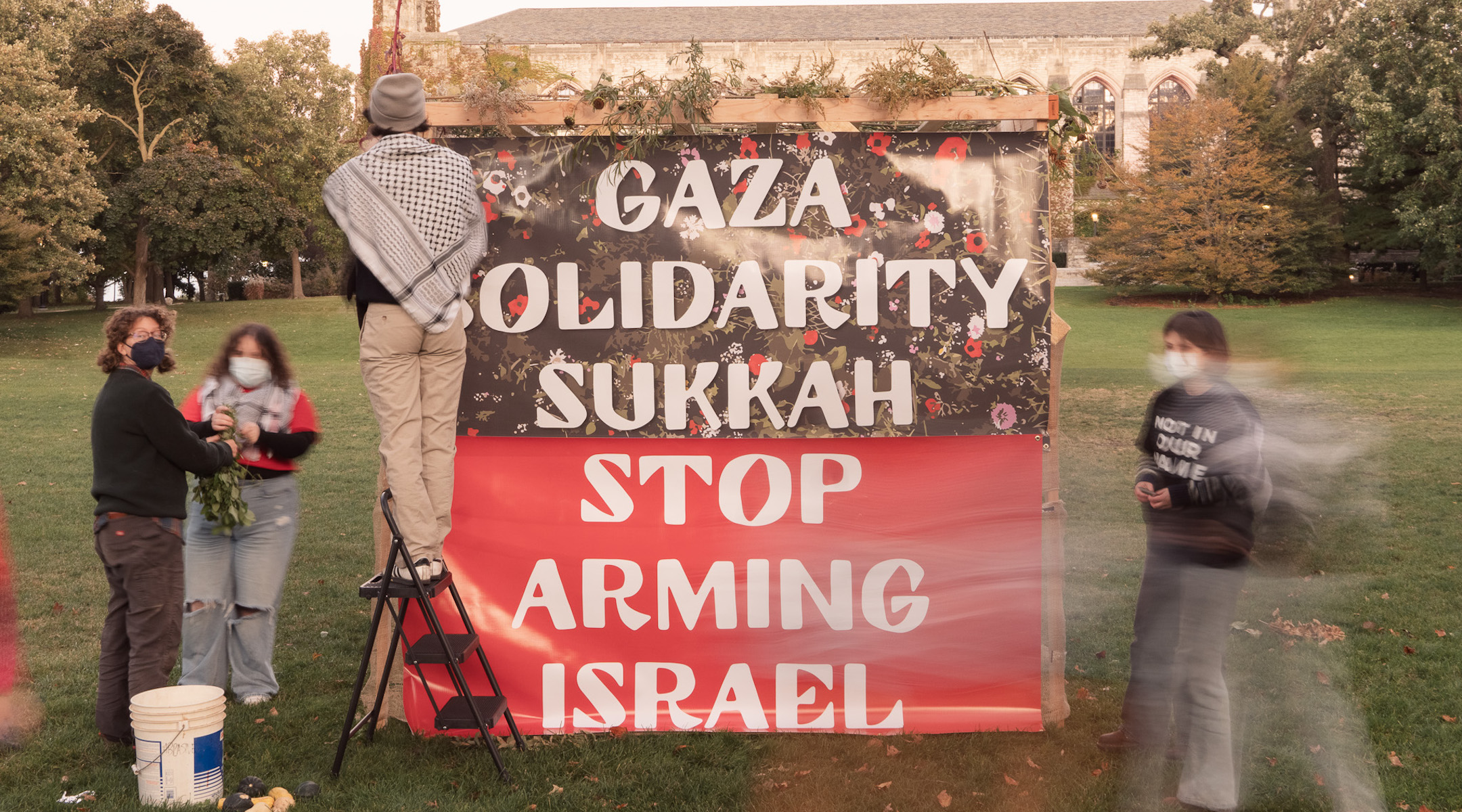
An anti-Zionist Jewish group constructs a “Gaza solidarity sukkah” on the campus of Northwestern University in Evanston, Illinois, for the holiday of Sukkot, 2024. (Courtesy of Jewish Voice for Peace)
“It is far, far easier to come out as gay than to come out as anti-Zionist,” one subject said.
Another interviewee, who grew up in a religious Zionist family that lived for a time in a settlement in the West Bank, stated, “I know that my parents are terribly sad that I am no longer a Zionist. I think they don’t realize how sad I am, too, that I am no longer a Zionist.”
“We weren’t meeting people who didn’t care,” Gringras summarized, describing their subjects as “sad, if not brokenhearted, about the way in which they not only find no expression for their Judaism, but also find the Judaism that they’re meeting very challenging.”
Gringras and Sterne are far from anti-Zionists themselves. Both are Jewish emigres to Israel; Sterne has held senior roles with the Jewish Agency and Hillel International, while Gringras is a former leader of the Jewish Agency’s Israel Education Laboratory. They founded For the Sake of Argument in 2022, with support from funders such as the Jim Joseph Foundation and the Natan Fund — realizing, in Gringras’s estimation, that “the way to learn about Israel, to be engaged in Israel, is to be engaged in its arguments.”
Talking to anti-Zionists wasn’t the project’s initial plan. At first, For The Sake of Argument sought out to explore what they’d theorized was a purely generational divide in Jewish views on Israel. But, the report’s authors say, they soon realized that age wasn’t the appropriate framing for the divide. Some younger subjects “expressed deep support for Israel,” the found, and some older ones “were deeply critical.”
The real divide, they determined, “is over Israel itself, between Zionists and anti-Zionists.” So they pivoted to interviewing anti-Zionists directly — with connections made via intermediaries, mostly on the East Coast, and the wording of questions carefully constructed in advance with “the assumption that no one is born Zionist or anti-Zionist.”
In fact some interview subjects said that, far from being born anti-Zionist, they only made the leap in the aftermath of Oct. 7 and the subsequent war in Gaza, out of distress over Israel’s behavior during the war. Some made asks of their Jewish leaders, such as to remove the Israeli flag from the bimah, that they had not previously considered.
All of it, the paper said, came from a place of deep identification with and concern for the Jewish community amid the anti-Zionists’ beliefs that it was aligning itself with an immoral cause.
The researchers all say Jewish leaders should conduct similar interviews within their own communities, to understand the real contours of sentiment about Israel.
For the Sake of Argument plans to offer programming to help facilitate such dialogue. Aronson emphasized that those conversations would ideally come from a place of mutual respect and vulnerability.
“I don’t think it will be effective if it comes from this position of, ‘We are mainstream Judaism, we are willing to have a conversation with you,’” she said. “It can only be done if it’s really from a willingness that all sides need to be open and listening to each other.”
Aronson noted that Zionist Jewish leaders, following one of JFNA’s own conclusions from its report, may see it as their job to try to convince their counterparts why Zionism matters. That approach could easily backfire, she said.
“For these highly engaged anti-Zionists who have gone through serious Jewish education and involvement, they actually have already heard all of the arguments that mainstream Judaism has to present,” she said. “I think that’s one of the reasons why they say, ‘We don’t need to hear your side.’ Because they’ll say, ‘We have learned it. You’ve taught it to us and we reject it.’”
Boxer noted that, in many of the Jewish population surveys he’s worked on, “community after community” has told him they struggle to broach conversations about Zionism. That makes them all the more essential, he said.
“I think it’s going to be painful, but we have to have these conversations,” Boxer said.
All the researchers agreed on something else: The divide between Zionist and anti-Zionist Jews is deep, and concerning.
“We don’t know what to do,” Gringras and Sterne admit in the report. Aronson concurred.
“I don’t know how we put the community back together. I don’t know that this is a bridgeable line, to be honest,” she said. “This is certainly not the first time in Jewish history when people have left and made their own tents.”