

In March 1968, Rachelle Halpern walked into her university in Szczecin, Poland, and found a group of her classmates gathered around a newspaper. She asked what they were reading about. The answer came: “Zionists.”
Halpern didn’t understand. Who were the Zionists? One classmate said, “The Jews.”
“But I’m a Jew,” said Halpern. Her classmates looked at her in disbelief. She couldn’t be, one said. She had no horns.
Halpern was about to be swept up in a spiral of social and political crises in communist Poland, culminating in a government-sponsored antisemitic campaign that stripped Jews of their jobs, schools and citizenship, forcing some 13,000 to leave the country. Within months, Halpern would find herself renouncing her Polish nationality and leaving everything she knew for a new life in the United States.
At that moment, when her classmates read the word “Zionists” and looked up at her with horror, she felt a shift.
“It sort of evoked a lot of distrust and fear, that somehow there were all these people around that were going to do some harm to the Polish people,” Halpern told the Jewish Telegraphic Agency.
Now 79 years old, Halpern joined a group of Polish emigrants and their children who traveled to Poland in April to unwind the trauma of 1968. Their meeting was organized by the Engaged Memory Consortium, a collection of organizations dedicated to Polish Jewish heritage, and funded by Poland’s Ministry of Foreign Affairs.
It was the first time that the government paid for a trip to reckon with the events of 1968 and invited the Jews whose lives were upended, according to the program’s coordinator, Patrycja Dołowy.
The nine participants came from Sweden, Denmark and the United States. Over eight days, they visited Jewish sites and community groups in Warsaw, Wrocław and Łódź. These three areas hosted the largest groups of Jews who remained in Poland after the Holocaust, where they decided to rebuild — and where their communities were decimated again in 1968. Though the members of the trip had never met, their memories overlapped, patching together a dark open wound in the history of Polish Jews.
It’s a chapter that remains obscure among many Poles and Jewish communities around the world, partly because of a myth that Jewish life was wholly extinguished by the Holocaust, according to Karen Auerbach, a historian of Polish Jews at the University of North Carolina at Chapel Hill.
“There’s such limited understanding of the fact that there was a Jewish population in Poland after the Second World War, that this doesn’t rise to the surface,” said Auerbach.
The Jewish flight of 1968 started with two words from Władysław Gomułka, then the leader of communist Poland. Days after Israel’s victory over Soviet-supported Arab countries in the Six-Day War of 1967, Gomułka said that Poland would not tolerate a “fifth column” of Polish Jews. The phrase signaled that Jews could be loyal to Israel and treasonous to Poland. Soon after, the communist secret police purged Jews from state and party apparatuses, especially the army.
This campaign exploded after Poland, like other countries across the globe, was rocked by youth uprisings in March 1968. Polish students demonstrated against state censorship and the growing restriction of their civil liberties under Gomułka. Thousands were detained, expelled from universities and dismissed from their jobs in the ensuing government crackdown. Some of the students were Jewish. That became the pretext for Polish authorities to accuse them of “Zionism,” pinning the demonstrations on a global Jewish conspiracy.
The government organized “anti-Zionist” rallies and stoked fear of “Zionists” in official propaganda, avoiding the word “Jew.” Newspapers outed “Zionists” to their neighbors. A new wave of purges expelled thousands of Jews from their jobs and exposed them to antisemitic attacks in their cities and towns. Jews were pressured to leave the country, and when they applied for exit documents, they were forced to renounce their Polish citizenship.
The purges were not only executed by government order, but also by ordinary Polish citizens who took advantage of the campaign and antisemitic sentiment to further their careers, said Dariusz Stola, director of the Polin Museum of the History of Polish Jews.
“It was opening opportunities for many people for advancement,” said Stola. “Say you compete for a position in your institution, and you have a Jewish colleague, why not accuse him of being a hidden Zionist? Or you have some accounts to settle from the past — you don’t like someone — let’s accuse him of Zionism, because the burden of proof he is not is on him.”
By the early 1970s, half the country’s Jews were gone, crushing a community that was tenuously growing back decades after the Holocaust. The campaign effectively ended organized Jewish life in Poland.
Fifty-eight years later, Dołowy guided Polish emigrants and their descendants through cultural institutions that have emerged to preserve Jewish history, culture and communal life since the fall of the Soviet Union, from the Polin Museum in Warsaw to the Marek Edelman Dialogue Center in Łódź. She also introduced them to Jews, like herself, whose families remained in Poland after 1968.
Rachelle Halpern, right, and other participants in the Miszpucha Foundation trip visit the Polin Museum of the History of Polish Jews in Warsaw, Poland. (Adam de Kaminski)
Dołowy is the former head of Warsaw’s Jewish Community Center and the founder of the Miszpucha Foundation. A part of the Engaged Memory Consortium, this foundation aims to strengthen ties between Jews in Poland and Jews who left, particularly those driven out in 1968. Dołowy arranged meetings between the emigrants and Jews who stayed in Poland — artists from the Kultur-Lige network in Wrocław, cultural event organizers for the nonprofit HaKoach in Łódź, and Jews in Warsaw who ranged from academics to entrepreneurs to JCC coordinators.
In 1968, Dołowy’s father was expelled from his university and lost permission to continue his PhD. The question of whether to stay or leave Poland split her parents from their families and friends. Half the Jews they knew chose to leave, dividing what she called the “miszpucha” — the Polish spelling of the Hebrew “mishpacha” and the Yiddish “mishpokhe,” meaning “family.”
Despite this rupture, Dołowy said she rarely saw the antisemitic campaign reflected in Polish history, beyond the hushed stories in Jewish families. Shame and confusion swirled around the events of 1968 for many Jews who considered themselves Polish, but were told by their government and their neighbors that they were not.
“I believe that this generation’s story is still something really silenced,” said Dołowy. “We don’t really talk about 1968, or if we talk about it, we don’t really know the words to describe what actually happened to us, to our community.”
Halpern was 22 when her family left in December 1968 to join a relative in Boston. Despite the Soviet propaganda that said Polish Jews harbored a suspicious bond to Israel, only some 3,000 actually went there. Most of the 13,000 emigrants fled to Sweden, Denmark and the United States, where Cold War-era programs welcomed political refugees from the communist bloc.
Waves of Polish Jewish survivors had migrated to Israel after the Holocaust. But many of those who remained by 1968 were secular and committed to life in Poland, with dwindling ties to Jewish religion, Israel and Zionism, according to Stola. Many were dedicated communists or socialists.
“We know that only a minority of them went to Israel, despite attempts to convince them,” he said.
To obtain exit permits, Halpern and other Jews were forced to declare the intention of going to Israel. Then they received a travel document that rendered them stateless.
“It looked like a regular identity document — a photograph, first name, family name, date of birth,” said Stola. “And the most important part of the document were letters at the bottom of the page saying, ‘The bearer of this document is not a citizen of the Polish People’s Republic.’ To my knowledge, this is the only identity document that says who you are not.”
Halpern gave up her Polish nationality together with her sister in an emigration office. She remembers everything as “gray” — the day, the Polish official and the room with a small window.
“We were looked at as if we were hostile people, enemies,” she said. “We had to stand there, and you had to raise your hand and say that you are renouncing your Polish citizenship. We cried and cried and cried.”
Still, Halpern almost stayed in Poland. Just before her family left Szczecin on an overnight train to Warsaw for the first leg of their journey, she ran away. Seized by fear and anxiety about losing the world she knew, she slept at a friend’s house that night. She woke up in the early hours with the realization that she had nothing left in Poland — no citizenship, no money, no university and no family. She caught up with her parents just before their next train departed from Warsaw to Vienna.
Halpern went to medical school in Boston and made her career as a doctor in California, then Colorado. She did not visit Poland again until 2007, nearly 40 years later.
Other young Jews leapt at the opportunity to leave in 1968. Wladimir Mietek Szpirt, another participant in the Miszpucha Foundation trip, was just starting medical school in Szczecin at 18 years old. He found a hostile environment at the university. When he heard Gomułka threaten the “fifth column,” he decided to apply for asylum in Denmark. For him, leaving the Soviet Union meant the chance to freely study medicine, develop his career and build a stable life.
But Szpirt’s parents were stuck. They lost their jobs as accountants at state institutions, and authorities said they knew too much state information to leave the country. Szpirt emigrated alone, uncertain when he would see his parents again. Nearly two years later, they managed to follow him to Denmark.
Szpirt recently retired from his long career as a doctor in Copenhagen. Like Halpern, he returned in April to the place where the first chapter of his life closed. Now in his later years, Szpirt reflected on growing closest to his origin by leaving it behind.
“In Denmark, I was always accepted as a Pole,” said Szpirt. “The funny thing is that for the first 18 years of my life, I was not accepted as a Pole in Poland. But in Denmark, I became a doctor who was born in Poland. I was not a Jew from Poland.”
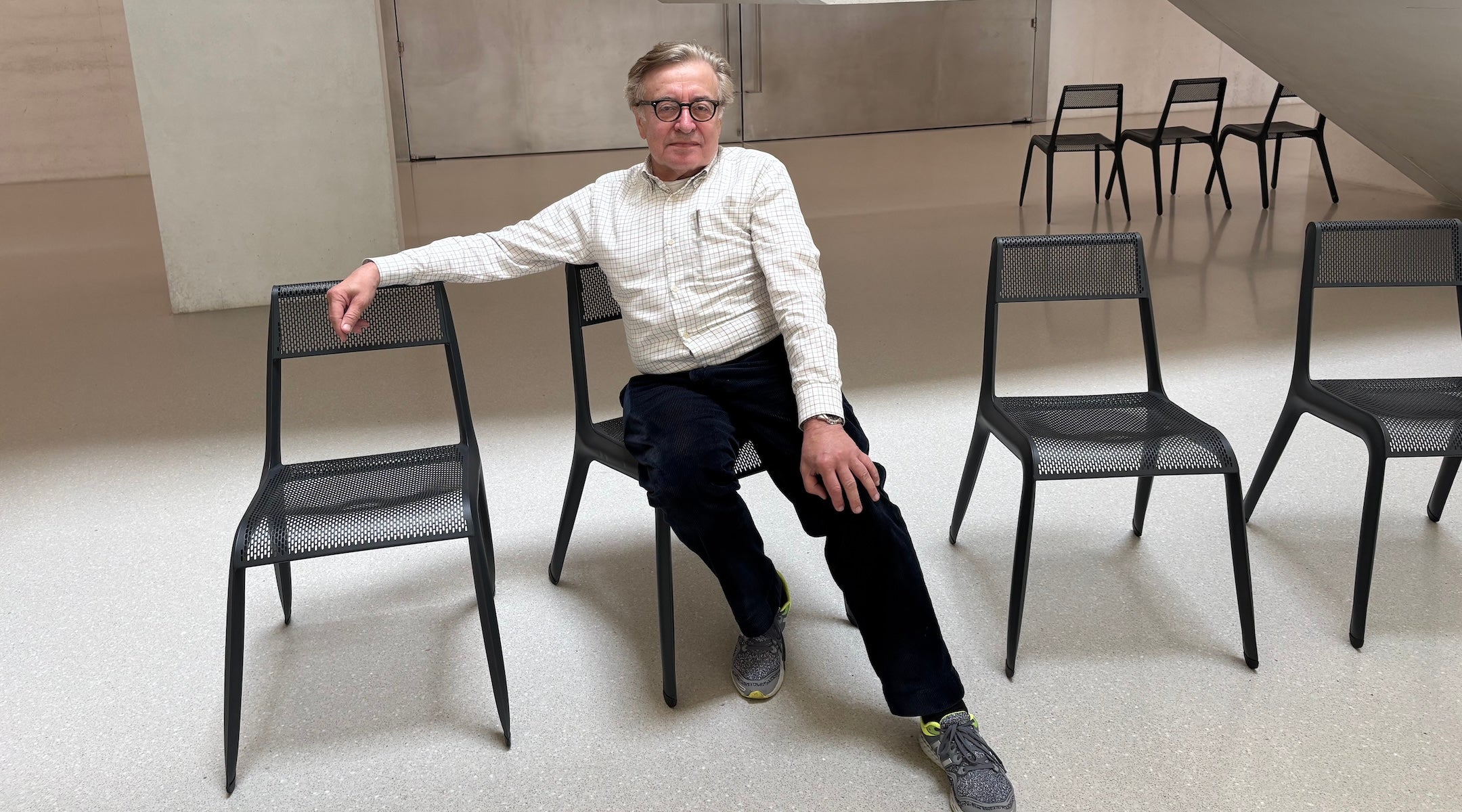
Wladimir Mietek Szpirt at the Museum of Modern Art in Warsaw, Poland. (Shira Li Bartov)
Many Jews never went back to Poland after the antisemitic campaign. Eliza Fishenfeld grew up in New York City with parents who fled in 1969 and 1974. The Miszpucha Foundation offered her first trip to Poland as the child of emigrants who were “very angry and very hurt,” she said. They decided not to return.
Fishenfeld lived in a displaced Polish Jewish world in New York. All of her parents’ friends were other Polish Jews affected by 1968, she said. They connected through the network of Jewish schools and camps from their childhood in Poland.
“I know they loved Poland before ‘68, because they told me so many stories about it and they were always so happy, and all their friends were from Poland,” said Fishenfeld. “Our community was the Polish Jewish emigré community.”
Fishenfeld said that arriving in Poland felt like a “homecoming of sorts,” though it was nothing like the communist country her parents remembered. She called them daily to describe the trip, but at their age now, she said they no longer travel.
The campaign didn’t only destroy Jewish communities. It also hollowed out Poland’s cultural and intellectual life, as Jews disappeared from universities, medical schools and hospitals, according Joanna Podolska, the former director of the Marek Edelman Dialogue Center in Łódź. She said their absence left visible holes in the city.
“We didn’t have so many well-educated people, so it was a difficult moment,” said Podolska. “Young people who could work for the city, for Poland, they became citizens of other countries. They were doctors, filmmakers, advocates, chemists, researchers, artists. Probably, Poland would be much richer as a country — more important — with these people who left.”
Decades after the 1968 campaign, it remains a sensitive subject in Polish politics. From 2015 to 2023, Poland was governed by the nationalist-conservative Law and Justice party, which promised to revive Poland’s pride in its past and eradicate what officials called a “pedagogy of shame.”
The narrative stifled research into Poland’s Holocaust history, particularly concerning instances of Polish antisemitism and Polish people who killed Jews or cooperated with the Nazi regime. Poland passed a law in 2018 that outlawed accusing Poland or the Polish people of complicity in Nazi crimes.
But the government also lashed out at a 2018 exhibition about 1968 in the Polin Museum. The exhibition called “Estranged” closed with a wall of quotes, which combined antisemitic and xenophobic statements from 1968 and 2018. Though the quotes were unattributed, two belonged to members of the ruling party.
The exhibition infuriated government officials, and former culture minister Piotr Gliński accused Stola of imposing “very aggressive politics” on the museum. Stola was pushed out as the director in 2019 despite winning a competition to extend his tenure. (In March, he was reinstated under Poland’s new government, led by centrist Prime Minister Donald Tusk.)
Anat Plocker, a historian of Eastern Europe at Stanford University’s Taube Center for Jewish Studies, said that Polish officials in 1968 defined a form of antisemitic rhetoric that echoes among Polish nationalist politicians to this day.
“The way they talk about the memory of the Holocaust, Jewish power, questions of who is really behind what’s going on in Poland — it’s really the Jews or it’s really a conspiracy of the West against Poland — all of this discourse became so important in Polish politics in ‘68,” said Plocker. “So what we see is that politicians are repeating, really sometimes word by word, the same phrases that were used against Jews in ’68.”
Eight years after the backlash to “Estranged,” Dołowy said she was proud to have garnered funding from the Ministry of Foreign Affairs for the Miszpucha Foundation trip. She hopes to arrange more trips for 1968 emigrants, so they can share their long-obscured stories while they still have the chance.
“These emigrants from 1968 became the generation of grandparents, so this is actually a very good moment for them to tell the story to be listened to by our children,” said Dołowy.
In 2007, Halpern learned about the Jewish Culture Festival in Kraków and went to Poland for the first time since leaving home. She has returned since then to attend the festival and Holocaust commemoration events, but she found that most of the other attendees were also visiting from abroad. “They are not people that are actually being Jews here,” she said.
That was why Halpern joined the Miszpucha Foundation trip. She was not interested in rehashing her parents’ Holocaust survival or reliving her own loss in 1968. Instead, she wanted to meet people like Dołowy — the other half of the “miszpucha” who stayed and created new lives.
“I didn’t really want to repeat the story of what happened to my mother, what happened to my father, what happened to the families,” said Halpern. “It was all more walking on people’s destroyed lives. So I wanted to see what is alive.”
Reporting the stories that define our era. When history unfolds in real-time, the Jewish world turns to JR. Your support ensures we can document the complexities of war and the resilience of Jewish communities with integrity.