
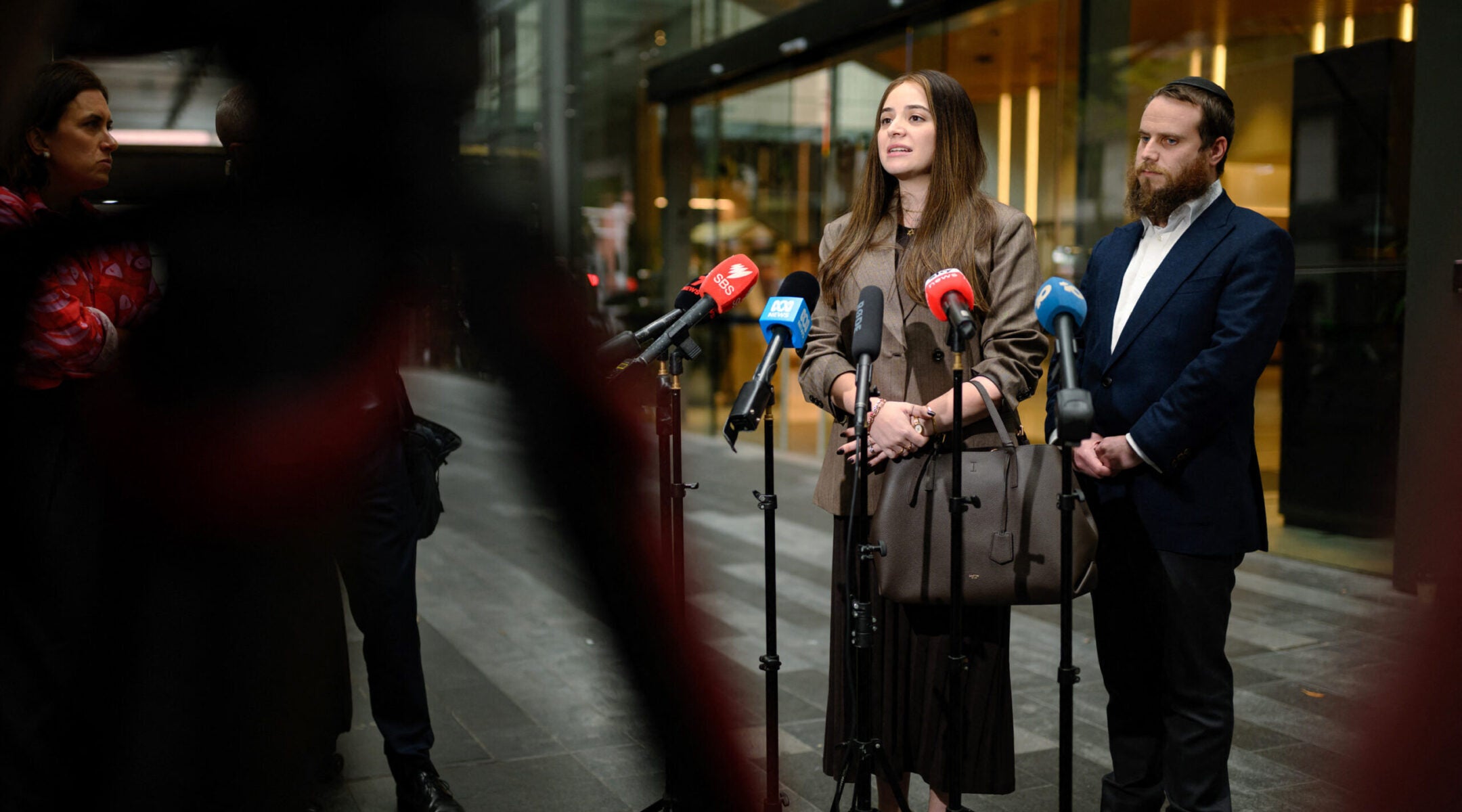
MELBOURNE — Six months ago, Sheina Gutnick was a 31-year-old mother of three at the end of her maternity leave. She had degrees in social science and psychology, and several years of experience worked at a Jewish school. She was an average mother looking to get back into a 9-to-5 routine after her baby started daycare.
Then, on the first night of Hanukkah, everything in her life changed.
Gutnick was at a Hanukkah party in Melbourne, Australia, with her husband and three children when she crossed paths with a friend from Sydney. He looked ghostly white and told her there had been a shooting at a Hanukkah party in Bondi. Her parents, who were visiting Sydney from their home in Melbourne, had been planning to attend.
“I immediately called my dad, but he didn’t answer. Then I called my mum and she answered and I could hear shooting, and she was screaming and told me they are shooting people on the beach and that my dad is running after the terrorists,” said Gutnick.
Her father, Reuven Morrison, would be one of 15 people murdered on Bondi Beach that night. Before he was killed, Morrison was filmed throwing a brick at the terrorists, charging toward them with whatever he could find, trying to shield his community with his body. The footage of his bravery against the terrorists would be seen around the world within hours. After diverting the terrorist’s attention from others, Morrison bled out on the beach after being shot 11 times. He was 62.
“At 7:13 p.m. I found out that my dad is no longer alive, and my first reaction was to tell my husband to get me on a plane to Sydney,” she said. “As I was standing at the doorframe to leave the house before I went to the airport, I turned to my husband and said, ‘This is the day our lives have changed.’”
Gutnick boarded the last flight from Melbourne to Sydney that night. She couldn’t stop crying, and a flight attendant asked what was wrong. “I told her that my dad had just been killed in Bondi,” she recalled. “She didn’t really know what to say, but told me, if you need vodka let us know, we’ll sort you out.”
Six months after the attack, the deadliest antisemitic incident in Australia and one of the bloodiest anywhere in recent history, Australia is still reeling. A royal commission is unearthing searing allegations of antisemitism and accounts of Jewish fear, and has started rolling out recommendations designed to shore up public safety and cohesion.
Gutnick, meanwhile, has vaulted into public view not just at home but abroad. This week, Anti-Defamation League CEO Jonathan Greenblatt posted a picture of himself with Gutnick on social media.
“I was honored to meet with Sheina Gutnick, daughter of Bondi hero Reuven Morrison z”l,” Greenblatt wrote. “Since Sheina’s father and 14 others were murdered by terrorists on Bondi Beach during Hanukkah, Sheina has tirelessly and relentlessly demanded that Australia take action against antisemitism. She is an inspiration.”
After throwing herself into speaking about her father, her experience and the challenges facing Australian Jews, Gutnick has now joined an international coterie of advocates transformed by their proximity to historic antisemitic violence.
“I get people saying to me, ‘Aren’t you exhausted?’” she said. “But the truth is, I get energy from it. I’m not a person that can sit when something has happened to me.”
The path that made Gutnick who she is was forged first in the former USSR, which Reuven Morrison left at 14 for Australia. Like many Soviet Jewish emigres, he knew little about Judaism when he arrived and for a time did not have much connection to Jewish practice in his new country, either.
But he became more religiously observant later in life, affiliating with the Chabad-Lubavitch movement that emphasizes outreach to Jews of all levels of observance. He became heavily involved in building Chabad of Bondi, a synagogue and community center in Sydney’s iconic beachfront neighborhood, helping to fight several legal battles while getting the building permits approved.
More than a decade ago, he moved to Melbourne. But the Sydney Jewish community, and especially Chabad of Bondi, remained close to his heart and he visited regularly. Its Chanukah by the Sea celebration, he decided, was one he would not miss.
Gutnick arrived in Sydney at 10 p.m., just a few hours after two men opened fire on the celebration, killing 15. Her father’s body still lay on Bondi beach, covered by a sheet, unable to be released for burial until all evidence had been collected from the scene of the massacre by Australian homicide detectives. She made her way to her uncle and aunt’s home, where her traumatized mother was waiting.
That night, nobody slept — and stories began trickling in.
“When I got there, we began hearing that my dad threw a brick at the terrorists. A lot of people started messaging me that he saved their lives based on actions that he took that night,” Gutnick recalled. “My mum had been on the beach and saw him running, and she saw when he went down, and she saw no one was helping and he ran to step in, but she hadn’t seen what he had actually done.”
An Australian homicide detective arrived at 1:30 a.m. to formally advise Gutnick and her mother Leah that Reuven had been murdered, and to explain the process for releasing his body back to the family for burial. It was slightly complicated, the detective told them, because this was Australia’s first major terrorist attack. The protocol was still being clarified.
“At this point, pure adrenaline and pure rage was running through my body, that this had actually happened. The fact that it was Bondi and it was my dad,” Gutnick recalled.
Gutnick returned to the apartment her parents owned in Sydney, situated right behind the Chabad of Bondi building, to collect a few things her mother needed. Outside, members of the Sydney Jewish community stood on the footpath alongside news crews and photographers. People on the street were crying.
Inside, Gutnick found her parents’ dog Simba who had come to Sydney with them, hungry and bewildered that he had been left alone since the night before. According to Jewish law, a Hanukkah menorah must be lit by each person in the place where they are spending the night. Reuven Morrison had set his up before leaving for the beach. On the table, it sat exactly where he had placed it, ready, unlit.
All the while, Gutnick’s phone kept ringing, with journalists asking her for comment. She felt, she recalls, like she was floating outside her own body.
“My mum was completely broken. Her world was torn apart; she has been with my dad for 42 years,” she recalled. “Every semblance of normal life was gone, she’s all of a sudden alone, she’s impacted in this way that is not humanely possible to comprehend.”
With dozens of media requests already flooding her phone, Gutnick ignored all of them — until she spotted one that was framed very differently.
The message came through Facebook from a producer at CBS News in the United States on Monday night, more than a day after the massacre, and it changed her life.
“I still hadn’t spoken to any media. They prefaced their message and said that they needed to help tell the world about my dad’s bravery, that they had seen the footage of him throwing a brick at the terrorists and they wanted to publicise it, so everyone knew about him and what he had done,” Gutnick recalled.
She felt compelled to respond: “It hit me so crushingly hard there is no one else to tell my dad’s story but me, so if I don’t do this, no one will hear about him and his bravery.
She messaged back, saying they could come to interview her the next morning. But CBS suggested they come right over immediately, in the middle of the night, so her interview could be aired on American prime time news. At 1 a.m., a full media crew arrived and Gutnick sat in front of lights that made her room feel like it was the middle of the day.
In the hours that followed, she wrote a personal reflection about what she believed her father’s death represented: a direct result of an Australian government that had been weak on antisemitism. After she circulated it, a prominent local Jewish figure whom she did not then know, the former treasurer of Australia, Josh Frydenberg, shared it on X, and it was republished widely. More media requests started flooding in and Gutnick started speaking about her dad.
“I realized how much I have on me to carry on my father’s legacy,” she said.
In between the interviews, she and her husband were on the phone to the Australian coroner and the chevra kadisha, the Jewish burial society, demanding that Australian authorities release her father’s body. A family friend, not knowing when the body would be released, flew his private plane from Melbourne to Sydney, ready to accompany Morrison home the moment his body was released. When that finally happened, a special flyover was arranged with the air controllers in Sydney so that the private plane with Morrison’s body could circle over Bondi Beach, in a final farewell to the place where Morrison had met his wife 42 years earlier.
Nobody who knew Sheina Gutnick Dec. 14 would have predicted what she’s done since. She says wouldn’t have predicted it either.
When Australian Prime Minister Anthony Albanese initially declined to call a royal commission into the Bondi attack and the broader rise of antisemitism in Australia, Gutnick, alongside other victim families, went to the front page of all of Australia’s major newspapers and called on him to reconsider. After weeks of lobbying, the prime minister relented.
When the royal commission convened, Gutnick was the first witness called to testify.
She described hearing “Free Palestine” shouted on the streets of Melbourne, chants that she said “not political expression but is explicit, targeted hatred and is designed to intimidate.” She recalled fearing the treatment her child would receive while undergoing surgery at a hospital where nurses had been fired after posting a viral video saying they would not treat Israeli patients. And she recounted being called a “f—ing terrorist” by a man she said had pointed at her Star of David necklace.
It was only one of countless stops to share her story. In the last six months, Gutnick has taken dozens of flights to meet with parliaments and groups to speak about her father and about Australian antisemitism. She has written in major national and international newspapers about her father and spoke at the Sydney reception for Israeli President Isaac Herzog.
She and her mother received condolence letters from across Australia and beyond. The one from King Charles, she said, was especially comforting. “He has an excellent team around him clearly, because it was such a beautiful, personalized letter, the one we received,” she said.
Her advocacy has been noticed at some of the highest levels within Australia’s Jewish community. “Sheina Gutnick never sought the public spotlight. She was thrust into it by the horrific murder of her father, and has responded with remarkable courage, dignity and moral clarity,” Jeremy Leibler, the president of the Zionist Federation of Australia, told JR. “Her advocacy has resonated because it is authentic.”
Alex Ryvchin, the co-chair of the Executive Council of Australian Jewry, the peak body for Australian Jews, knew Reuven Morrison for years before he was killed. “He was an outstanding human being and now Australia knows him as a hero who gave his life to save others,” he told JR. “Sheina honours his memory and legacy and I’m proud to stand with her in the fight against antisemitism.”
Rabbi Yehoram Ulman, the rabbi of Chabad of Bondi, whose son in law Rabbi Eli Schlanger and many close friends and congregants were murdered Bondi Beach also has deep appreciation for Gutnick’s advocacy.
She “emerged as one of the most compelling and eloquent new voices in Australia’s fight against antisemitism, transforming personal tragedy into sustained public advocacy,” he said.
After booking dozens of engagements independently, Gutnick was offered a role as the first public affairs officer of the recently established Australian branch of the Combat Antisemitism Movement, an international advocacy organization.
The group’s supporters argue that CAM is responding to a genuine rise in antisemitism and see it as trying to address problems that existing Jewish groups have failed to solve. They also argue that the group’s efforts to push back against anti-Israel sentiment are justified because anti-Zionism is often used as a vehicle for anti-Jewish prejudice.
CAM has indeed attracted criticism from other Jewish groups and civil liberties advocates who argue that it takes an overly broad approach to antisemitism and too often conflates anti-Zionism or criticism of Israel with antisemitism.
In Australia, the organization has also faced scrutiny over its political alliances, including relationships with some conservative and right-wing groups, as well as criticism that it imports American culture-war politics into debates about antisemitism.
Gutnick is aware of some of this criticism but isn’t really bothered by it. “Every organization has its controversial moments, so this stuff — it doesn’t really concern me,” she said. “The work CAM is doing now is so relevant in our lives in a post Oct.-7 world and a post-Bondi world,” she said.
In fact, she is grateful for the many connections they have helped her with both in Australia and around the world as well as their extensive research into antisemitism. “They gave me the ability to tell my dad’s story in many public spaces,” she said. “I continuously say, as Jews, we need to know the facts and figures on the ground about antisemitism, and what resolutions and legislation we need to have in place, and as an international org, CAM has the ability to help me do this.”
The royal commission has presented its first recommendations, designed to improve the processes that left the Bondi Hanukkah celebration with inadequate police protection despite the known threats. Soon, it is expected to say more — with a backlash to follow from those who believe that antisemitism is getting outsized attention and who say that efforts to address it will likely inappropriately constraint anti-Israel protest.
Gutnick doesn’t know exactly what the future will hold for her, but she knows that she will never return to where she stood six months ago — a spot that, in retrospect, feels like it may have been on the sidelines of the fight for Jewish security.
“As Jews, we are being faced with so much darkness,” she said. “I have gone through the worst thing — my father was killed for antisemitism — so I have become stronger, wanting to spread the message that no matter what happens, as the Jewish people we are one people, part of one faith, and although it’s terrible, this is something we have faced before.”
Reporting the stories that define our era. When history unfolds in real-time, the Jewish world turns to JR. Your support ensures we can document the complexities of war and the resilience of Jewish communities with integrity.