
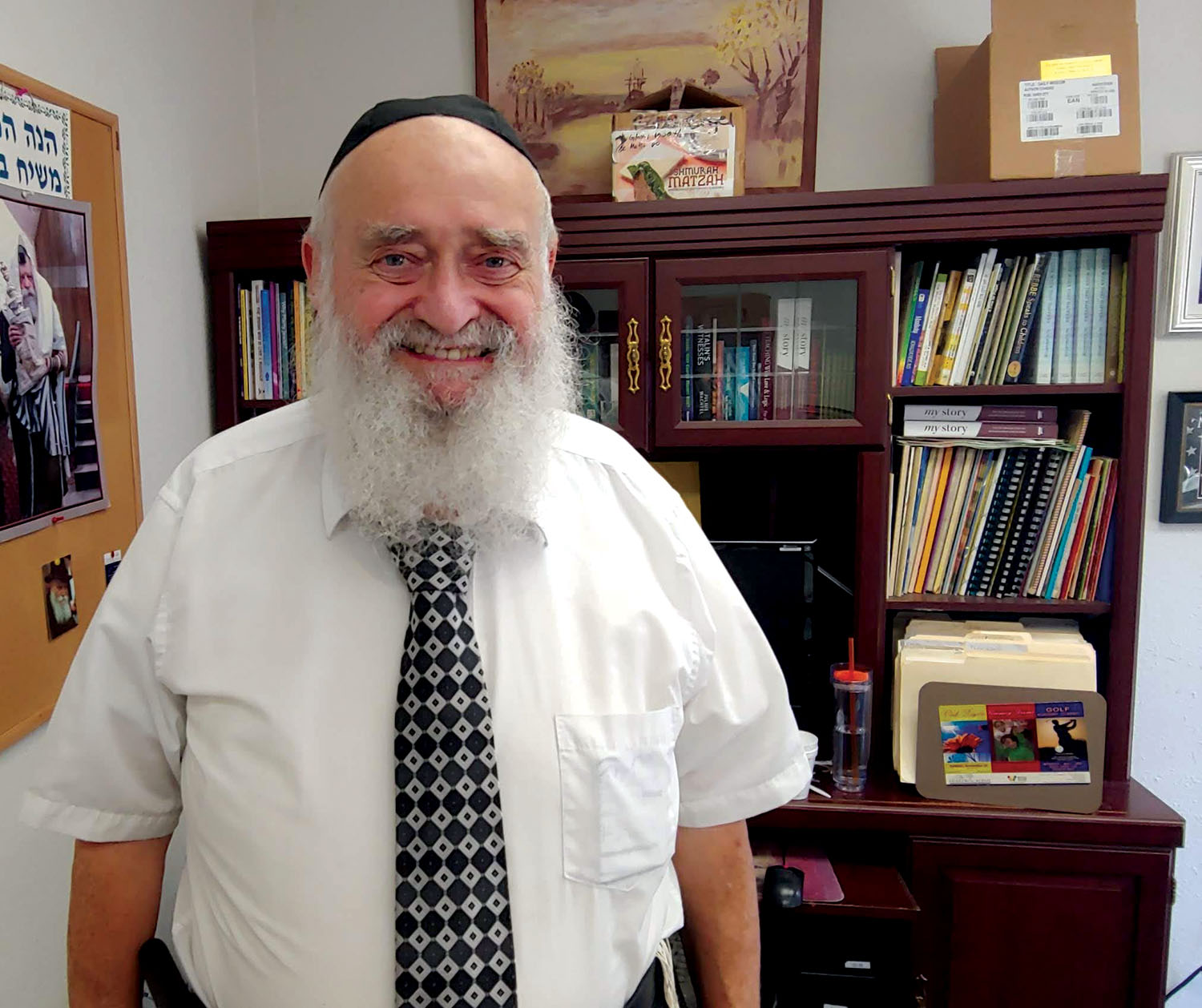
How does a rabbi become an author? Rabbi Moshe Engel described his unique route.
“Many years ago, when I was 50, I decided I am going to write a book,” the retired 78-year-old teacher said. “The book was going to be about positive thinking because I had an excellent story about the subject,” which he told in last week’s Jewish Journal.
But when “Shabbos in a Gas Station” was published late last year, a friend asked Rabbi Engel “What’s your second book?” The rabbi said, “There is none. These are stories that happened to me, and that’s it.” He thought, “I don’t have any more stories. What am I writing about?’ He surprised himself and soon changed his mind. “I do have stories,” the native Canadian told himself. “Stories started coming into my head. As they started coming, I wrote notes. Then I realized I had 70, maybe 80, stories.”
A friend of Rabbi Engel’s spent five years researching a book on the late Lubavitcher Rebbe. Rabbi Engel doesn’t have that kind of time.
When he sat down to write his second book, “Rabbi in the Hood,” his goal was “to inspire people by things I got inspired with or how I inspired others.” Like “Shabbos in a Gas Station,” the title story of “Rabbi in the Hood” is not what a reader – or even a friend of the rabbi’s – would expect.
But after he decided to write his second book, he landed in the hospital, “and a lot of things got in the way of the book,” Rabbi Engel said. His task was clear. “I have another 30, 40 stories to write,” he said. “I have them all written down.”
Two days later, he’s walking home and “four stories came into my head on the way from shul, which only takes 10 minutes. … Then more and more things that have happened to me came into my head.”
Rabbi Engel promises there will be a difference in “Rabbi in the Hood.” In it he will address “certain issues” people keep asking him about. “For example, men and women keep asking me – why in the Orthodox synagogue the man has the main role and the woman has the lesser role.”
He turned to Rashi, one of the most respected minds in Judaism, to explain why men and women move separately in the Orthodox universe. “The men are on the battlefront,” Rabbi Engel said, “and the women are keeping the homefront. Each is very important. I am going to show that while I am at shul, my wife is taking care of our kids, making sure they say the morning blessings, that it is just as important as the men’s duties in keeping Yiddishkeit going.”
He is confident the book is going to have the same flavor, the same kind of stories, but at the same time, he is going to address certain issues – for example, cremation and burial. “As we know,” Rabbi Engel noted, “Jewish tradition is against cremation. Nowadays, though, it has become so popular because of the costs. Second of all, Jews just don’t know that cremation is against Jewish law, which happens to be one of my pet topics.”
The rabbi gives away the secret behind the title of his second book. “The Rabbi in the Hood” is not about being in a perilous area. Instead, it’s a true story about a rabbi under the hood of a bus. A Jewish woman in Southern California has three daughters. All attend public school. On Easter, one daughter is assigned to a play where she is the mother of Jesus. The mother was not religious, but this casting freaked her out. She said to herself, “I’ve got to check out the Jewish school.”
Since it was near the end of the school year, first she decided she and her daughters should take a tour of the local summer camps. Ten minutes before she arrives, the camp’s bus driver – the author of “Shabbos in a Gas Station”– just happened to be returning to the camp grounds with a load of campers.
At that moment, the bus sputtered and died. Without a bus, he “can’t drive the kids home. I need a mechanic – quickly!”
Rabbi Engel called a mechanic he knew, then stepped out of the bus to check out the engine.
The futility of this hits him. He is the wrong rabbi to pass judgement about something as complicated as a school bus. He said to himself “I know as much about the inside of a car or a bus as I do about Chinese dancing. Nothing.”
The bus looked especially long to the rabbi. At that very moment, a mother arrived at camp with her three daughters. She walked into the office and said “I would like to speak with Rabbi Engel.”
Told he was out by the ailing camp bus, she saw the troubled rabbi sort of inspecting the troubled bus. “She sees me with my head in the hood of the bus, looking around, having no idea what I am looking at.”
The mother, of course, did not realize that. What she saw was a rabbi, a leader, deeply involved. She thought, “Now that’s the kind of rabbi I like. He gets involved in things. He’s not just an observer.”
That moment was a life-changer. She decided: “I am sending my girls to this camp.”
Her three daughters spent the next five years in Rabbi Engel’s school, the Hebrew Academy Jewish Day School in Orange County. Since then, Linda Labelson and her husband Ralph, a designer who creates objects out of metal, have developed a close relationship with Rabbi Yitzchok Newman, director of the Academy, and Rabbi Engel.
A few years ago, Rabbi Engel’s school decided to get into “The Guinness Book of World Records” by making the world’s largest latke. Ralph Labelson designed the entire latke space. The rabbi recalled that “we came very, very close to winning. All of the kids in the school participated. Every class got what goes into a latke, and they all made little doughs that went into the big one. The latke was as big as this room.”