
Israel’s Noam Bettan finished second at the Eurovision 2026 Grand Final in Vienna on May 16, giving Israel its second straight runner-up finish in the competition. Bettan performed “Michelle,” a Hebrew, French and English pop song, and finished with 343 total points: 220 from the public vote and 123 from national juries. Bulgaria’s DARA took first place with “Bangaranga.”
The result came four days after Bettan qualified for the Grand Final out of the first semifinal on May 12. Israel advanced alongside Greece, Finland, Belgium, Sweden, Moldova, Serbia, Croatia, Lithuania and Poland. It was the fifth time Israel qualified for the Eurovision final in the past six years.
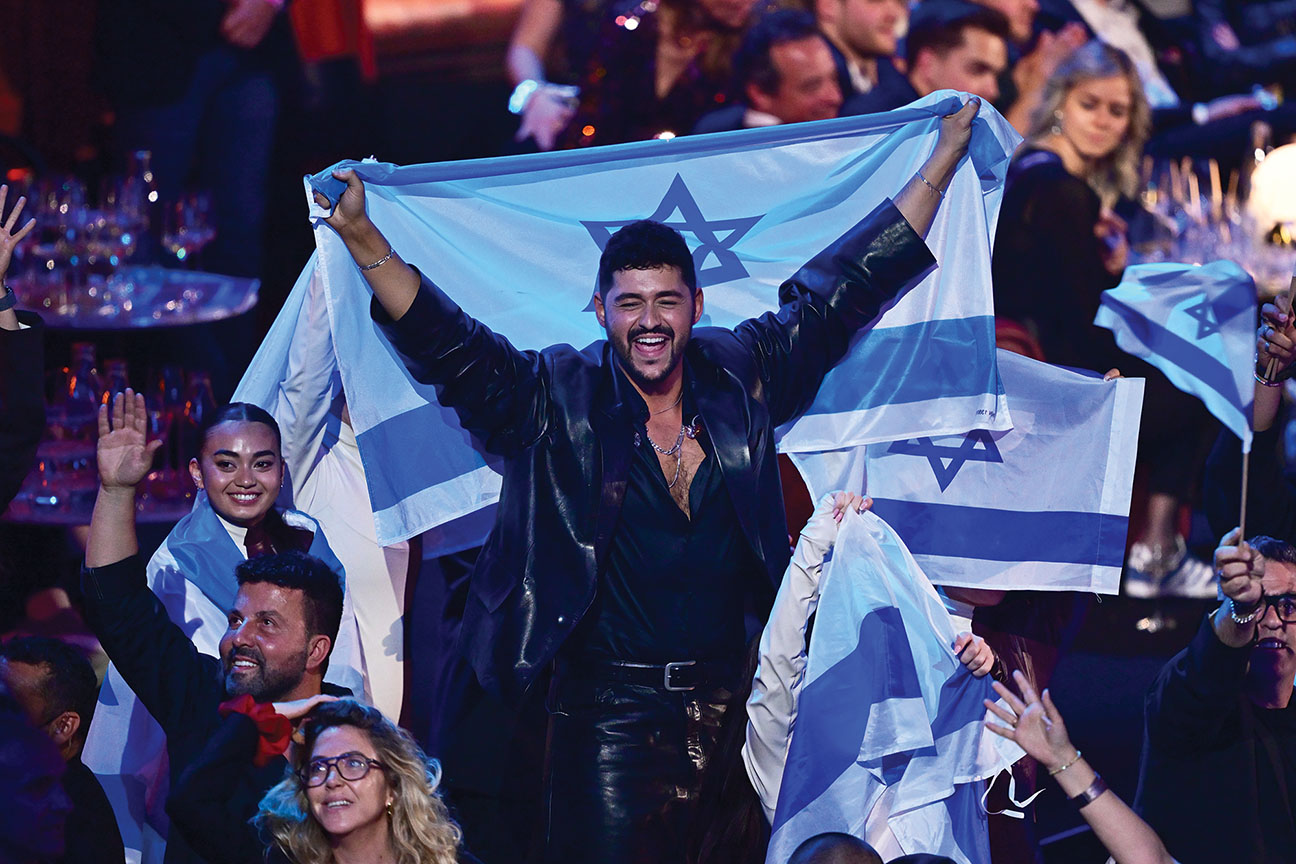
After the three-minute Grand Final performance, Bettan received applause from the audience at Vienna’s Wiener Stadthalle. Several Israeli flags were seen waving during the performance, and the cameras cut to fans wearing festive clothing adorned with Israeli flags.
He told Kan 11, “Wow, wow, wow. That was crazy. I felt more emotional than the previous times… I felt good, I felt I gave 100% in real time. It was crazy, it was fun, we’re done now… I love you, Am Israel Chai!”
On social media after taking second place, Bettan said, “I’m still processing everything and trying to find the words for this incredible journey. You guys are amazing and this is all because of you. I love every single one of you!” He added, “This is just the beginning, there are so many amazing things in the way!”
Israel briefly moved into first place during the results sequence after receiving its public-vote total. Bettan finished third in the televote, receiving the maximum 12 public-vote points from Finland, Portugal, Switzerland, Germany, Azerbaijan and France. The United Kingdom gave Israel 10 televote points, while Cyprus and Italy each gave Israel eight. Australia, Croatia and Lithuania were the only countries that gave Israel no audience points in the Grand Final.
Israel received fewer top public-vote scores than last year. Six countries gave Israel 12 televote points this year, compared with 12 countries that gave Israel the top public score in 2025. Israel also did not win the “Rest of the World” vote for the first time since that vote was introduced in 2023. It finished fifth in that bloc with six points.
The jury vote also helped Bettan. Poland’s jury gave Israel 12 points, while Ukraine gave Israel 10. Lithuania, Austria, Albania and Moldova each gave Israel eight jury points. Israel received jury points from 22 of the 34 voting countries, compared with 14 of 36 countries for Yuval Raphael in 2025. Bettan’s 123 jury points more than doubled Raphael’s jury total of 60 points last year.
Israel’s own votes also went to the eventual winner. The Israeli public gave Bulgaria 12 points, followed by Australia with 10, Moldova with eight, Italy with seven and Denmark with six. Israel’s professional jury gave its top score to Australia’s Delta Goodrem for “Eclipse,” followed by Denmark, Bulgaria, Finland, Moldova and Greece. Israeli mentalist Lior Suchard announced Israel’s jury results during the broadcast.
Before taking the stage, Bettan told Kan 11, “I feel good, I’m excited, I’m relaxed at the moment.” During Saturday’s rehearsal, Bettan said he heard boos that were “the loudest I ever heard,” but said many fans were cheering him on. “And we’re doing it for them,” Bettan said.
As with years past, there were some jeers from the live audience. During the final rehearsal before the live semifinal broadcast, Palestinian flags were seen in the crowd. During the live broadcast, chants of “stop the genocide” could be heard. The Austrian newspaper Österreich reported that two people disrupting the show were ejected by security. Bettan’s weeks of rehearsals included preparation for boos and a hostile reception.
Still, during Bettan’s final performance, there did not appear to be any noticeable disruption during the broadcast.
The song opens with Bettan singing over arpeggiated acoustic guitar. In the first verse, as he sings the lyrics “Oh Michelle,” dancer Lihi Freud appears by his side inside a diamond-shaped mirror stage prop. Bettan was wearing a black shirt under a black jacket with black leather pants. The spinning diamond then opened as the song’s first verse kicked up. They were then joined on stage by four backup dancers wearing half black, half white singlets.
Bettan is a 28-year-old singer-songwriter born in Ra’anana, Israel, to a French family. His breakout hit, “Buba,” was released in 2022 and has over 9 million listens on Spotify. His solo album “Me’al HaMayim” was released the following year.
Bettan secured his Eurovision spot by winning Israel’s reality singing competition “Rising Star” on January 20. He sang a cover of French pop star Indila’s “Dernière Danse” (“Last Dance”).
“Michelle” is a ballad about leaving a toxic relationship. Like Yuval Raphael’s “New Day Will Rise” at Eurovision in 2025, Bettan’s Eurovision song has lyrics in Hebrew, English and French. Raphael, a survivor of the Nova Festival massacre, took second place at Eurovision last year and is a co-writer of “Michelle.” Israel’s 2024 entry, “Hurricane” by Eden Golan, took fifth place. Bettan’s song is the first song since Noa Kirel’s “Unicorn” to not have any direct reference to the attacks of Oct. 7, 2023.
The song was selected for Bettan by an internal Kan Television committee from more than 200 submissions. Bettan told reporters after the selection that Israel was ready for “a different kind of energy” after sending several ballads in recent years.
Bettan also received support from other entertainment figures during Eurovision week. DARA, who won for Bulgaria, liked a clip of Bettan’s rehearsal performance. Before the final, Gal Gadot sent Bettan a video greeting and told him not to let the booing rattle him. “They don’t have any power over you… You’re amazing, and you’re talented, and we’re all behind you,” Gadot said.
Five countries boycotted this year’s Eurovision contest over Israel’s inclusion: Iceland, Spain, Slovenia, Ireland and the Netherlands. Ireland, Slovenia and Spain also said they would not broadcast the contest, while Iceland still planned to air it and the Netherlands’ sister broadcasters NOS and NTR planned to carry it through NPO 1.
In Vienna, organizers had given each competing country a themed café. According to the Jerusalem Post, Israel’s café was vandalized before the semifinal with anti-Israel graffiti found on a bathroom wall; it was removed after police arrived. Café owner Liza Vigenstein downplayed the incident, saying Vienna was full of security and “felt safer than Berlin.”
Anti-Israel protests also took place in Vienna throughout the week. Police increased security around the contest, barred protests near the 16,000-seat arena and banned all political materials besides national flags. Austrian police also assigned two elite units to protect the Israeli delegation. Ynet reported that hundreds attended the protest, which was billed as a “concert against genocide” under the slogan “No Stage for Genocide.”
Creative Community for Peace said the result showed public rejection of the cultural boycott of Israel. “The Eurovision Song Contest results sent a resounding message: the public rejects the cultural boycott of Israel,” the organization said. “Despite months of coordinated pressure, intimidation campaigns, and calls to exclude Israel from the competition, audiences across Europe and around the world delivered one of the strongest public vote totals of the night in support of Israel’s entry and contestant, Noam Bettan.”
Israel has participated in Eurovision since 1973 and has won four times: 1978, 1979, 1998 and 2018. Bettan’s second-place finish gives Israel a second straight runner-up result and another strong public-vote showing after recent entries by Noa Kirel, Eden Golan and Yuval Raphael.