
More than 500 rabbis, cantors and Jewish communal leaders have signed onto a letter calling on Israel’s ambassador to the United States, Yechiel Leiter, to rescind and apologize for remarks describing J Street as a “cancer within the Jewish community.”
The letter, which J Street shared with the Jewish Telegraphic Agency on Thursday, accused Leiter, a Netanyahu appointee and former settler leader, of using language that “dehumanizes fellow Jews” during his remarks in Washington, D.C., on Monday.
J Street is the leading liberal pro-Israel lobby, and has increasingly staked out positions that have departed from other mainstream pro-Israel groups. Last month, the group announced its opposition to continued U.S. military aid to Israel, which Leiter decried in his remarks.
The signatories wrote that while Judaism embraces vigorous debate, disagreements must be conducted with “humanity, humility and respect for the dignity of every Jew.”
“At this painful and polarized moment in Jewish life, leaders on both sides of the ocean bear a heightened responsibility to lower the flames rather than fan them further,” the letter read. “We therefore call on you to retract your remarks and issue a public apology to the many American Jews, rabbis, cantors and communal leaders who have been hurt by them.”
Among the signatories were New York Rep. Jerrold Nadler, former U.S. ambassadors to Israel Daniel Kurtzer and Tom Nides, National Council of Jewish Women CEO Jody Rabhan, Union for Reform Judaism President Rabbi Rick Jacobs and Rabbi David Saperstein, the director emeritus of the Religious Action Center of Reform Judaism.
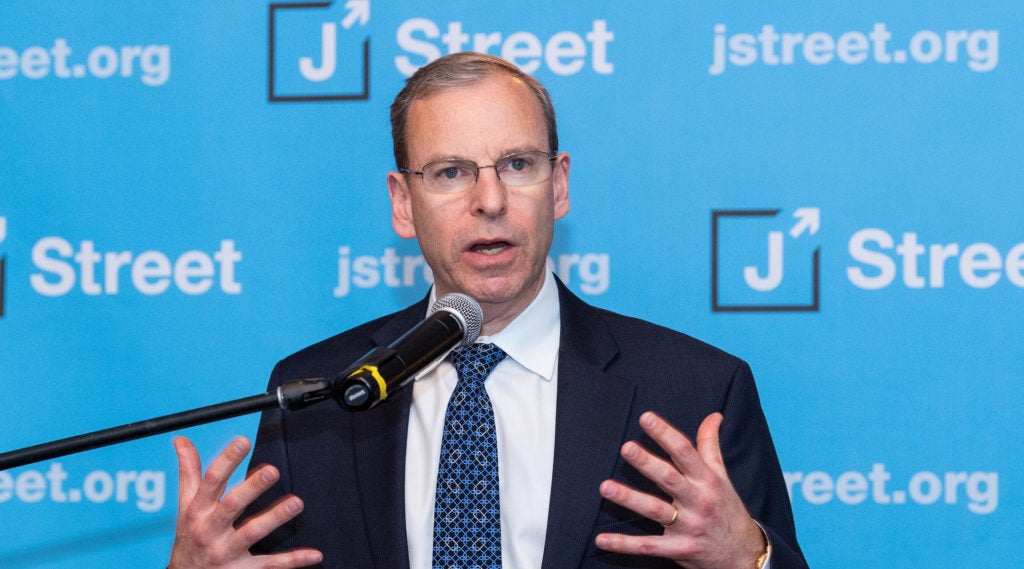
J Street President Jeremy Ben-Ami told (JEWISH REVIEW) that his initial reaction to Leiter’s comments was “simply dismay on behalf of Israel and on behalf of the Jewish community.”
“It’s a shame, because Israel, right now, needs all the friends it can get, and it really needs diplomats who seek to open doors and not slam them in people’s faces,” Ben-Ami said.
The Israeli Embassy did not immediately respond to a request for comment from (JEWISH REVIEW).
The comments from Leiter follow a long history of criticism of the lobby from pro-Israel officials. In 2017, former U.S. ambassador to Israel David Friedman called the group “worse than kapos,” a reference to Jews who aided the Nazis during WWII.
While Ben-Ami said that the latest attack was “not new,” he felt spurred to craft a communal rebuke of Leiter’s rhetoric because he felt it was “breaking” not just the US-Israel relationship, but the relationship between the “American Jewish community and the Israeli Jewish community.”
“Within 24 hours we had hundreds and hundreds of people, and I think it just shows what a raw nerve Ambassador Leiter has touched here, and just what a big mistake it is for the Israeli government to write off the majority of Jewish Americans who are deeply critical of the government but supportive of the state and the people,” Ben-Ami said of the number of signatories.
While Ben-Ami said that J Street had long been invited to meet with former Israeli ambassadors, he claimed that since Leiter arrived, the group had been “blacklisted by the Embassy, and there’s been no engagement whatsoever.”
The letter comes as J Street has also faced scrutiny from across the political aisle, with the Zionist Organization of America calling for Hillels, Jewish Community Relations Councils and federations to cease relations with the group, while the student government of Sarah Lawrence College rejected an application to form a chapter of the group on its campus.
“There’s going to be people to our left who are intolerant and you know engage in similar tactics to folks on the right who are intolerant and try to shut out those they disagree with, and that is just as disturbing,” Ben-Ami said.
Looking ahead, Ben-Ami said that he hoped the letter would serve as a reminder that Jewish leaders need to make room for ideological differences rather than treat dissent as disloyalty.
“The message more broadly here is, we need to embrace the diversity of opinion,” Ben-Ami said. “We need to embrace our disagreements and recognize that that is indeed part of Jewish tradition.”
Reporting the stories that define our era. When history unfolds in real-time, the Jewish world turns to (JEWISH REVIEW). Your support ensures we can document the complexities of war and the resilience of Jewish communities with integrity.