
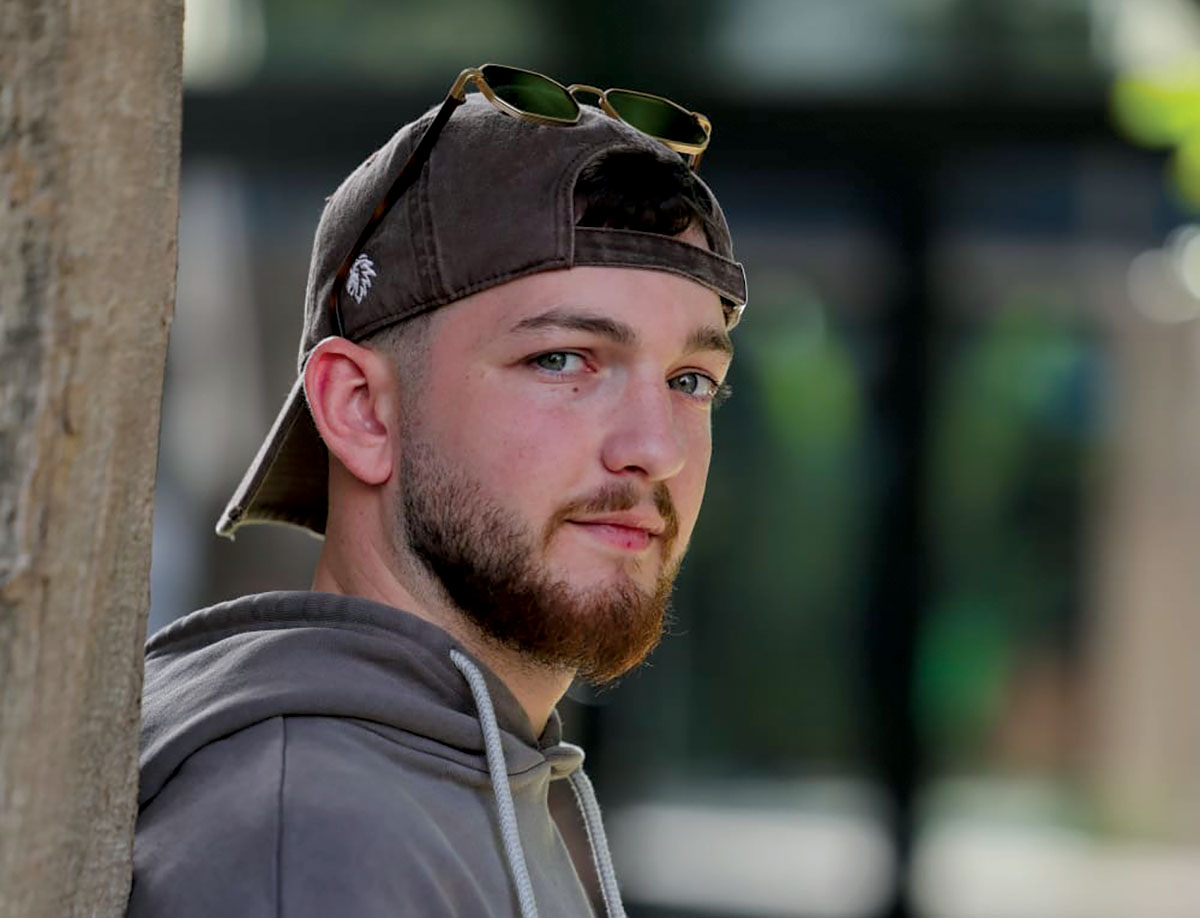
On April 1, Bar Kupershtein celebrated his 24th birthday and his first Passover with his family in Israel since being kidnapped by Hamas on Oct. 7, 2023. Kupershtein had been working as a paramedic and deputy security officer at the Nova music festival when he was abducted. He spent 738 days in Gaza’s tunnels, enduring severe physical torture.
In his book “Unbroken,” published in Hebrew by Yedioth Sfarim just before Passover this year, Kupershtein recounts his harrowing experience in Hamas captivity. He writes about the holiday he spent underground in Gaza, forced to dig tunnels with his bare hands under the watch of his captors. He was held in complete darkness nearly 50 meters underground, with little air and no certainty about his fate. Kupershtein endured extreme hunger, inhumane conditions and constant psychological torment. Yet even in those depths, he fought daily to preserve his humanity.
“Six months since the abduction, and Passover is approaching — the holiday of freedom — and with it, my birthday,” he writes. “We have no matzah, of course, and no birthday cake, but suddenly the terrorists throw out a comment: ‘They tried to bring matzah for you prisoners, but they didn’t give food to us Gazans.’ That casual, seemingly meaningless sentence encourages me like a small gift. Despite having no medicine, no conditions and certainly no matzah, it is a greeting from home. They are thinking of us. They have not forgotten us.”
The book also recounts the story from the perspective of Kuperstein’s parents, Julie and Tal. Julie had to stay strong for her four younger children and her husband, who was a volunteer with United Hatzalah and was severely injured seven years ago after stopping to help victims of a car accident. He suffered a stroke that left him permanently disabled and confined to a wheelchair. Bar supported the family financially by taking on odd jobs, something he was allowed to continue even after enlisting in the IDF. His status as a soldier was kept secret out of concern that it could lead to harsher retaliation and further torture.
This, of course, didn’t prevent Hamas from torturing him — at one point, he was beaten until he lost consciousness
“My child will be 22,” Julie Kupershtein writes. “I wonder how to mark that day. I don’t want balloons or cakes. I am searching in my own way for him. What will Bar do without matzah? The child who was born on Passover and has never eaten leavened bread on the holiday.”
She turned to contacts involved in efforts to help the hostages and asked them to try to send matzah through a humanitarian convoy.
“Through the military and relevant negotiating channels, I send the following message: ‘My Bar has been held hostage in Gaza for 188 days. I wish he and the others will not be there for Passover. Bar is Jewish. Bar has never eaten leavened bread on Passover. Bar will not eat leavened bread on Passover. I fear for his life.”
Working on the Sabbath had caused inner conflict and discomfort for Kupershtein, especially in relation to his mother, who turned Orthodox 14 years ago. However, because the family needed the money in order to move into a more accessible rental apartment, he could not give up the job. He had tried to refrain from working on Shabbat but was told by the head of security that he was urgently needed that day. “I called my mother and told her I wouldn’t be coming home for the holiday because I had to work,” Kupershtein recalled. His mother told him she wasn’t upset. Later, he would revisit that decision, wondering what might have happened had he stayed home for Simchat Torah. He might not have been kidnapped.
That thought was ultimately put to rest after he met a police detective who told him that his actions on Oct. 7 had helped save more than 2,000 people at the Nova festival. When Hamas militants launched their attack, Kupershtein had an opportunity to escape — but chose to stay and treat the wounded until he was abducted and taken into Gaza.
“I’m often asked if I would have done anything differently that day,” Kupershtein said during one of his lectures in the U.S. “My answer is always no. I would have done exactly the same.”
A couple of days before Passover, Kupershtein visited the office of Israeli President Isaac Herzog, and gave him a copy of the book. He also played a recording of the president from Holocaust Remembrance Day the previous year, in which the president vowed to do everything possible to bring the hostages home. Kupershtein described how, deep inside the tunnels, the hostages who heard the president’s words on the radio drew strength and renewed hope from them.
Being in captivity, Kupershtein writes, made him realize what truly matters. He felt that God had saved him, sending signs that things would eventually be okay and that he would survive. On his 23rd birthday, while 30 meters underground, he heard his mother speaking on the radio — a rare moment when they managed to find a frequency. In his book, he writes, “I wake everyone up and we huddle around the radio. Her incredible voice comes out of the device.”
Julie invited people to arrive at the Hostage Square in Tel Aviv to study Torah together and pray for the safe return of the hostages. “I can’t stop the tears from the emotion, and I cry such a big cry. There, this is Mom, this is that incredible woman I know. Mom usually doesn’t agree to be interviewed or photographed, and if she goes on the radio on my birthday it’s crazy, a special gift for me.”
When Kupershtein was 10 years old, his mother became observant, a change he initially resisted as he chose to remain secular. Yet in the tunnels, something shifted. He made sure to recite Kiddush, sing Shabbat songs and found himself longing for a deeper connection to Judaism. Each morning, he would wake up and pray, promising that once he was released, he would begin putting on tefillin.
Kupershtein also dedicated a special section of the book to commemorating the 2,032 soldiers and civilians who were killed on Oct. 7 and during the war, with their names appearing at the end.
On April 12, Kupershtein will travel to the United States to share his remarkable story in coordination with the Mitzvos for the Israel Defense Forces (IDF). The organization, led by Rabbi Dovid Caytak, is dedicated to raising funds to support the spiritual and physical well-being of IDF soldiers.
Bar Kupershtein will be speaking in Los Angeles on April 21, 22, and 23 at Aish Hatorah, Hillel Hebrew Academy, and a community gathering. Communities interested in hosting Bar Kupershtein or arranging a speaking engagement, email at [email protected].