
This article was produced by the events team at 70 Faces Media, the non-profit organization that publishes (JR) and the New York Jewish Week.
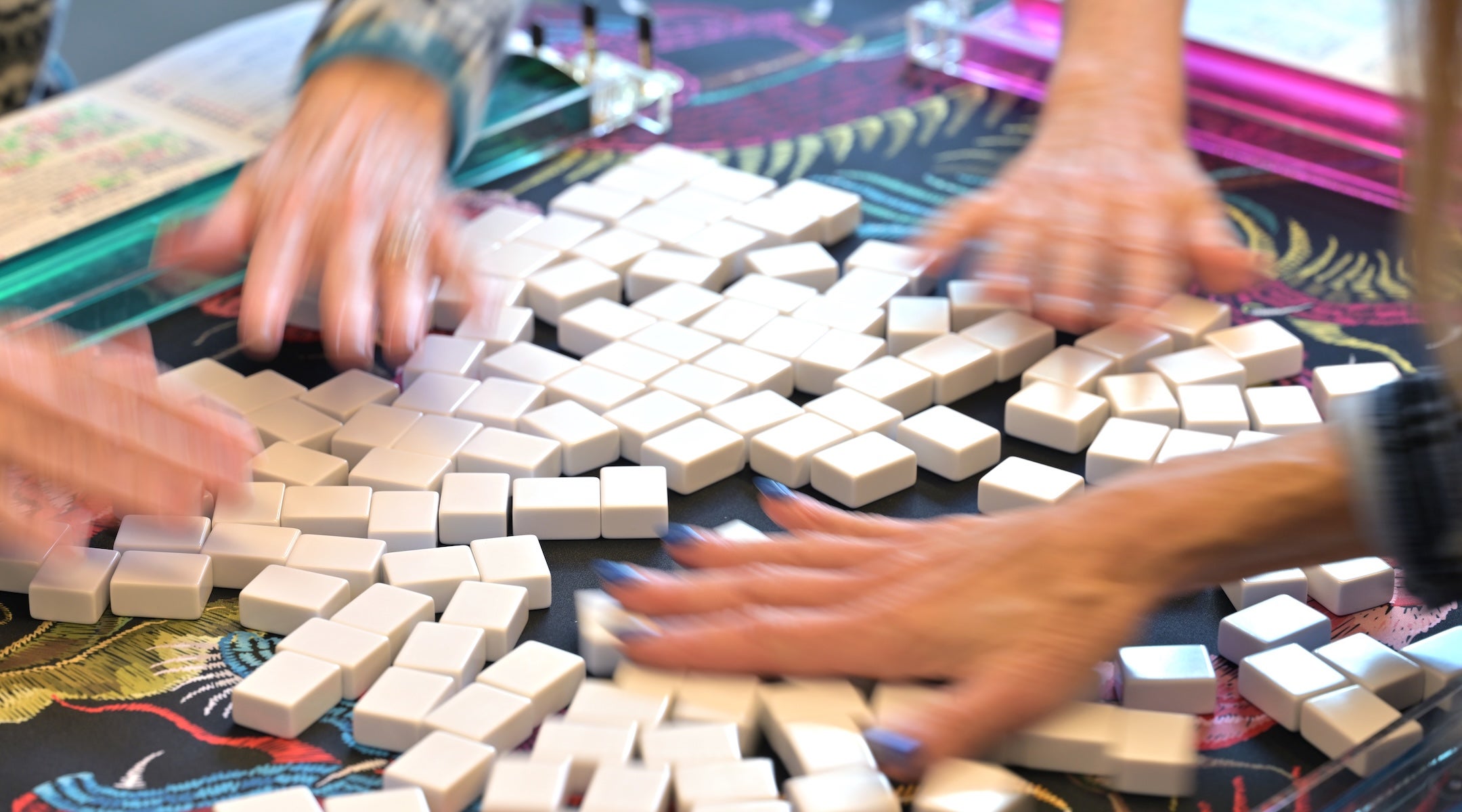
It’s no secret: Mah jongg is having a major moment.
The historic Chinese game — first popularized in the United States more than 100 years ago, then nurtured by Jewish women starting in the World War II-era to the present day — is arguably more popular than ever before. There are myriad reasons for this, starting with the COVID-19 pandemic, when online classes, games and tournaments surged in popularity.
Since then, the rummy-like, tile-based game — known in previous decades as a game favored by grandmothers — has caught on among younger generations. These days, there’s been a massive surge in mah jongg content on social media, mah jongg clubs are popping up in American cities from coast to coast and, this past spring, the Hallmark Channel even debuted a movie about the game, “All’s Fair in Love and Mahjong.”
And now, at the height of the craze, 70 Faces Media, together with our partner site, Kveller, and the founders of Modern Mahjong, will host New York City’s first-ever New York Jewish Mah Jongg Festival this Sunday and Monday, June 28 and 29, at the Museum of Jewish Heritage in Lower Manhattan (36 Battery Place).
“Having an in-person event in New York City is amazing, to feel the electricity of everyone coming together, connecting in person with our mah jongg community,” said Dara Collins, who co-founded Modern Mahjong with Donna Kassman in 2019. Since then, the longtime friends and former lawyers have taught more than 10,000 people how to play, including through online Kveller courses.
“It’s wonderful to be online and be able to play — it got us through the pandemic — but to be able to get over 300 people in one space, all sharing the love of a game, is just great,” Collins added.
The two-day event combines mah jongg classes for all levels, social and tournament play, as well as panel discussions on the history and the popularity of the game. There will also be networking opportunities, free lunch and snacks (including mah jongg-themed food), specialty vendors selling mah jongg merch and a visit each day from the Manischewitz food truck.
“While most mah jongg gatherings across the country are focused solely on tournaments, or on only playing the game, we have created a true festival experience that goes beyond the gameplay,” said Gabe Friedman, 70 Faces Media’s director of editorial experiences, who is the main organizer of the festival. “It’s a celebration of the Jewish American connection to the game.”
Mah jongg (also spelled mahjong) originated in China in the 1800s. It first became popular on American shores in the 1920s thanks to Joseph Babcock, an American businessman who learned the game while living in Shanghai. Like flapper dresses and the Charleston, however, the craze quickly died off.
In 1937, however, a group of devotees to the game — Jewish women, all — came together in New York to create the National Mah Jongg League. These women standardized the rules and hands, and created the tri-fold card that is updated annually “to add more excitement to the game.”
The American version of the game caught on quickly among Jewish communities, becoming a fun and powerful way to bring Jewish women together everywhere from suburban living rooms to synagogue social halls to Borscht Belt resorts.
“In effect, mahjong served as a way for Jewish Americans to distinguish their evolving ethnic identity,” Anneliese Heinz, a history professor at the and author of “Mahjong: A Chinese Game and the Making of American Culture,” wrote in The Wall Street Journal. “As mahjong ceased to be widely popular and became particularly associated with Jewish women, it subtly marked a space apart from mainstream Christian society.”
Additionally, a charitable aspect was woven into the American version of the game from Day 1. “From the very beginning, if you bought a card [from the National Mah Jongg League] — and at the time I think it was 10 cents, and then it went up to 35 cents — a few cents, and now several dollars, go to the charity of your choice,” Collins said.
“Mah jongg has been adopted by generations of Jews as a game that brings people together,” said Joshua Mack, the Museum of Jewish Heritage’s senior vice president of marketing and communications. “We’ve had smaller mah jongg events in the past, and they have been very popular, so when 70 Faces approached us, we leaped at the opportunity to introduce lots of new people to the museum.”
Today, more than 40 different styles of mah jongg are played around the world. Influencer and advocate Amy Alberston — a Chinese-American Jewish woman who lived in Israel for several years — will be speaking on a panel discussion about the various cultural perspectives on the game on Sunday, along with Sara Loffman, a co-founder of the small business Challah Back Girls, and Sokie Lee, a mah jongg instructor who frequently works with The Museum of Chinese in America.
“There’s a lot of overlap between the Chinese community and the Jewish community in America — particularly in a place like New York, and also in the Bay Area, where I live,” said Albertson, who regularly plays with her Chinese-American grandmother and her caretaker. (Her Jewish grandmother, meanwhile, told Albertson that her game “was not for beginners.”)
“I love nothing more than finding the similarities or the connecting points between my two heritages and cultures,” Alberston added. “So, for me, mah jongg is like just one of the most fun ones that exist.”
Westchester resident Daniela Taitel, who recently launched her own business, Mahj Atelier, is looking forward to connecting with likeminded people at the New York Jewish Mah Jongg Festival. “When you’re at the table, nobody’s asking you what your religion is, what your politics are — they just want to know how well you can play,” she said. “There’s a sense of return to humanity when we’re all playing together at the table.”
By playing mah jongg, she added, “I think there’s a sense of sisterhood that you really can’t find any place else.”
The New York Jewish Mah Jongg Festival will take place at the Museum of Jewish Heritage-A Living Memorial to the Holocaust on June 28 and 29. Tickets for Day 1 are sold out, but players interested in joining the Day 2 tournament can purchase tickets here.
Jewish stories matter, and so does your support. The New York Jewish Week brings you the stories behind the headlines, keeping you connected to Jewish life in New York. Help sustain the reporting you trust by donating today.