

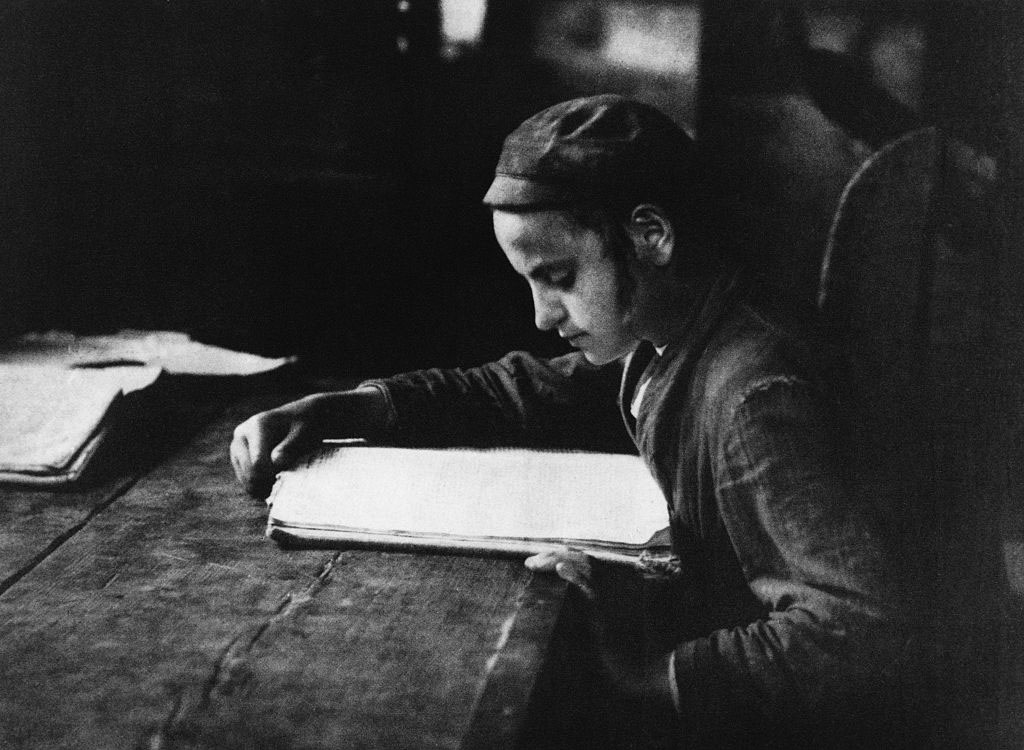
Study of the Talmud teaches us that the goal of studying any text
should not be to find answers to a problem but
to the generation of questions about problems that have vexed
the reader while studying it. The text’s not used as a short cut
to finding in the words that it contained a literary solution
to problems in the questions that the text had raised,
this rationale for reading the source of their intellectual evolution,
and the reason why what is problematic in any text is what should be praised.
While Rashi’s explanations of the Talmud text are nearly always indispensible,
the questions they cause Tosaphot to ask don’t always provide answers that are sensible,
but generate talmudically in the texts a spiritual evolution
which enables scholars to stand on their heads in order to provide for all the questions a solution —
standing on one’s head a way to climb talmud texts which are trees of knowledge
that evolution enabled us to climb this way, one that is not taught in any yeshivah or college,
such evolution providing us with the prime program that prevents pollution
caused by progressive processes like those now threatening our nation with dismaying dissolution.
In “Many schools fail to instill a questioning mindset. Studies suggest most questions in the classroom are posed by teachers to students,” WSJ, 8/4/26, Andrew Stark writes:
Hilary Putnam often gave his Harvard philosophy students a final exam consisting of an unusual challenge. He instructed each student to decide on what questions the examination should include—and then respond to them. It was a devilish test. If a student came up with questions that were too hard, answering correctly would be a struggle. But if the questions were too easy, the student would lose marks for asking puffballs.
Interestingly Deuteronomy implies thatit provides solutioins to all the questions the king may ask. In “The Origins of Constitutional Thought—Found in Deuteronomy,” thetorah.com, Bernard Levinson writes in thetoraah.com:
https://www.thetorah.com/article/the-origins-of-constitutional-thought-found-in-deuteronomy
In the end, there remains for the king but a single positive duty: to “read each day of his life”—while sitting demurely on his throne—from the very Torah scroll that daily circumscribes his powers, with its legal paragraph containing Deuteronomy’s Law of the King:
דברים יז:יח וְהָיָה כְשִׁבְתּוֹ עַל כִּסֵּא מַמְלַכְתּוֹ וְכָתַב לוֹ אֶת מִשְׁנֵה הַתּוֹרָה הַזֹּאת עַל סֵפֶר מִלִּפְנֵי הַכֹּהֲנִים הַלְוִיִּם. יז:יט וְהָיְתָה עִמּוֹ וְקָרָא בוֹ כָּל יְמֵי חַיָּיו לְמַעַן יִלְמַד לְיִרְאָה אֶת יְ־הוָה אֱלֹהָיו לִשְׁמֹר אֶת כָּל דִּבְרֵי הַתּוֹרָה הַזֹּאת וְאֶת הַחֻקִּים הָאֵלֶּה לַעֲשֹׂתָם. Deut 17:18 When he comes to sit on the throne of his kingdom, he shall have a copy of this Torah written for him upon a scroll in the presence of the levitical priests. 17:19 It shall remain with him and he shall read in it all the days of his life, so that he may learn to fear YHWH his God by diligently performing all the words of this Torah and all the statutes.
Deuteronomy has reduced the king to mere titular head of state. The sole potent authority is the Deuteronomic Torah, the very lawbook in whose original reception, formulation, transcription, and implementation Deuteronomy’s king plays absolutely no role.
Gershon Hepner is a poet who has written over 25,000 poems on subjects ranging from music to literature, politics to Torah. He grew up in England and moved to Los Angeles in 1976. Using his varied interests and experiences, he has authored dozens of papers in medical and academic journals, and authored “Legal Friction: Law, Narrative, and Identity Politics in Biblical Israel.” He can be reached at [email protected].