
Russia’s war with Ukraine may have slipped from the front pages of American newspapers, but in Ukraine, where I live, it’s inescapable. As August ended, a Russian strike on a shopping center in my city injured 136 people, 26 of them children, as families were readying kids for school. Sixteen people died. Since Russia’s full-scale invasion began on Feb. 24, 2022, some 150,000 Ukrainians have been killed, among them roughly 200 Ukrainian Jewish soldiers — an enormous loss for our small community.
War doesn’t pause ordinary life; it plunders it. Before the war began, getting to New York from my hometown, Kryvyi Rih — an industrial city in central Ukraine — meant a seven-hour overnight train to Kyiv and then an 11-hour flight. But now, as I prepare to make that same trip, I have to take a 24-hour minibus ride to Warsaw, because Ukrainian trains are too often disrupted by strikes and damaged tracks. After an overnight stay in Poland, I’ll finally board a flight to the U.S. A trip that used to take one day now takes nearly three to reach the rooms where Ukraine’s future is decided.
This means that during Rosh Hashanah and Yom Kippur this year, I’ll be far from my Jewish community in Kryvyi Rih. Russian attacks don’t pause for Jewish holidays, and neither do the people working to decide Ukraine’s future. As the CEO of Project Kesher Ukraine, a Jewish feminist leadership organization, I will be visiting New York and Washington because this month Congress is weighing Ukraine support, the UN General Assembly is taking up the war’s toll on women and the Clinton Global Initiative’s Ukraine Action Network is convening. My colleagues and I will be in rooms advocating for the Ukrainian Jewish community and the women of Ukraine, and we’ll also seek out potential partners to ensure that we can leverage our limited resources.
Because this trip coincides with the High Holidays, I will seek out moments for prayer and reflection. But I will spend most of Rosh Hashanah and Yom Kippur doing what Rabbi Abraham Joshua Heschel famously described as “praying with my feet” — showing up where I am needed, for the Jewish people and for Ukraine.
In Ukraine, we measure what war has done not only in distances and hours, but in how much uncertainty it forces into everything. We don’t know what winter holds, or when this violence ends. But we don’t need to wait for the war to be over in order to decide what kind of country we’re building. That future is already taking shape.
Ukrainian Jews are creating something new
War has forced Ukraine’s Jewish community to face questions we might otherwise have put off: Who are we, where do we belong, what do we want? Our history encompasses centuries of Jewish creativity and connection alongside antisemitism and violence. We don’t need to flatten that history. At the same time, we won’t let the darkest parts be rebranded as patriotism, or let antisemitism find a place in Ukraine’s future.
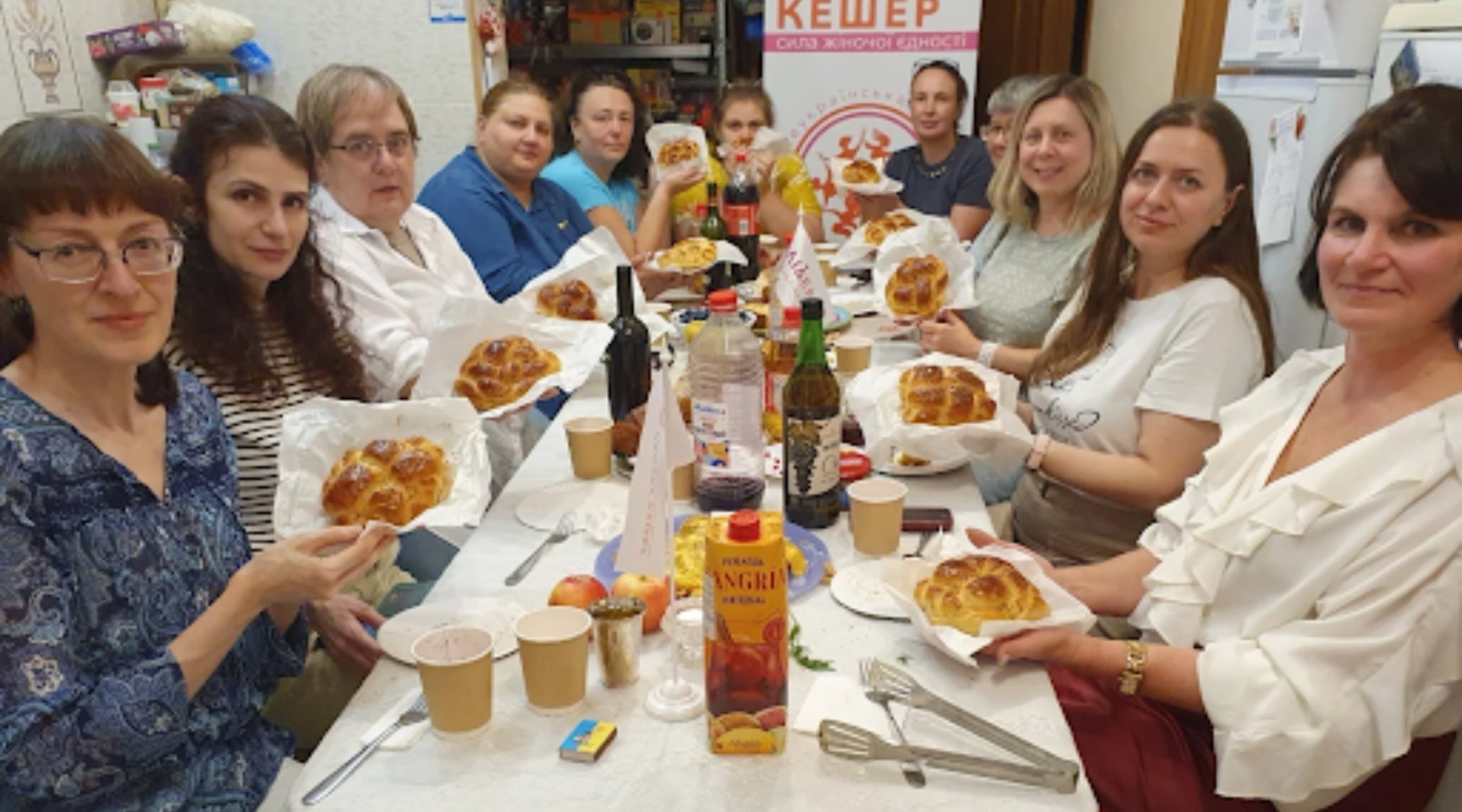
We now have a chance to define what it means to be a Ukrainian Jew in a modern, democratic, European Ukraine. At Project Kesher Ukraine, we endeavor to continue to build Jewish life in Ukraine as well as support Ukrainian women, many of whom are the economic engine of the country and are suffering from displacement. Project Kesher takes its name from the Hebrew word for “connection,” and our aim is to link Jewish identity to Ukrainian identity and to the history we’re currently writing.
Despite the war, Jewish life in Ukraine isn’t disappearing; in many places it continues to thrive. Prior to the war, Project Kesher had spent nearly three decades building a pipeline of Jewish leaders and creating Jewish curriculum for students. With the displacement of many in the Jewish community, Project Kesher has regrouped to rebuild this network of leadership. We are adapting our programming to wartime conditions as well as the emergence of Ukrainian, and not Russian, as the language of the Jewish community. In 2025–26, our Jewish Weekends drew more than 5,000 participants nationwide. We keep investing in Jewish education and leadership — including a new Ukrainian-language siddur and our sixth Ukrainian-Jewish calendar — with support from UJA-Federation of New York, JUF Chicago and the Schusterman Family Foundation.
Over the years we’ve placed 16 Torah scrolls in Ukrainian communities, moving them as displacement demands. In August, we relocated a Torah gifted by Temple Beth El in Helena, Arkansas, from Vinnytsia, a city now too close to the front, to Chernivtsi, where a Masorti community used it this summer with 215 campers and will keep it for the High Holidays. Against the scale of war, this might look small, but it isn’t. It’s proof people are still gathering, praying, asking who they are — building community during the war, not after it.
Project Kesher Ukraine CEO Vlada Nedak. (Courtesy Project Kesher Ukraine)
The next Ukraine is already emerging
I see the same drive across Ukrainian society. Books about the wartime experiences and post-war vision of Ukraine are being published, and opportunities to demonstrate Ukrainian creativity through art, festivals and exhibitions happen regularly, even as cities remain under fire. People are arguing over history, language, memory, identity — imagining what Ukraine should become now, not someday.
For instance, in early August I was at BestsellerFest, a book festival in Lviv, listening to Artur Dron, a writer and soldier who’s been called a “rising star in Ukrainian literature.” Looking around the room filled with people in their 20s and 30s, I thought: Here they are, the generation after mine.
We spend a lot of energy worrying about the Ukrainians who’ve left, wondering if they’ll return. But that worry can crowd out something just as important: the people who stayed. They aren’t waiting for the war to end before building — they’re writing, making art, raising children, sustaining communities. They aren’t surviving until the future arrives. They’re making it.
What are we enduring for?
As the months go by, I believe less and less in the word “after.” We won’t wake up one morning to the war’s end and step back into the lives we left in February 2022. That world is gone. A new one is forming — during air-raid alerts, on delayed trains, in books written by young soldiers, in packed festival halls, in Ukrainian translations of Jewish prayer.
That’s why survival can’t be the whole story when we ask the world to stand with Ukraine. Ukraine needs humanitarian aid and military protection. But it also needs the world to understand what we’re enduring for: our communities, our culture, our children, and most of all, the freedom to decide who we are and what country we want to become. For Ukrainian Jews, that includes building a Jewish life rooted in both our heritage and Ukraine’s future.
Soon, Jews everywhere will mark Rosh Hashanah, a holiday that asks us to look backward and forward at once. How do you plan for a new year without knowing what winter brings? Maybe the answer is to stop waiting for certainty before we start. We can’t know what Ukraine looks like when this war ends. But we can decide what we want it to become — and build it now.
Help build what comes next
Project Kesher is supporting Jewish communities, women leaders and the next generation of Ukrainians as they build a future in Ukraine today. Join us in building that future.
This is a paid post. JR’s editorial team had no role in its production.