

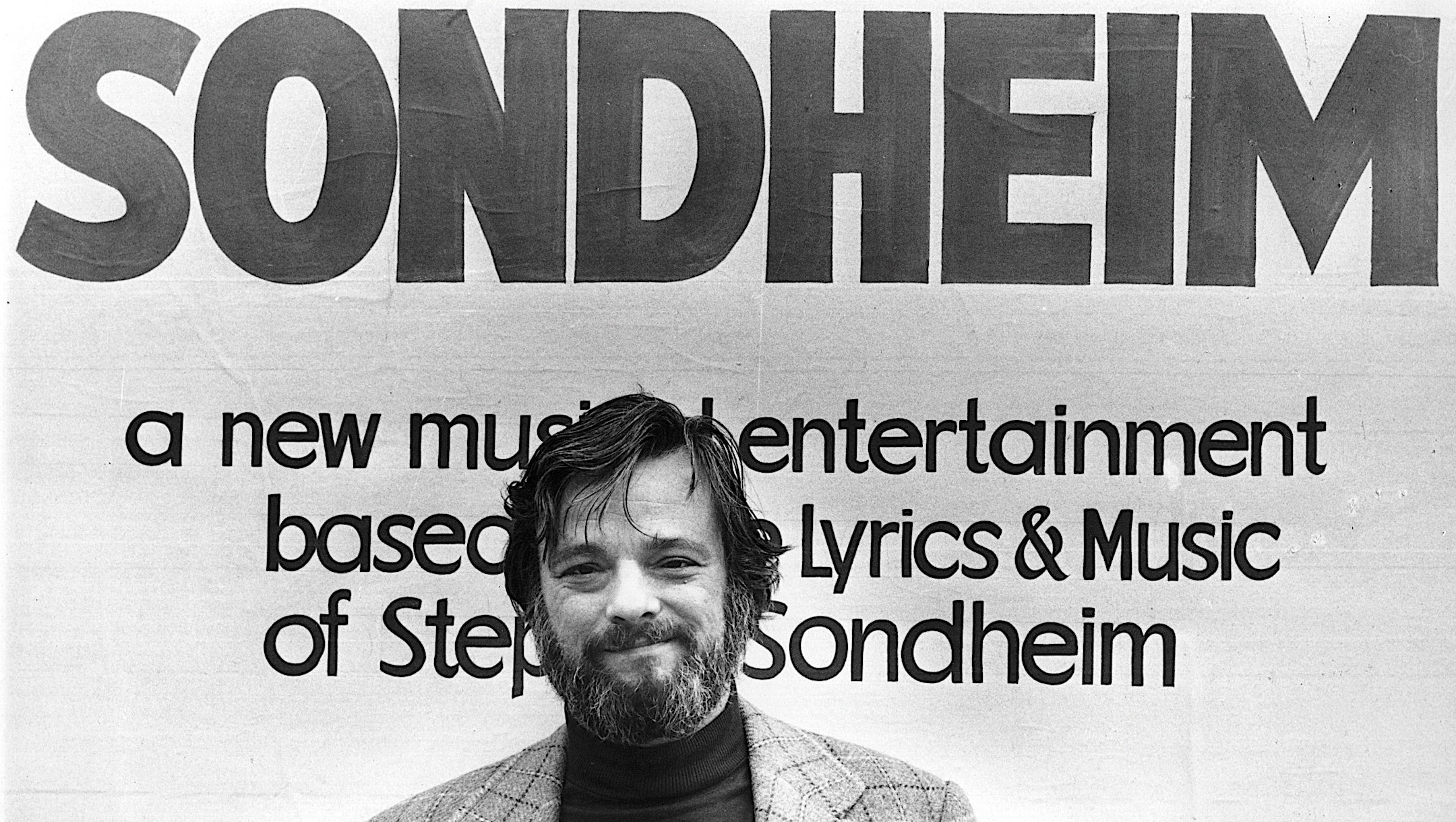
When Daniel Okrent first proposed writing a biography of Stephen Sondheim for the Yale Jewish Lives series, he had a warning for his publisher.
“I would love to write about Sondheim if you’re interested, but I have to tell you that he was not in any way, in any remote way, a practicing Jew,” Okrent recalled saying.
The people at Jewish Lives were unfazed — that is, until he turned in his manuscript.
“They said, ‘Could we have a little bit more Jewish stuff in there?’”
I can sympathize. It can be tricky to write about famous, highly assimilated Jews like Sondheim, for whom Jewishness did not seem to be a significant part of their private identity or what made them famous. In writing an obituary, for example, there’s a risk of “claiming” someone as Jewish in ways they might have rejected, or of forcing their life into a Jewish narrative in a way that seems artificial or exaggerated.
And yet, Okrent argues, Sondheim was unmistakably Jewish.
“I look at it as a form of Americanized Yiddishkeit: his nature, his worldview, his sense of humor,” said Okrent in an interview last week. “To me, also having grown up as a pretty areligious Jew, that felt very Jewish.”
Okrent, a journalist and former public editor of The New York Times whose previous books include histories of prohibition and U.S. immigration policy, wrote “Stephen Sondheim: Art Isn’t Easy” as an unabashed fan.
“I wanted to understand the life through the work and the work through the life,” he told me. The book chronicles the friendships, rivalries and personal demons that informed Sondheim’s unmatched contribution to the American musical, from the lyrics he wrote for “West Side Story” and “Gypsy” to the scores and lyrics he composed for canonical shows like “Company,” “A Little Night Music,” “Sweeney Todd” and “Sunday in the Park with George.”
And while Sondheim, who died in 2023 at age 91, spent a lifetime denying it, Okrent concluded that his life and art were “intimately intertwined,” and that his shows were often autobiographical.
With the exception of a handful of musicals, “everything else reflects his life, his feelings, his triumphs, his failures,” said Okrent.
That includes “Sweeney Todd,” the ghoulish, operatic story of a deranged barber who kills his customers and serves them up as meat pies. When Judy Prince, wife of his longtime collaborator Hal Prince, told Sondheim that “Sweeney Todd” was the story of his life, Sondheim agreed.
“What did he see in that? Revenge,” said Okrent. Sondheim understood what it was to hold a grudge — against critics, notably, and anyone else who suggested his shows were too elitist, too cool or (and this galled him to the degree that he wrote a song about it) not “hummable.”
What almost never appears in his shows or music, however, is a Jewish theme or character, at least explicitly so. And when they do appear — notably as theatrical producers in shows like “Gypsy” and “Merrily We Roll Along” — they reflect the main way Sondheim himself claimed his Jewishness.
When asked about his Jewish identity by the journalist Abigail Pogrebin for her 2005 book “Stars of David,” Sondheim said, “It’s very deep. It’s the fact that so many of the people that I admire in the arts are Jewish. And art is as close to a religion as I have.”
The future composer grew up on New York’s Upper West Side; his parents, Herbert and Etta, known as Foxy, were prominent in the dressmaking business. They belonged to Temple Emanu-El, the socially prominent Reform synagogue on the East Side. After their divorce when Sondheim was 10, he moved with his mother to a Pennsylvania exurb not far from the lyricist Oscar Hammerstein, who became a surrogate father and musical mentor.
Hammerstein was himself only one-quarter Jewish by ancestry but is, as Okrent notes, now included in the pantheon of Jews who helped create the Broadway musical as we know it.
Sondheim sought Hammerstein’s counsel until his mentor’s death in 1960. When an up-and-coming Sondheim balked at an offer to write the lyrics for “Gypsy,” saying he wanted to compose as well as write lyrics, Hammerstein convinced him that it was an unmissable opportunity to learn how to write for a star — in this case, the Broadway legend Ethel Merman.
Before that, there was a stint in military school, which Okrent writes that he loved, and math and music studies at the WASP-y WIlliams College, where the Jewish kid was blackballed from a fraternity. Having had no religious schooling or bar mitzvah, Sondheim once asked his Jewish roommate, “Am I even Jewish?” Okrent quotes musicologist Steven Swayne: Sondheim may have been “‘a Jew to the goyim,’ but not to himself.’”
And yet, Sondheim’s professional world would become saturated with Jewishness.
He teamed up with Leonard Bernstein, Arthur Laurents and Jerome Robbins, three other gay Jewish men, on “West Side Story.” In addition to Prince, he created shows with Jule Styne, John Weidman, James Lapine and Larry Gelbart.
But Sondheim did not appear to approach his work by looking for Jewish stories, even when others were mining hits from the Jewish past (“Fiddler on the Roof”), the birth of Israel (“Milk and Honey”) and even the Holocaust (“Cabaret”).
“He never would have said, ‘I want to find a show that has, you know, a Jewish theme,’ any more than he said, ‘I want to find a show that has a cowboy theme,’” Okrent said. “It’s just not the way he went about his work.”
Instead, stories usually came to him through collaborators. “Sweeney Todd” and “Passion,” one of his last shows, were among the exceptions.
Others have attempted to locate Sondheim on the spectrum of Jewishness. Okrent mentions a course given in 2022 at the 92nd Street Y, “Sondheim and the Torah.” The theater scholar Gabrielle Hoyt, in a 2022 paper, also sees Jewish themes in many of his shows: “the line between vengeance and justice” in “Sweeney Todd”; the “boundaries of community” in “Company”; the “isolation of the prophet” in the 1960s flop “Anyone Can Whistle.”
Hoyt also compares Sondheim’s eagerness to nurture young talent to that of a rabbi. Okrent writes about the young composers and lyricists Sondheim mentored, including Jonathan Larson, Adam Guettel, Lin-Manuel Miranda and “South Park” creators Trey Parker and Matt Stone, whom he encouraged during their work on “The Book of Mormon.”
“He provided really substantive criticism for those who came to him for help and with whom he built relationships,” said Okrent.
Okrent, who co-created the 2012 stage revue “Old Jews Telling Jokes,” chuckled when I compared Sondheim’s Jewishness to the metaphysical joke about a fish. “How’s the water?” an old fish asks a young fish. “What the hell is water?” says the young fish.
Sondheim, agreed Okrent, may have been so deeply immersed in a Jewish milieu that he rarely thought about it, or bothered to craft a carefully worked-out theory, like so many others, as to why Jews thrived on Broadway.
“I suppose if he interrogated himself about it, he probably would have. But I don’t know. I can’t say that with certainty,” Okrent acknowledged.
Sometimes, Sondheim did notice the water. Okrent recalls that he was proud of “A Little Night Music,” his hit adaptation of the Swedish director Ingmar Bergman’s film “Smiles of a Summer Night.”
“But I don’t know if I really like it,” Sondheim told the Jewish playwright Jules Feiffer. “It’s so damn goyische.”
As the Year Turns, Support the Journalism You Trust. (JR) covers the stories shaping Jewish life around the world — with the depth this moment calls for. As you reflect on the year ahead, consider a gift that keeps independent Jewish journalism strong.