

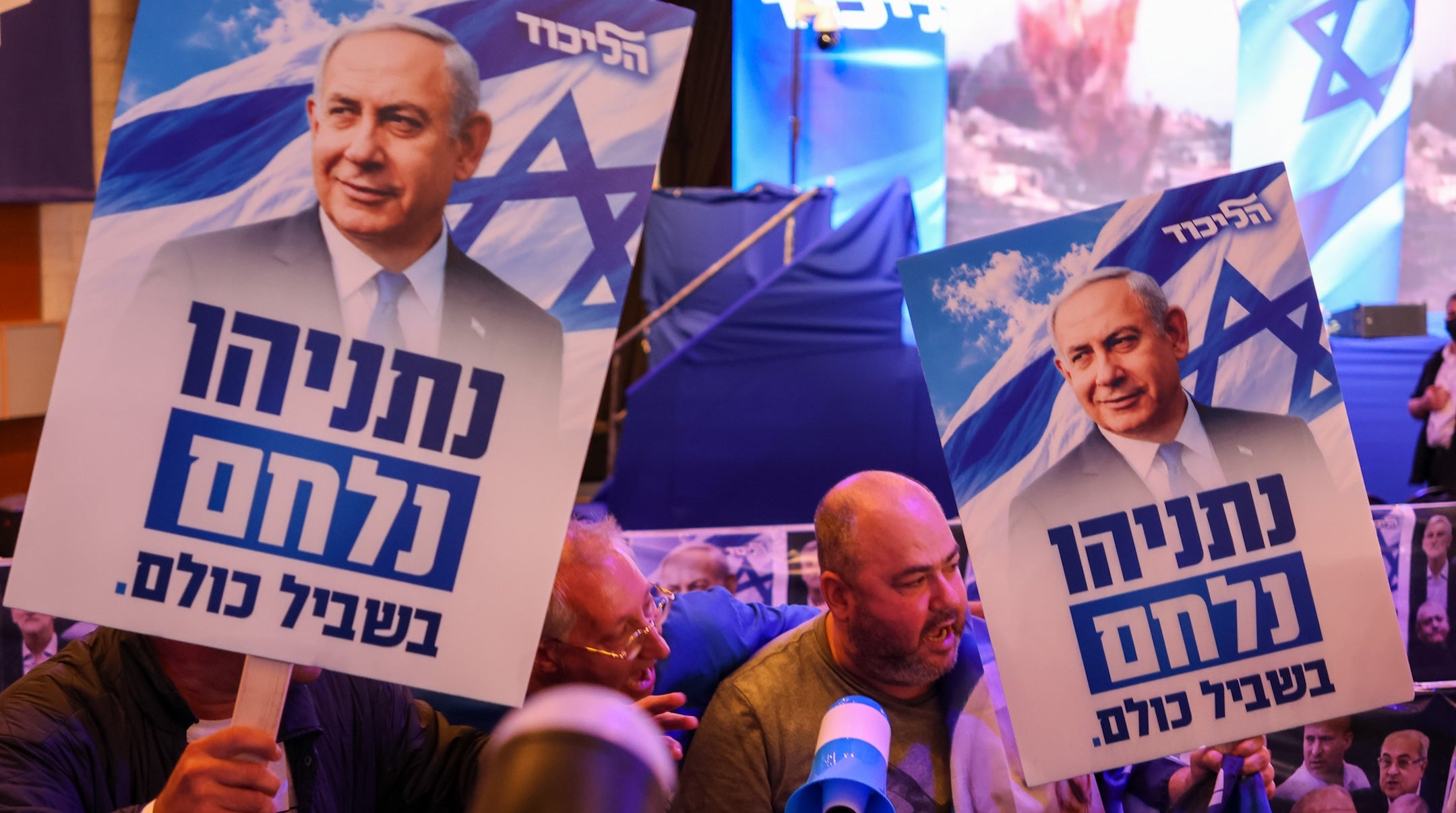
JERUSALEM — Forty-five minutes after Israeli channels released their first exit polls, a silence had washed over the Likud election watch party held at the International Convention Center in Jerusalem.
Supporters had waited in anticipation for the exit polls to appear on the screen. When Channel 14 — which had a broadcast desk stationed in the corner of the room — first showed its poll, a cheer circulated through those in attendance. But as everyone looked down at their phones to track the results from the other channels, the mood became increasingly subdued.
Supporters hoping for a strong Netanyahu victory were disappointed by polls showing that his Likud party did not have enough support to form a governing coalition.
They had hoped to celebrate the moment with Netanyahu, who, in the end, did not show up.
The initial exit polls, released at 10 p.m. as polling stations closed, showed Likud as the largest party. However, neither it nor its committed coalition partners had gained enough seats for a parliamentary majority that would allow it to form the next government. Channel 12 had Prime Minister Benjamin Netanyahu’s bloc, which at its height had 68 seats in the outgoing Knesset, dropping to 50, with the opposition parties at 53 across the network projections.
The Central Elections Committee hopes to finish counting the votes by Thursday. By law, the official results have to be published by Nov. 4.
The historic turnout in the election, billed by many as the most consequential in Israel’s history, stood in stark contrast to the empty convention center hall. It appeared that only the most dedicated of Bibi fans had decided to make the trip to the watch party. Three hardcore supporters held up a blue and white Likud flag while chanting “Malach Bibi,” meaning “King Bibi,” with a crowd of journalists pushing past each other to get footage.
Every two minutes, the Likud jingle echoed through the hall on a loop, and a string of AI-generated Likud election videos played on the screen. The lectern sat empty, and Netanyahu had not issued a statement in the wake of the first results. Netanyahu, along with Likud MKs, had been expected to address supporters in the hall had there been a clearer mandate; instead, journalists gathered, snacking on refreshments while waiting for more Likud supporters to show up.
Yossi Levi, 71, a pensioner from Eilat, made the long drive to Jerusalem to show his support. He said that for his entire tenure as prime minister, Netanyahu has had to fight the 120 members of the Knesset for his survival, and that he “thankfully” had so far always come out on top.
Levi recalled his time working on the Likud security team when Netanyahu first began his career and paused the interview to shake hands with Netanyahu’s head of security before returning to his story. Whether or not Netanyahu was able to form a coalition, he said, his support would remain unwavering.
That appeared to describe the crowd on Tuesday night: those who had stood by Netanyahu as he ascended to the heights of Israeli electoral power, and who were standing by him now, as his bloc appeared to shed 18 seats in the Knesset.
Boaz, who lives in the city center of Jerusalem, described the mood as not exactly disappointment “but something in the middle,” as the results did not yet indicate a clear winner or loser and adding that it was now time for coalition politics to begin.
Holding a blue-and-white Likud flag and milling about the lobby alone, he did not project confidence but insisted that he would stay at the event in case any of the party’s parliamentary members decided to show up.
With few audience members in attendance, the event center gave the appearance of something of a crashed party. By 11 p.m. Jerusalem time, the hall had begun to empty, with both supporters and those there to cover the event deciding to leave the scene.
A Season of Big Decisions. From the Knesset campaign to American midterms, Jewish communities are weighing what comes next. Help (JEWISH REVIEW) keep delivering the deeper context.


