

This story was last updated at 12:30 a.m. ET on Oct. 28.
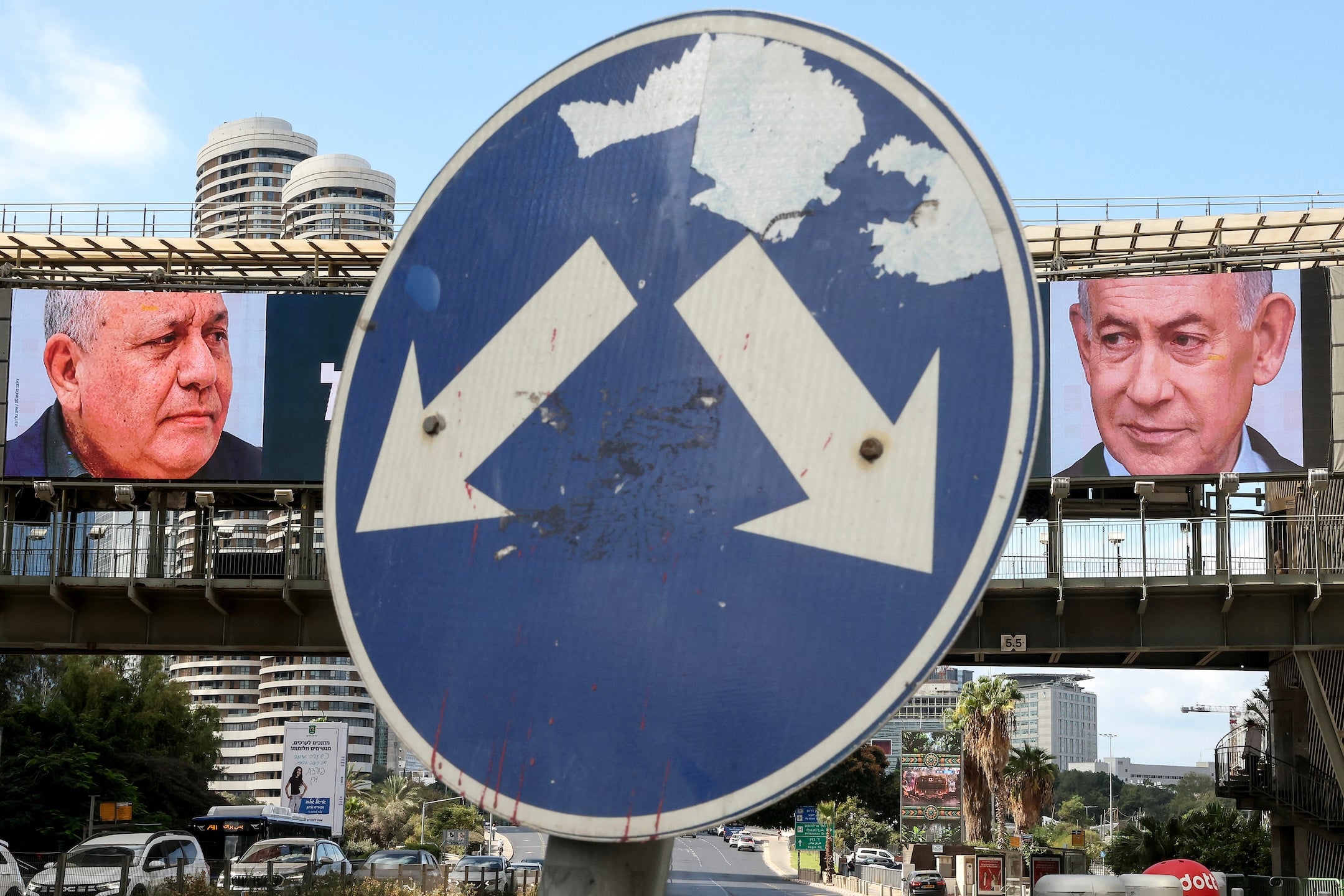
JERUSALEM – Israeli Prime Minister Benjamin Netanyahu and his centrist rival Gadi Eisenkot were locked in a battle for the future of Israel after an election Tuesday night that left no clear winner as exit polls were released.
The exit polls showed Netanyahu’s Likud party in first place and his bloc with the most seats even as they suffered a sharp drop in support from their current representation in the legislature, the Knesset. The Netanyahu bloc’s projected 52 seats leaves it far short of the 61 votes needed to form a new governing coalition.
The biggest gains were made by the Arab parties, which nearly doubled their representation in the Knesset to 19 seats, according to revised exit polls. That has complicated the path to a government for either major party because both have ruled out including Arab-led parties in their coalitions.
Eisenkot, however, claimed to have won the election and early Wednesday morning said that the public had rejected Netanyahu. Eisenkot spoke while polls still showed his bloc leading Netanyahu’s, only to fall down to 49 with the revised count.
Eisenkot might have a more plausible path to creating a government than Netanyahu because his centrist coalition could have an easier time making a deal with an Arab party, even though several of the parties in his would-be coalition have ruled out the possibility.
Netanyahu, whose bloc includes ultra-Orthodox and far-right parties, stressed that the results were not final. “We are still waiting for the real results that we will receive within the next 48 hours,” Netanyahu said. He noted, however, one exit poll result that he believed was correct: “The Likud is the biggest party in the state of Israel.”
However, Eisenkot said the results showed that the Netanyahu era was over and that “the public voted for change.” Eisenkot’s current bloc is collectively known as the “change bloc” and includes his own Yashar party, Naftali Bennett and Yair Lapid’s B’Yachad, Avigdor Lieberman’s Yisrael Beiteinu and Yair Golan’s Democrats.
Eisenkot argued that given the high voter turnout – with 77.7% casting ballots, it was the highest rate since 1999 – it would be a mistake to head to another election, which would happen if no party gains enough support to form a government.
But Eisenkot made clear that he thought he could form a government. “I will work together with my partners for change in order to ensure that the will of the people is realized through the establishment of a Zionist and stable government.”
Bennett, the head of the second-biggest party in the anti-Netanyahu bloc, confirmed on Tuesday that the different parties were already in contact with each other.
“We are all talking and we are all coordinating in this change bloc, like I promised time and time again, in order to promise a Zionist serving government,” he said.
Bennett declared that “Netanyahu lost,” adding that “the government of October 7th will go home.” Tuesday’s elections were the first national elections since the Hamas invasion of southern Israel in 2023.
Mansour Abbas, head of Ra’am, one of the two Arab parties to win seats Tuesday, told Israel’s Channel 12 that he was interested in joining Eisenkot’s bloc while he disparaged Netanyahu. But he noted that he was talking with people in both blocs and said that a senior official from the right-wing bloc had contacted him to seek ways to cooperate.
Yousef Jabareen, chairman of the other Arab party, the Joint List, called the vote “historic.”
“The public has made its voice heard and turned out in droves to the polling stations, giving us its unequivocal vote of confidence,” he said. “Our message is clear and sharp: the bloodshed government must go!”
Netanyahu, for his part, slammed “the propaganda channels” trying to convince members of the public that the Likud was in decline, accusing detractors of the “engineering of people’s consciousness.”
“We must establish a national right-wing strong, strong government,” Netanyahu said when he spoke to supporters around 3 a.m. Israel time. “It is simply forbidden that we should endanger Israel and establish a government that leans on Arab parties that are anti-Zionist.”
Netanyahu described Israel as “stronger than it has ever been,” describing Iran as “now weaker than it ever has been.” He also credited his “wonderful friend Donald Trump” for deciding to tackle the Iranian threat in the region.
Analysts who spoke to the Jewish Telegraphic Agency said it was too early to say what would happen next, emphasizing that no side appeared to be victorious.
“Netanyahu did much better than anyone thought,” said Professor Jonathan Rynhold, from the department of political studies at Bar-Ilan University, referring to polls taken ahead of Tuesday’s vote.
“It’s actually unbelievable how well he has done,” he said, but added that “he has cannibalized his own bloc,” meaning most of the voters shifted away from other right-wing parties that would have strengthened his coalition.
“Unless there is some massive change, Netanyahu does not have a government,” Rynhold concluded.
But he noted that the opposition might not be able to form a government either, given that the opposition has ruled out including Arab parties in the government. “If the opposition sticks to what they’ve said, then I am sure Netanyahu will be happy to go to another election,” Rynhold said.
Eisenkot’s change bloc partners were more bullish on their prospects of taking power.
Lapid, Bennett’s partner in B’Yachad, said that “the Netanyahu bloc has suffered a crushing defeat. This is a total collapse and the public has told them to go home.”
Yair Golan, leader of the Democrats party, said, “The change bloc has won.”
“The Israeli public fired Netanyahu and the Likud today. Now we must ensure that those dismissals take effect. We must form a change government — and we must do so quickly,” he said.
But the Netanyahu bloc urged caution in evaluating the results. Finance Minister Bezalel Smotrich, head of the Religious Zionist party, said he thought Netanyahu’s bloc might grow.
“We are waiting for the soldiers’ votes,” he said. “I see that the Arabs are celebrating tonight. I’m telling you and them – we will not let them celebrate.”
Analysts pointed to the large turnout of Arab voters, some 20% of Israel’s population, as the biggest surprise of the day.
Gideon Rahat, a senior fellow at the Israel Democracy Institute and a political scientist at the Hebrew University of Jerusalem, said that constant incitement against Arab citizens of Israel by government figures such as far-right Minister for National Security Itamar Ben-Gvir might have been what motivated them to vote in such unprecedented numbers on Tuesday.
While some Israelis might see Arabs’ high voter turnout as a dangerous development, he said, others will say it is “a Zionist victory that at last they are taking part in the Jewish state” rather than staying home.
A Season of Big Decisions. From the Knesset campaign to American midterms, Jewish communities are weighing what comes next. Help (JEWISH REVIEW) keep delivering the deeper context.