

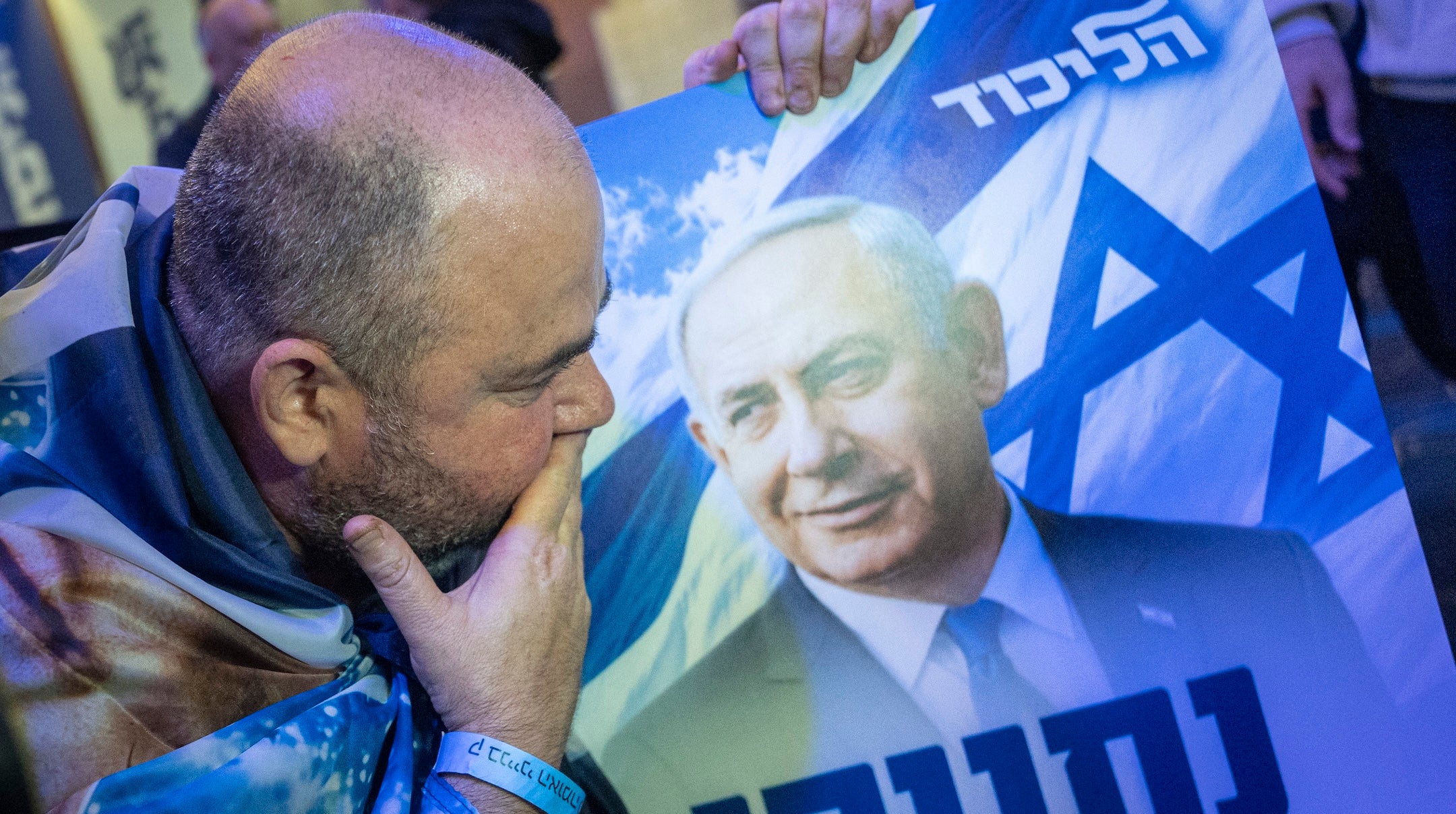
JERUSALEM – As election results from Israel’s parliamentary vote on Tuesday continue to trickle in, what seems clearest is that no side in this political race will have enough votes to form a majority government, meaning the question of who Israel’s next prime minister will be remains uncertain.
According to the vote count so far, Prime Minister Benjamin Netanyahu’s Likud party could have as many as 28 seats, yet his bloc of right-wing and ultra-Orthodox parties will fall short of the 61 seats needed to form a majority government.
Yashar, the party led by Netanyahu’s main rival, former Israeli army chief Gadi Eisenkot, looks set to be the second-largest party, with around 22 seats. The so-called “change” bloc that Eisenkot leads will likely have around 47 seats, also far short of what is needed to form a government on its own.
Meanwhile, Israel’s Arab parties, which both blocs have said they wouldn’t include in a coalition, are on pace to get at least 17 seats collectively and could become key to helping the opposition oust Netanyahu.
The formal process whereby each party holds consultations with Israel’s President Isaac Herzog to recommend a candidate for prime minister will likely begin next week. Political analysts are already speculating on possible scenarios.
Their tentative takeaway: Reality may force political leaders to break their solemn promises to not work with certain other parties.
So what are the possible scenarios if the final results leave the political arena so starkly divided? Here are the three most likely outcomes.
1. The “change” bloc plus the Arab parties
All the parties in the change bloc bar the Democrats, led by Yair Golan, stated throughout their campaigns that they would not form a government with either of the Arab parties, even though Mansour Abbas, the leader of Ra’am, an Islamist faction, joined a centrist coalition from 2021-2022, breaking what had once been a taboo. Abbas is again offering to join forces with the change bloc.
“Clearly this is emerging as an option mathematically and politically,” Yohanan Plesner, president of the Israel Democracy Institute, told the Jewish Telegraphic Agency on Wednesday. But he added, “It’s obviously not only a violation of campaign promises, but I think the Israeli public opinion is deeply unprepared for such an option.” Tolerance for working with an Islamist party has diminished since the deadly Oct. 7, 2023, Hamas-led raids.
Another variation on this option is for the change bloc — Eisenkot’s Yashar party, B’Yachad, led by former prime ministers Naftali Bennett and Yair Lapid, and Avigdor Lieberman’s Yisrael Beiteinu party, as well as the Democrats — to form a minority government.
While 61 seats are needed to form a majority government, there is nothing to prevent a government with fewer than 61 seats from being formed if it can gain support on key legislative decisions.
This could happen if Arab factions support the change bloc on key votes but otherwise don’t play a role in the government. This would give the change bloc up to 65 seats when Arab parties’ support from the sidelines is added in.
Even this step has been rejected by Lieberman, yet Professor Jonathan Rynhold, of the Department of Political Studies at Bar-Ilan University, said it was possible that Eisenkot could put pressure on him to accept.
“Even though Lieberman has said no to such an option, he might say yes if he’s the prime minister,” Rynhold said.
On the other hand, the Arab parties, especially the Joint List, might demand concessions for such an agreement that Eisenkot himself finds hard to stomach.
2. Formation of a unity government
A quick look at the political map following Tuesday’s vote shows that center-right parties ranging from Eisenkot’s Yashar party to Lieberman’s Yisrael Beiteinu, with Likud and B’Yachad in between, gained a substantial share of the seats. One possible scenario is that some of these parties, even though they are avowed political foes, could join forces.
“I think it is perhaps more likely that there will be serious negotiations around a unity government,” Plesner said. “I would imagine that Netanyahu would prefer unity based on him forming a coalition with all of his bloc members, and then luring one of the ‘change bloc’ parties to his government.” That would mean including ultra-Orthodox parties Shas and United Torah Judaism and far-right parties led by Itamar Ben-Gvir and Bezalel Smotrich.
However, Plesner said the change bloc parties would most likely push for a “real unity government,” whereby Netanyahu “gives up on one of the far-right parties that has caused a lot of challenges for Israel’s international image, or perhaps an ultra-Orthodox party that has refused to pass a military draft bill.” He was referring to a law that would force more haredi men to serve in the military, from which they’ve traditionally been exempted. This, he said, would create a “Zionist, more centrist-leaning option.”
“I think this is something that Israeli public opinion would be able to live with and perhaps even prefer, but I can’t say anything about the political viability of it,” Plesner said.
The change bloc ran on replacing Netanyahu, and no doubt many of its voters would feel betrayed by such an outcome.
3. Another round of elections
In his election night speech, Eisenkot declared that “after an election with such high voter turnout, it would be a mistake to hold another election.” Some 77.7% of voters cast ballots, the highest since 1999, according to election officials.
However, with no bloc reaching a majority and serious ideological disagreements among the parties, another round of elections might be the most likely possibility. For Netanyahu in particular, allowing the process to play out while he retains his position as interim prime minister until another election is held could well be the most favorable outcome for the long-serving leader, according to Plesner.
A similar scenario played out beginning in 2019, when Netanyahu’s bloc of supporters failed to achieve a majority. Israel then held a series of elections, culminating in the March 2021 vote, when Netanyahu’s bloc was ousted by a center-left alliance led by Bennett and Lapid. The November 2022 election returned Netanyahu to power.
“I don’t really know what the path forward is now,” said Gideon Rahat, a political scientist at the Hebrew University of Jerusalem.
“If we were talking 10 years ago, I would say that something else might happen – a unity government or a different solution perhaps,” he said. But given the entrenched political camps at this point, another round of elections might be where the country is headed.
On the other hand, given the unpredictable nature of Israel’s political scene, Plesner noted that it could be a “time for politicians to get creative.”
“I wouldn’t be surprised if all sorts of ideas that we haven’t thought of before come up in the upcoming few weeks,” he said, adding that he believed that, with so much uncertainty, it could “take weeks and perhaps months” before the next prime minister is determined.
A Season of Big Decisions. From the Knesset campaign to American midterms, Jewish communities are weighing what comes next. Help (JEWISH REVIEW) keep delivering the deeper context.


