
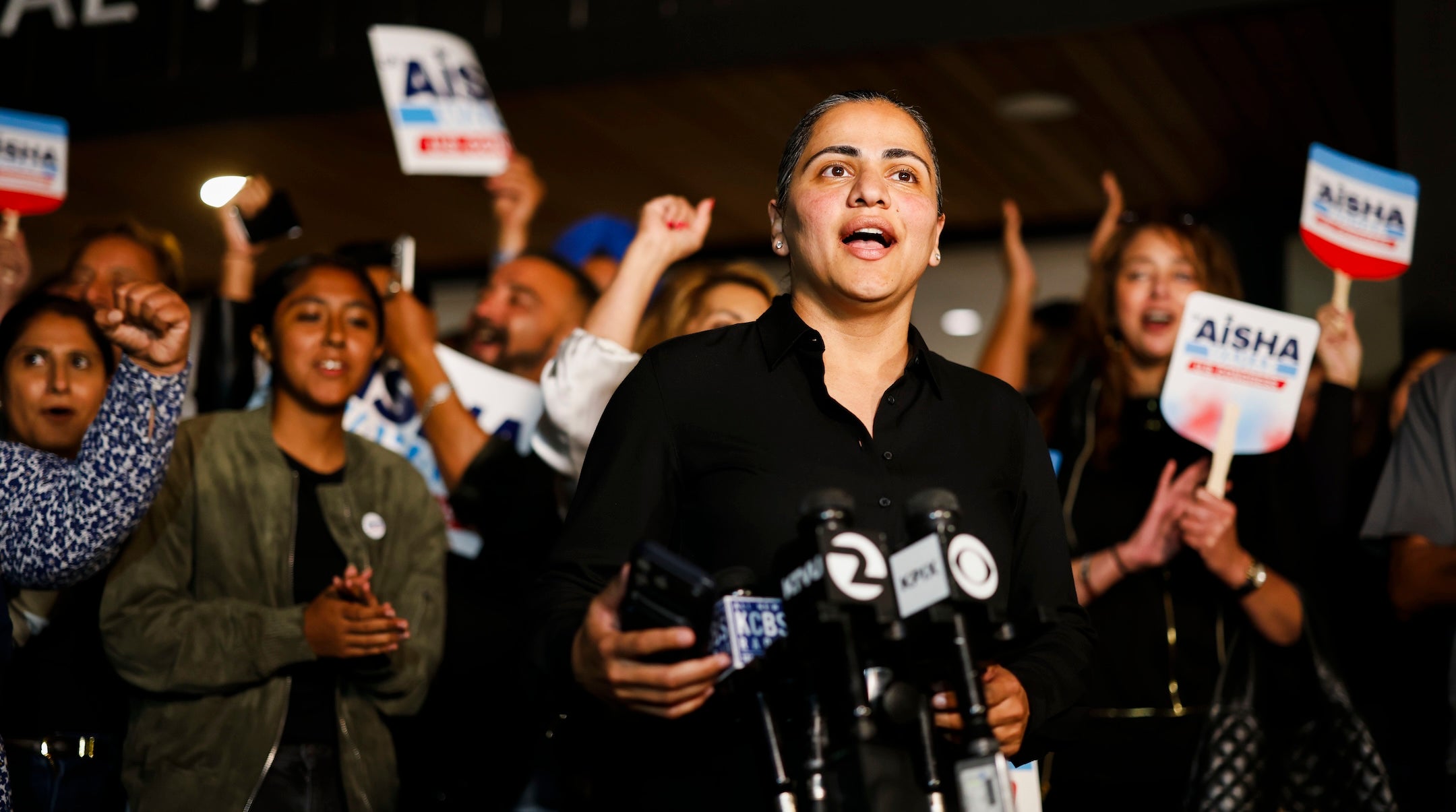
California progressive Aisha Wahab defeated AIPAC-backed moderate Melissa Hernandez in a congressional runoff this week, capping off a contest that had become unexpectedly tight after the pro-Israel lobby entered the fray.
The Associated Press called the race between the Democrats — who were vying to replace a disgraced former Rep. Eric Swalwell — a full two days after polls closed, when Wahab secured 53.1% of votes to Hernandez’s 46.9%, with 95% of ballots tallied. The gap between them grew by four percentage points from Tuesday evening, when Wahab had held a narrow 51% lead to Hernandez’s 49%.
“We stayed focused on the people, and I will fight for this district that raised me,” Wahab said in a Thursday statement, noting her journey “from foster care to Congress” in her East Bay community.
Although Wahab ended up victorious, the narrow initial margin on Tuesday shocked California’s 14th District, given that she had secured a double-digit lead in preliminary races two months ago.
But in the past few weeks, an unforeseen variable appeared to influence the trajectories of the two campaigns: a massive spending push from the American Israel Public Affairs Committee aimed at turning the tides for Hernandez.
Since the beginning of August alone, AIPAC’s super PAC, the United Democracy Project, and other affiliated groups spent more than $2.5 million on both boosting Hernandez and denigrating Wahab with negative ads and mailers, according to Federal Election Commission filings.
“This was not a landslide for Wahab by any means,” local Democratic strategist Noah Finneburgh, who is not affiliated with either candidate, told the Jewish Telegraphic Agency.
“They narrowed the gap for sure,” Finneburgh added, referring to AIPAC. “They spent millions of dollars attacking Wahab very aggressively.”
These attacks, he explained, did not involve Israel and instead focused on divisive issues for the Bay Area, such as public safety and protecting kids.
“Negative advertising with a persuasive message can be very effective,” Finneburgh said.
In her Thursday night statement, Wahab declared that her “district cannot be bought,” describing the race as “one of the ugliest, most expensive elections we’ve ever seen.”
Prior to this influx of cash and related ads, neither AIPAC nor Israel had played a significant role in this short-lived race, which began in April following Swalwell’s resignation amid allegations of sexual assault. He has denied the allegations.
When the district held a special primary to seek Swalwell’s replacement on June 16, Wahab and Hernandez finished as the top-two candidates and moved on to this week’s special general runoff election.
California primaries are “nonpartisan” or “top-two” races, in which the two highest ranking candidates move on to the general election, irrespective of their parties. The top-two in this case were both Democrats, like Swalwell, in a district that the Cook Political Report deems solidly blue.
Even though Wahab will now finish the remainder of Swalwell’s term, she will have to compete with Hernandez again in the November general election for a full term that begins on January 3, 2027.
In a June 16 special primary that preceded this week’s runoff, there was still a massive gap between the two candidates, with Wahab accruing 42.8% of the votes, compared to Hernandez’s 16.8%. A separate primary for the November race, which occurred two weeks earlier, placed Wahab at 38.3% and Hernandez at 17.2%.
Wahab, who will be the first Afghan American in Congress, has focused on affordability, civil rights, education and climate change. Her campaign calls for an end to wars and “prolonged occupations” but only specifically calls out U.S. military activity in “Afghanistan, Iraq, Syria, Libya, Yemen, Pakistan, Somalia, and elsewhere.”
Though Wahab has been critical of Israel and its operations in Gaza, she has not been as vocal about the issue as many other progressive colleagues nationwide. She responded “yes” when asked if Israel was committing genocide in a primary debate, but she didn’t include Israel or Gaza in her campaign priorities.
During a recent appearance on far-right influencer Hasan Piker’s livestream, Wahab acknowledged that “it’s not a zero-sum game in the Middle East,” adding that “we can care for all people.” She also referenced a resolution she introduced last year in the California legislature, pushing for a ceasefire in Gaza but also condemning Hamas and demanding the release of the hostages.
“We talk about both Palestinians and the Israeli victims there,” Wahab told Piker. “We talk about holding the perpetrators accountable from both sides.”
Asked if she was in favor of “ending all U.S. aid to Israel,” she responded “yes,” while stressing that “humanitarian aid is important to me, too.”
Wahab has earned the backing of multiple labor unions, the California Democratic Party and Our Revolution, the group formed by Sen. Bernie Sanders to advance the progressive movement. The liberal pro-Israel group J Street also recently invested $108,000 in her campaign, according to the FEC. American Priorities, a pro-Palestinian PAC, also spent at least $200,000 on supporting her.
Hernandez has received endorsements from several police and fire unions, as well as Democratic Jewish Reps. Lois Frankel of Florida and Brad Schneider of Illinois.
Come November, Hernandez will gain one additional asset. Due to statewide redistricting, the 14th District will gain about 26,000 new voters from Dublin, where Hernandez previously served as mayor, the San Francisco Chronicle reported.
But Finneburgh said he believes that Hernandez has only a minimal chance of winning that race, especially because Wahab will be heading into that election as an incumbent.
He also suggested that if “she plays her card right,” Wahab could even take some endorsements away from Hernandez.
“There’s going to be people who are going to probably move over from the Hernandez camp and back her,” Finneburgh added. “It’s going to be hard to unseat her.”
Reporting the stories that define our era. When history unfolds in real-time, the Jewish world turns to (JEWISH REVIEW). Your support ensures we can document the complexities of war and the resilience of Jewish communities with integrity.