

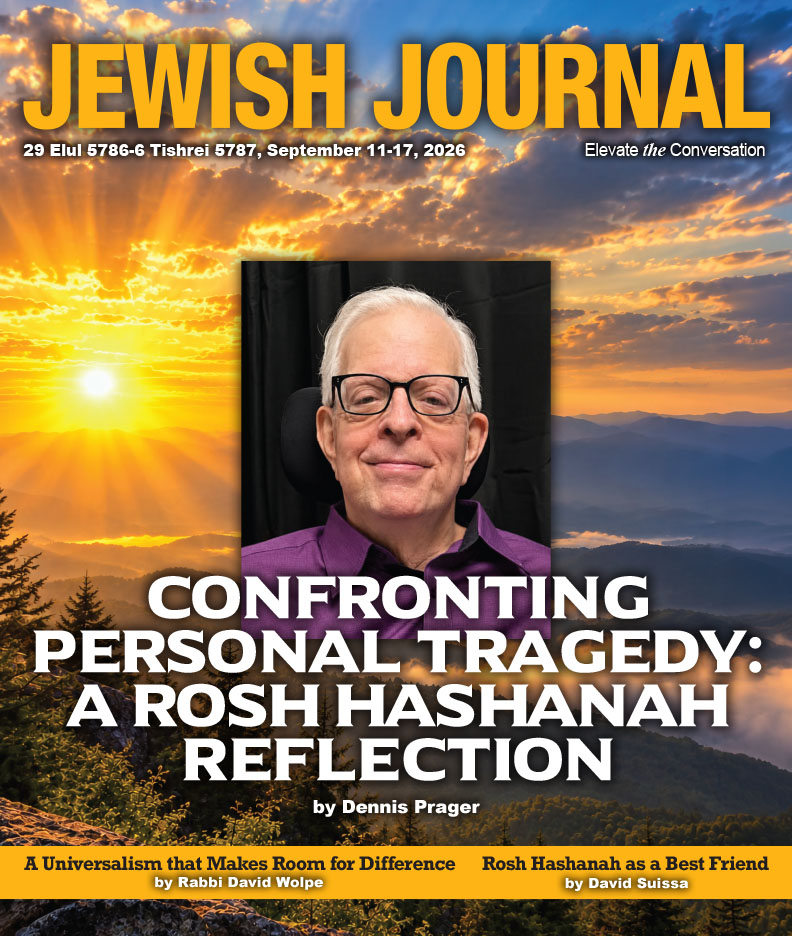
On Tuesday morning, Nov. 12, 2024, I stepped out of the shower in my home, slipped on the finished wooden floor, and fell backward, hitting my head on the side of the bathtub on the way down. The result was a catastrophic injury: I was rendered quadriplegic, paralyzed from the shoulders down. Fortunately, I sustained no brain damage.
After a series of recent visits with me, David Suissa, editor of The Jewish Journal, asked me how I was able to handle this devastating injury as well as I have. Why wasn’t I depressed? How was I able to complete my latest book, “If There Is No God: The Battle Over Who Defines Good And Evil,” and now work a few hours almost every day to complete my commentary on Leviticus, the fifth volume of my Torah commentary, “The Rational Bible”? In addition, for the past two months, I have been doing a weekly podcast on PragerU and been interviewed on multiple other podcasts. In October I will give my first in-person speech at a PragerU event in Miami. After visiting me each day for a week, David commented that he felt he was talking to the “old Dennis,” not the “new Dennis.”
As soon as he said that, I volunteered to write an answer to his questions for the Jewish Journal. He immediately suggested that it should be the cover story for the Rosh Hashanah edition. If Rosh Hashanah is about anything, it is about cheshbon hanefesh: taking an account of one’s life and grappling with the greatest questions of life.
I hope that how I am dealing with this awful injury will be of help to many others.
Since my early teens I have been preoccupied, perhaps even obsessed, with good and evil, and especially with the problem of unjust suffering. Many of the conclusions I reached helped prepare me intellectually, and perhaps even emotionally, to deal with my accident.
Proof is that I wrote most of these conclusions 30 years ago in my book on happiness, “Happiness Is a Serious Problem.” The quotations that follow are exactly as written in the book.
We Need a Philosophy of Life and a Philosophy of Suffering
“We can determine how we react to events; we make this determination on the basis of more than disposition. Our reaction is determined by our attitudes and perspective, or more precisely by our philosophy of life.
“Without a philosophy of life [and suffering] we do not know how to react to what life deals us.
“Most people wait until tragedy strikes before thinking about how to incorporate tragedy into their life. And then the shock is often too great to absorb into their emotional and psychological system.”
How this attitude has helped me.
In formulating my views on happiness, I have had to deal realistically with the ubiquity of unjust, often seemingly pointless, pain and suffering. I have had to deal with the Holocaust, the Gulag, Mao’s starving of 60 to 80 million Chinese, Pol Pot’s killing fields in Cambodia, the innumerable people enslaved and tortured and the women raped throughout history. And those are only the victims of human evil. What about all the victims of natural evil, such as earthquakes, diseases, plagues, the death of children and all the women who died in childbirth?
This has had two effects on me. First, it has engendered immense and constant gratitude in me. And since gratitude is the mother of happiness, I have been able to be happy. At the same time, I always reminded myself that tragedy is not confined to the “other guy;” I am just as likely to be the “other guy.” And now I am.
I Love Life, But I Have a Largely Tragic View of It
“I do not come to the subject of happiness from a particularly rosy outlook on life. On the contrary, I come to it from a largely tragic view of life. I believe that suffering is real, not as some fine souls in the East would have it, a function of the ego, and not as some fine souls in the West would have it, ‘all for the best.’ Some suffering is a result of egocentrism, and sometimes suffering does indeed lead to positive results, but much suffering that people have had to endure is undeserved, awful, and leads to nothing positive.
“There are a number of important philosophical and emotional consequences to having such an outlook. For one thing, I walk around amazed at my good fortune. Given how much unjust suffering and unhappiness there are, I am deeply grateful for, sometimes even perplexed by, how much misery I have been spared.”
Expectations Are Damaging
“Imagine that you discover a strange new lump on your body. You go to a doctor, who tells you that it looks suspicious and that you should have a biopsy. After waiting a week for the results, you learn that the lump is benign. That day will be one of the happiest days of your life. Why? Because on this day, you did not expect to be healthy. Am I therefore saying that we should not expect to be healthy? Yes. We can and should desire to be healthy and work at being healthy. But ideally, we should awaken every day and be as happy about our good health as if we had just received the wonderful news that a lump was diagnosed as benign.”
Expectations Undermine the Most Important Element in Happiness
“When expectations are unfulfilled they cause gratuitous pain, and when they are fulfilled, they diminish gratitude, the most important element in happiness.
“Yes, there is a ‘secret to happiness’ — and it is gratitude. All happy people are grateful, and ungrateful people cannot be happy.
“Because gratitude is the key to happiness, anything that undermines gratitude must undermine happiness. And nothing undermines gratitude as much as expectations.
“While I can take it for granted that the sun will rise tomorrow, I cannot take for granted a healthful tomorrow; one day I will not wake up healthy, but the sun will surely rise on that day.
“Optimism has two dictionary definitions. One is the more immature one: ‘A tendency to expect the best possible outcome. The other is ‘To dwell on the most hopeful aspects of a situation.’ This definition of optimism is vitally necessary to happiness.”
On Regarding Oneself as a Victim
“You cannot be happy if your primary identity is that of a victim, even if you really are one.
“People who have chosen to regard themselves as victims cannot allow themselves to enjoy life, because enjoying life would challenge their perception of themselves as victims.”
How this attitude has helped me.
There is no question about my being a victim. I cannot move my legs, and worst of all, I cannot move my arms. I envy paraplegics. I would give anything to be able to wheel myself around, use a keyboard, hug my wife, children, grandchildren, and friends. I have spent most of the last nearly two years trying to recover the ability to breathe without a ventilator and to regain my normal voice. I have lost 80 percent of my income while my expenses have increased significantly, as I need 24/7 nursing care, and for some reason, Medicare does not pay anything for home care for patients with spinal cord injuries.
Seeing Yourself as a Victim
Despite all that, I refuse to see myself as a victim.
One reason is that seeing myself as a a victim would ensure anger and depression, negating any possibility of happiness. Another is the effect my seeing myself as a victim, with its concomitant anger and depression, would have on those who love me and, for that matter, all those who visit me.
Instead, I regard myself in many ways as quite lucky without denying any of the objective facts of my condition.
Here is one example of that good fortune for which I am grateful: On virtually any given morning, while I showered upstairs, my wife was downstairs in the kitchen or in the garage preparing my food for my radio show. Yet on that fateful morning, Sue was upstairs and actually saw me fall. She not only saved me from brain damage, she literally saved my life.
The surgeon on duty at the hospital to which the ambulance brought me initially recommended against the surgery needed to prevent further damage to my spinal cord from swelling. Instead, he said I should be given palliative care to make my final days as painless as possible. This doctor did not know of the next bit of good fortune on which I focus my gratitude: Upon hearing the news of my fall, Marissa Streit, CEO of PragerU, made an emergency call to a friend of hers who happens to be a neurosurgeon — Dr. Jared Ament, who was at the time on a medical mission trip to Bolivia, performing lifesaving surgeries on the poor. This doctor took a look at my MRI, determined the injury was survivable, and helped my wife advocate for the needed decompression surgery — lifesaving measure number two.
These two episodes of good luck were followed by a succession of fortuitous events too numerous to mention here.
I regard myself in many ways as quite lucky without denying any of the objective facts of my condition … Every doctor and RN who has seen me has marveled at the fact that I can breathe without a ventilator and speak as well as I can, given the high level of my injury.
So, am I a victim or a particularly lucky man? Every doctor and RN who has seen me has marveled at the fact that I can breathe without a ventilator and speak as well as I can, given the high level of my injury.
U = I-R
In my happiness book, I came up with an equation to measure unhappiness: Unhappiness = Image – Reality. This is the primary reason for men’s midlife crises. Men have an image of what they will be at a certain age, and the distance between their image and their reality is the amount of unhappiness they will experience.
“I think, for example, of Leon Fleisher, one of the greatest pianists of the twentieth century. Early in his career, he was struck with a mysterious affliction that made it impossible for him to play with his right hand. Because the greatest physicians [of his day] were powerless to help him, he changed his career to teaching, conducting, and playing piano pieces written for the left hand. Perhaps all of these replacements did not bring him the satisfaction that playing with both hands had brought him, but they were infinitely superior to dwelling on his missing [use of his] right hand.”
God
And what is God’s role in all of this? Should He have prevented my fall? Did He ensure that Sue was almost miraculously present when I fell? As the Sovereign of the universe, did He, for reasons we cannot know, seek my fall? Or was He not responsible for any of it, and allowed it to happen?
The answers to these questions are unavailable to us humans in this lifetime. As for me, I have for many years said publicly that I do not expect God to protect me from calamity. I never thought that I was more worthy of saving than the six million Jews, or the 60 million Chinese.
What I believe is that God is with me at this painful time in my life. And what I know is that God has intervened on behalf of the Jewish people.
These are among the themes of Rosh Hashanah: Who will live and who will die? Who will suffer and who will prosper? And if I may add a couple of questions of my own: Who will be grateful and who will be ungrateful? Who will complain and who will create?
There is so much more to be said, but these are among the themes of Rosh Hashanah: Who will live and who will die? Who will suffer and who will prosper? And if I may add a couple of questions of my own: Who will be grateful and who will be ungrateful? Who will complain and who will create?
I wish you all a happy and healthy New Year, and may God protect the United States of America and our beloved State of Israel.
Dennis Prager is the cofounder of PragerU.