
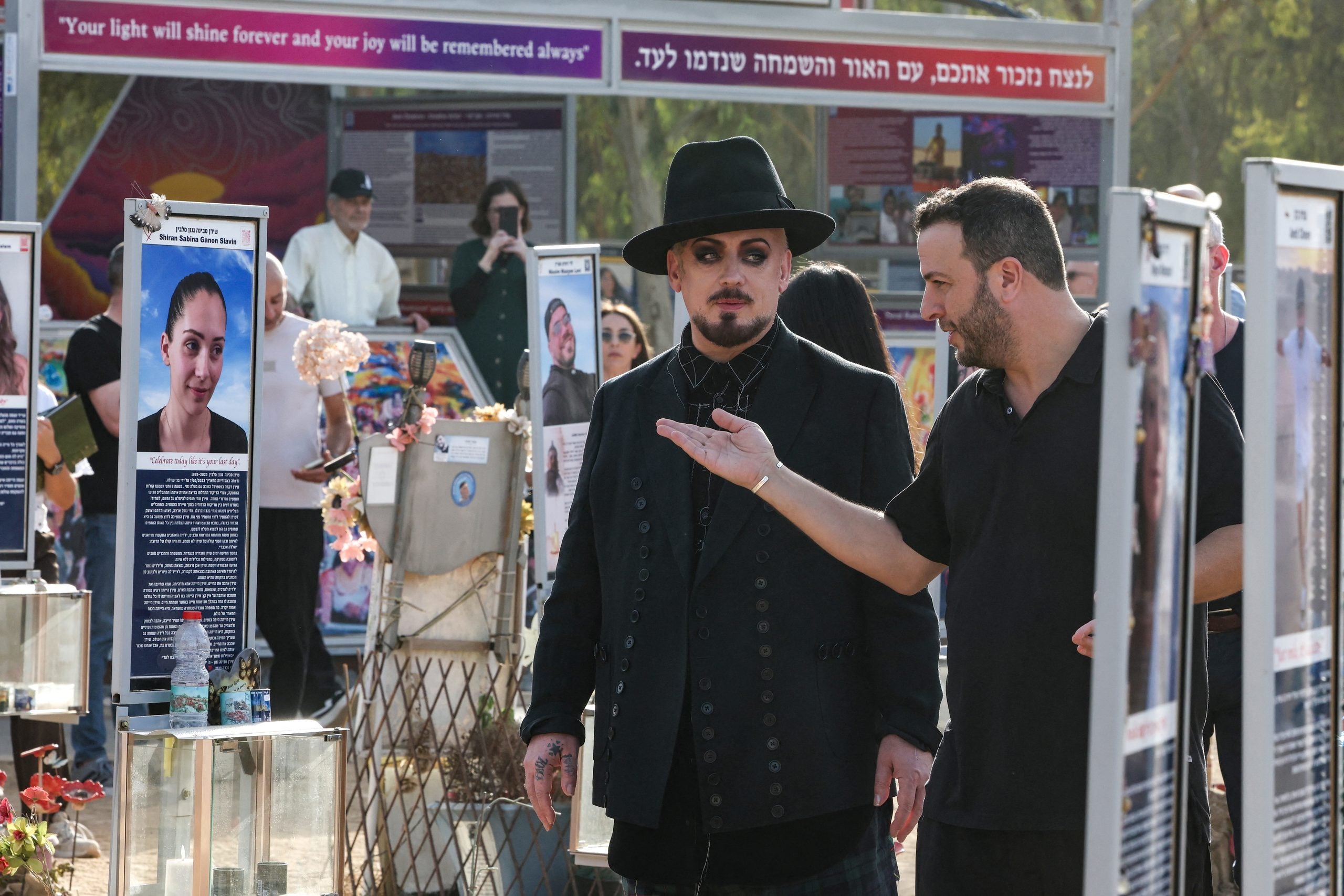
RE’IM, Nova Festival Memorial Site, Israel – Iconic 80s pop star Boy George is in Israel this week. He’s made all the usual stops on a celebrity visit: met with the president, placed a note in the Western Wall and, of course, performed two concerts. But it was his visit to the Nova Festival Memorial Site near Kibbutz Re’im on Tuesday that underscored the main reason for his visit.
An outspoken supporter of Jews and Israel, even as he has faced a backlash within the music industry, the singer said that hearing about the massacre and seeing the site where more than 360 people were killed on Oct. 7, 2023, had only strengthened his convictions.
“I saw what happened on October 7 … I was up very early, and I saw it, and it just horrified me,” Boy George told a press conference on Tuesday, following a tour of the memorial with former hostages, survivors and other members of the Tribe of Nova Community Association.
“But what horrified me more was hearing people that have no connection to what happened telling me it wasn’t true, that it was made up, and that I shouldn’t believe it,” he said.
Boy George, a British singer who achieved international fame in the 1980s with the Culture Club and hits such as “Do You Really Want to Hurt Me?” and “Karma Chameleon,” holds a pioneering place in modern pop history. With his androgynous look, Rastafarian-inspired dreadlocks and oversized hats, the white singer challenged conventional ideas about gender and sexuality at a time when doing so could come at a cost.
He countered convention again in the wake of the Oct. 7 attacks, speaking out on behalf of Jews and Israel when parts of an entertainment industry were calling for boycotts and blacklists of Israeli performers and their allies.
Boy George, 65, told journalists in Israel this week that he had lost long-time friends over his position on Israel but said he was not particularly troubled by it, because he felt he was doing the right thing.
“I feel odd being thanked for doing what’s just normal,” he said. “Music should make people feel safe, celebrated, and like they belong. That’s the music I want to make.”
The singer said some of the reactions to his support for Israel have been “shocking to me, but also a bit predictable.”
He said that the attacks against him have ranged from bashing his music to calling him “irrelevant” to accusing him of being a “Zionist.”
“Until I started getting called a Zionist, I hadn’t really explored what it meant, and then I was like, ‘Well, I guess it must be,’” Boy George said. “In the end, I just put a thing up [on social media] saying, ‘I’m a Zionist, get over it.’”
Two incidents this year solidified his support for Jews and Israel. In April, he arrived in the London Jewish neighborhood of Golders Green and witnessed the aftermath of the stabbing of two Jewish men. He later went on British television, tearily condemning the attack and calling for support for “our Jewish community.”
In May, at a traveling exhibit about the Nova attack, he heard the testimony of a young survivor, May Hayat. The 33-year-old Tel Avivian witnessed the murder of two friends before Hamas terrorists set her free.
Moved by Hayat’s story, the singer wrote “We Will Dance Again,” a slogan he borrowed from the Tribe of Nova community. Released on July 26, its lyrics include, “you say genocide / I say war.”
“One of the things I’ve always hated doing is explaining why I’ve written something,” Boy George said of the song, which drew massive criticism from some in the music industry but has become an anthem for Israelis.
“Very often, what I write is sort of personal, a little bit surreptitious, secretive … but I’m afraid with ‘We Will Dance Again,’ there was no secrecy or subtext whatsoever,” he said.
“I kept hearing that word [genocide] over and over and over and obviously, I’ve done a bit of research on the word, and I know it wasn’t the right word and I felt, well, if it’s being bandied about by every single person that I speak to, then maybe I should put it in the song,” he said.
The singer also highlighted another line from the song: “If you’re ever confused / I stand with the Jews.”
The singer said he doubted the song would get airplay, “but it really wasn’t about that … it was about what do I need to do about what I feel deeply inside.”
Speaking to the Jewish Telegraphic Agency, Hayat said she was flattered that Boy George was inspired to write a song after hearing her story, but added that this was precisely why she now devotes her time to telling others what happened on Oct. 7.
“If I was saved and I am still alive, then I have to tell this story for myself and for those who can’t tell their story,” she said. The song “strengthens me in doing what I am doing.”
Boy George said that being at the site of the Nova festival was “very powerful.”
“Obviously, you can see there’s a lot of healing that’s gone on, and that’s really important because an outsider never knows what they’re supposed to feel,” he said, after touring the memorial, which includes photos of each victim, as well as tributes from friends and family.
Boy George was accompanied to the Nova site by Sylvan Adams, president of the World Jewish Congress Israel. Adams, together with the Museum of Tolerance Jerusalem, donated 1,500 concert tickets to Nova survivors and bereaved families so they could attend Saturday night’s concert.
“At a time when too many international artists have chosen to boycott Israel or remain silent in the face of antisemitism, you chose to come,” said Adams. “You used your voice and your international platform to stand with the Jewish people, despite the threats and boycotts. That takes courage. And moral clarity.”
A Season of Big Decisions. From the Knesset campaign to American midterms, Jewish communities are weighing what comes next. Help (JEWISH REVIEW) keep delivering the deeper context.