

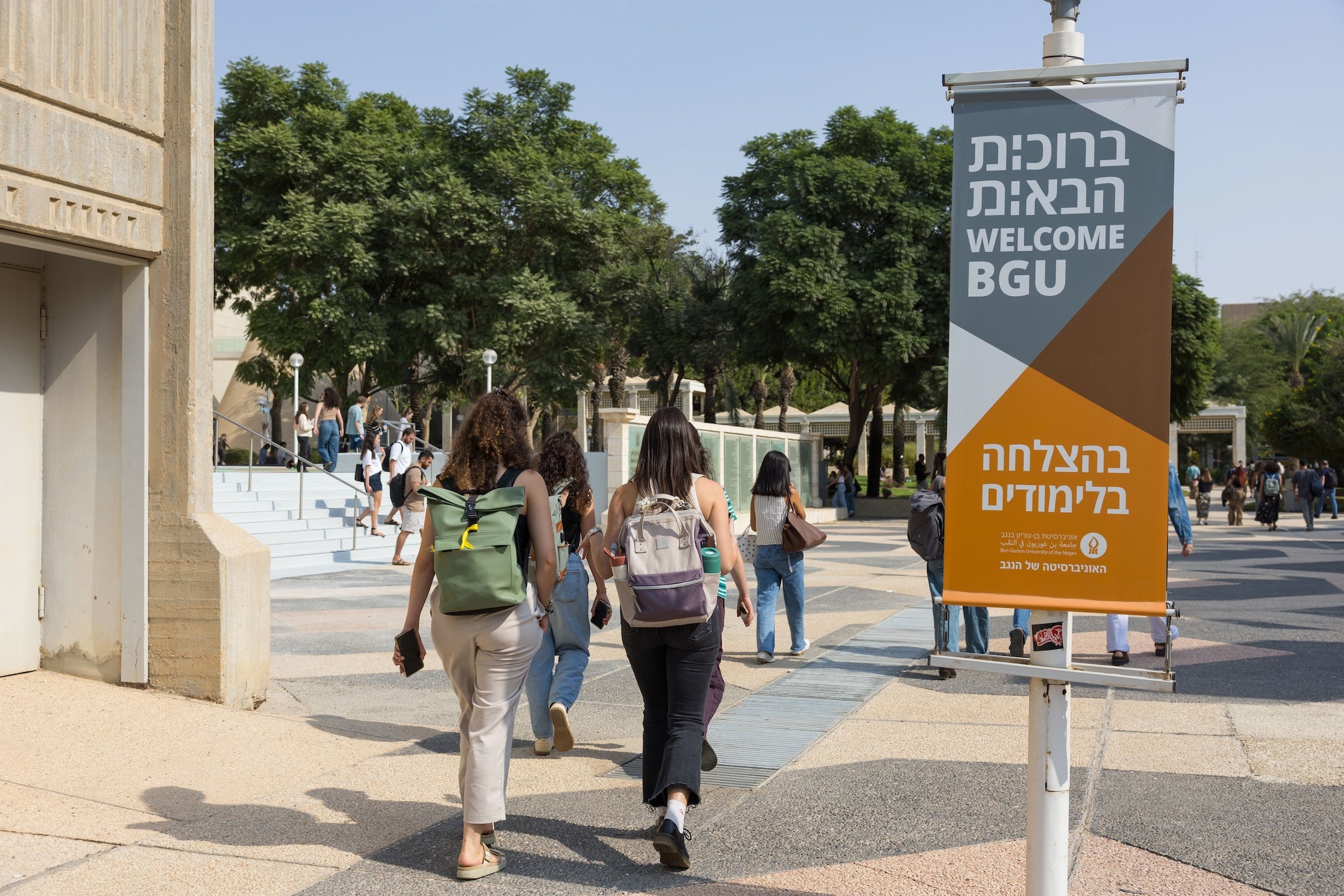
BEERSHEBA, ISRAEL (J. The Jewish News of Northern California via (JEWISH REVIEW)) — As a high school student in Beersheba in the mid-1990s, Tomer Cohen used to stop by Ben-Gurion University to use its computer lab, which had the machines and, more to the point, the internet.
“I was hanging out on BGU long before I was a student, and it’s the only place I applied to,” he said.
Then he left. Cohen graduated in 2005, worked around Tel Aviv, earned an MBA at Stanford and spent 14 years at LinkedIn headquarters in Sunnyvale, six of them as chief product officer.
“It was really the jobs that drew me where I went to live,” said Cohen, who still lives in the Bay Area. But he sees potential for his hometown. “People would stay gladly if the opportunities were there,” he said.
For more than a decade Ben-Gurion University has been trying to create those opportunities itself. It opened a technology park next to campus back in 2013 when no developer would, helped draw chip giant Nvidia, other tech giants and the Israeli army’s computing corps to that site, and started a venture fund run by its students. The goal is to give the engineers it trains a reason to build careers in the Negev’s largest city instead of leaving.
Whether the plan works out may depend on Silicon Valley companies whose commitments can rapidly shift, as well as on a population that Israel’s tech industry has only begun to tap: the Negev’s Bedouin residents.
Why they leave
Most Ben-Gurion graduates who leave head to Tel Aviv, Israel’s economic center located on the Mediterranean coast an hour north by train. Part of the reason they leave is the location itself. In August, the average afternoon reaches 93 degrees in land-locked Beersheba. In spring and fall the sharav, a hot desert wind, can cut visibility to a few hundred feet.
For decades, the Negev was where the state sent new immigrants. Cohen’s parents came separately from Tunisia and were settled in Beersheba at a time when few public services were available.
“For many years, the country failed the development of the Negev,” said Dan Blumberg, a Ben-Gurion vice president. “In many ways, this was, and in some ways still is, the backyard of the country.”
The city lacks the density that draws young engineers to Tel Aviv. About 220,000 people live in Beersheba, according to government records. Tal Levi, who directs strategic partnerships at Prisma Negev, a regional economic development center that the university launched in January, acknowledged the challenge Beersheba faces. A company that moves to the area is asking its employees to live somewhere without the conveniences they’re used to in Tel Aviv, like a “coffee shop under their house,” he said.
Ben-Gurion President Daniel Chamovitz turns that into a selling point. “Because there’s nothing to do in Beersheba, the students come to Ben-Gurion University to build a new life for themselves,” he said. He calls it Israel’s only destination university — meaning one that students move away from home to attend.
The university’s graduates are building successful companies. A 2026 analysis by professor Ilya Strebulaev of Stanford’s Graduate School of Business and its Venture Capital Initiative ranks Ben-Gurion as No. 3 among 18 institutions outside the United States with the best odds of a graduate founding a venture-backed startup inside the United States that becomes a billion-dollar company.
Only Tsinghua University in Beijing and Insead, a global business school with campuses in France, Singapore and Abu Dhabi, score higher. Ben-Gurion ranks above Tel Aviv University, Oxford and Cambridge. The question is whether more of these Israeli graduates could build their companies in Israel.
A park no one would build
The technology park that opened 13 years ago was the university’s idea. “The only reason we did it is because no one would come and invest,” Chamovitz said. “They don’t want to believe in the potential.”
Gav-Yam, a publicly traded Israeli property company, owns 73% of the park and put up the buildings. The university, the city, private investors and KUD International, the firm that designed the site, own the rest. Today, the park holds about 4,000 tech workers at some 70 companies, including Microsoft, Dell, Wix and CyberArk. Gav-Yam said about 80% of those employees live in the Negev.
The most recent expansion at the park came via Silicon Valley. In July, Santa Clara-based Nvidia tripled its Beersheba site to about 32,000 square feet, in the park’s fifth building. Its teams there, inherited from the 2019 acquisition of the Israeli company Mellanox, work on technology that ties thousands of chips together inside AI data centers.
That investment is now less certain. Israeli officials worry that turmoil at Nvidia, including CEO Jensen Huang’s departure and U.S. government suspicions that Nvidia’s chips reached China, could hurt Israel’s economy. Israel collects about $3.1 billion a year in taxes from the company. Nvidia declined a request for comment.
Blumberg, who played a major role in getting the technology park built, said its selling point is the pipeline of talent that’s minted by the university.
“The reason Nvidia are here is not because they like the Negev, not because they’re Zionists. But the bottleneck of every company now is human capital,” he said. “And we produce the engineers that they want, and they want to get them early on.” In practice that means hiring fourth-year undergraduates and steering master’s students toward areas the company cares about.
The army is moving in next door, too. In May, the first units arrived at a new communications campus beside the park that will eventually hold about 8,000 soldiers and officers. About 20,000 military technology personnel are expected to serve in the Negev by the end of the decade.
Chamovitz would rather the army were a smaller part of the story.
“I don’t want to be known as a military university,” he said. “We’re not a military university, but the ecosystem has the military involved in it.”
Starting before graduation
The university is encouraging students to start companies while they’re still on campus. In 2018, it set up Cactus Capital, a venture fund run by students and funded with $3 million out of the president’s budget, according to Dana Gavish-Fridman, who with professor Carmel Sofer founded Yazamut 360, the entrepreneurship center that houses it.
“Do it here in the hub. Don’t wait until you graduate,” Gavish-Fridman said, describing the university’s message. “Do it while you study.”
The fund’s chief executive is Ariel Cohen, a 25-year-old math major who wasn’t sure he wanted to go to college at all. (He isn’t related to Tomer Cohen.) “Globally we’re trying to model what’s happening in Silicon Valley,” he said.
Startup founders supported by Cactus Capital have gone on to raise more than $14 million from other investors, according to Cohen. The standout example is Feminai, which is working on a wearable patch that lets women screen themselves for breast cancer at home. In January, the startup raised $6 million in a round led by Vertex Ventures Israel.
Some faculty have built companies of their own. Professor Mor Peretz turned down offers from UC Berkeley and MIT to build CaPow out of his Ben-Gurion lab. It powers warehouse robots over radio waves while they move, so a fleet never has to stop for charging. Toyota Ventures and Elements co-led a $15 million round in March for CaPow, and 34 people work there, most of them his students.
Still, Peretz told the business daily Calcalist last year that the Negev still has no real tech “ecosystem.” Companies trying to pull workers south, he said, must offer room to advance, not just higher pay.
Close to home
The largest untapped supply of engineers in the south is Bedouin citizens. They make up close to 40% of the Negev’s population. About 60% of them are under 18.
Othman Alshekh grew up in Tel Sheva, a Bedouin town outside Beersheba. He earned his doctorate at Ben-Gurion and lectures there. Nine years ago he co-founded Siraj Technologies to bring Bedouin engineers into tech. The name is Arabic for “lamp.”
“We established Siraj to create role models that create technology, working with their MacBooks and AirPods,” he said.
Siraj started with four employees. It now has more than 30, most of them engineers. They come from Rahat, Segev Shalom and Beersheba, and from villages the government doesn’t recognize. Alshekh expects the staff to be half women within two years. Most of the engineering students he sees now are women, he said.
Its newest work focuses on Bedouin towns. An AI voice agent answers municipal call centers in Bedouin Arabic. Residents can photograph a pothole or a fallen tree, and the system opens a ticket. Rahat, Lakiya and Hura use it.
“So imagine that Bedouin engineers using the edge of the technology to serve their own towns,” Alshekh said.
Some of his engineers live in unrecognized villages without paved roads or cell service. In winter, the tracks turn to mud, and they work from home. Most have Starlink.
Siraj chose the technology park for its headquarters.
“We are here by choice,” Alshekh said. “We want to be part of the game, in the middle of the game.” The company has taken its software on a road show to Santa Clara and San Jose. But Alshekh said that isn’t the goal.
“We’re not trying to send talent from the Negev to Silicon Valley,” he said. “We’re bringing Silicon Valley opportunities to the Negev.”
This story was first reported by J. The Jewish News of Northern California and is reprinted with permission.
Count yourself in. Independent Jewish journalism runs on thousands of readers. Join them with a year-end gift. We can’t do it without you.