

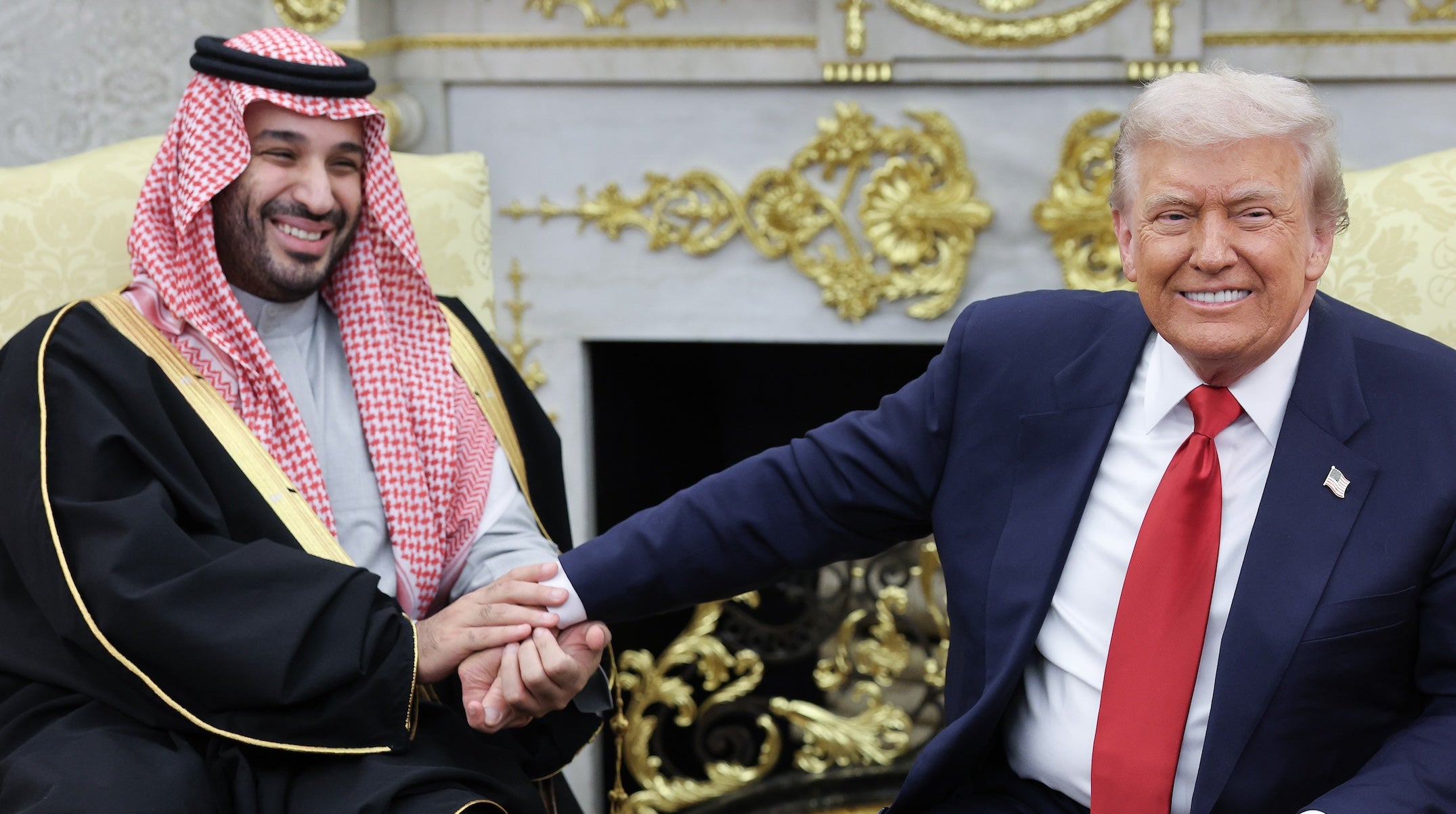
JERUSALEM — A U.S. civilian nuclear deal with Saudi Arabia announced by the Trump administration on Wednesday is alarming some Israelis and Americans.
Critics are concerned that the deal, through which U.S. companies would help Saudi Arabia build civilian nuclear energy plants, could allow Saudi Arabia to eventually develop nuclear weapons. The proposed plants would have the capacity to enrich uranium and reprocess spent nuclear fuel without pervasive oversight.
The arrangement removes one of the key incentives to encourage Saudi Arabia to normalize relations with Israel. The Biden administration had been in the process of exchanging such nuclear access for Saudi acceptance of open ties with the Jewish state when the Hamas-led attack against Israel on Oct. 7, 2023, upended the efforts.
A statement announcing the deal by Energy Secretary Chris Wright did not mention Israel. The two agreements signed Wednesday, one allowing U.S. companies access and a bilateral safeguards agreement, “advance U.S. and regional security by upholding high standards of nuclear safety, security and nonproliferation,” Wright said.
The nuclear deal will be given to Congress for review, but according to Reuters, it can only be blocked by a two-thirds majority.
When quizzed by Army Radio on the deal, Likud Culture and Sports Minister Miki Zohar said Israel has been clear with the United States about its red lines but would not say if such a deal crossed that line.
These are conversations that Prime Minister Benjamin Netanyahu is having with security experts, he said.
Israeli opposition politicians were blunter about the potential danger ahead of the deal. Former Israeli Defense Ministers Avigdor Liberman and Benny Gantz both warned that a U.S.-Saudi nuclear deal could spark a regional arms race.
That could happen because a nuclear Saudi Arabia, which is Sunni, could spur its Shi’a rival, Iran, to take even more aggressive steps toward building a nuclear bomb. Iran already possesses enrichment capabilities, and the point of the current war launched by the United States and Israel is to keep it from obtaining a nuclear weapon.
Liberman, who heads Yisrael Beytenu, wrote on X that “a civilian nuclear program in Saudi Arabia will end with nuclear weapons [production] and lead to a mad arms race across the entire Middle East.”
Yair Golan, a former IDF major general who was a deputy chief of staff and now heads the opposition Democrat Party, said that the long desired Israeli-Saudi deal would have created important diplomatic ties and anchor a regional strategic alliance against Iran.
To give Saudi Arabia nuclear capabilities “without stringent monitoring requirements and without a framework of relations with Israel as a condition creates a dangerous reality for the State of Israel,” Golan wrote on X.
Wright in his statement sought to assuage such concerns. “Rest assured, these agreements uphold the highest standards of nuclear safety and nonproliferation,” he said.
At the White House on Tuesday, Trump spoke broadly about other countries joining the Abraham Accords, the regional normalization agreements he brokered at the end of his first term in 2020, but did not mention Saudi Arabia.
The accords created a regional rubric under which Israel normalized ties with some Muslim countries, including the United Arab Emirates, Bahrain and Morocco. Both Trump and former President Joe Biden had sought to bring Saudi Arabia into the pact.
Tensions throughout the region following the Oct. 7 attack and the Gaza war, however, pushed Saudi-Israel normalization further out of reach. The Saudi demands for normalization sharpened in the subsequent years and include Palestinian statehood or, at the very least, progress toward that goal. The Netanyahu government has adamantly rejected such a condition in the wake of the attack, and the Israeli public has increasingly opposed the concept as well.
Sen. Lindsey Graham of South Carolina, who died last week, was an ardent advocate for an Israeli-Saudi deal. He had pushed Trump not to make nuclear concessions to Saudi Arabia without the kingdom moving closer to Israel.
Graham had continued to work on normalization in the months leading up to his death. He told CBS News in June, “We’re going to try to get Saudi Arabia to join the Abraham Accords to end the Arab-Israeli conflict in 2026.”
Dan Shapiro, who worked during the Biden administration as a senior adviser on Middle East regional integration for the State Department, said Wednesday that a U.S.-Saudi nuclear deal would make such normalization more difficult.
The plan originally was for a civil nuclear energy agreement with sufficient safeguards against proliferation to be part of a package that would include normalization with Israel, he said.
“It appears that the Trump administration has given it away without normalization,” Shapiro told the Jewish Telegraphic Agency. Trump’s deal “seems to have abandoned a very important point of leverage to advance another important regional goal of the United States,” he said.
“This was supposed to be a major carrot for Saudi Arabia if they were to normalize with Israel, and now that carrot has been provided without it.”As a result, he said, “the whole incentive structure would have to be redone.”
Reporting the stories that define our era. When history unfolds in real-time, the Jewish world turns to (JEWISH REVIEW). Your support ensures we can document the complexities of war and the resilience of Jewish communities with integrity.