
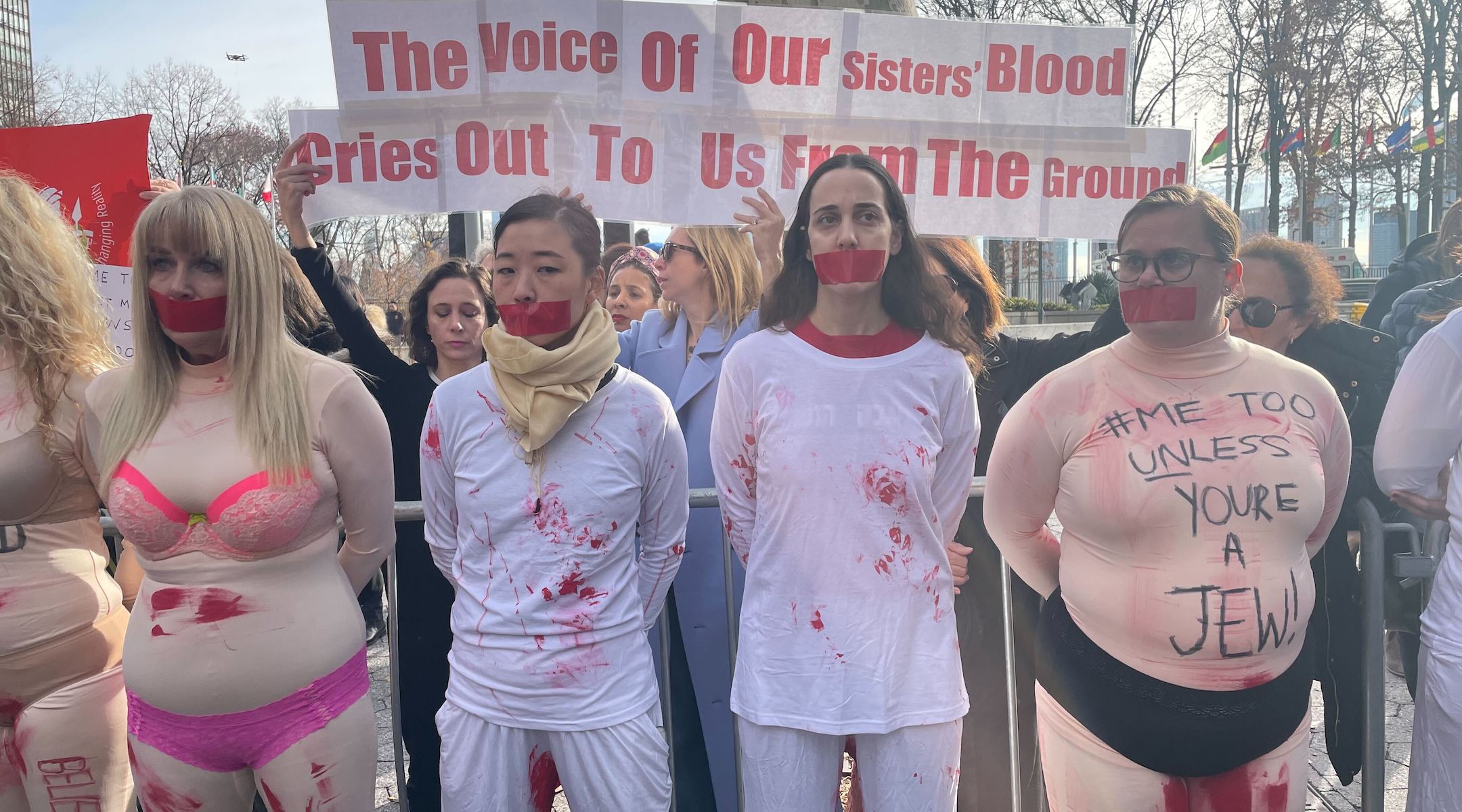
A sweeping new Israeli report on sexual violence committed during the Hamas-led Oct. 7 attacks and against hostages in Gaza concludes that the crimes formed part of a deliberate strategy. It also lays out a roadmap for turning two years of documentation into legal prosecution.
The report concludes that “sexual and gender-based violence was systematic, widespread, and integral to the October 7 attacks and their aftermath.”
The report comes from Israel’s Civil Commission on Oct. 7 Crimes by Hamas Against Women and Children, an independent panel convened in the immediate wake of the attack. The commission was led by Cochav Elkayam-Levy, an attorney and international law expert who was recently awarded the Israel Prize, Israel’s top civilian honor, for her work.
Starting by collecting online material filmed or circulated by Hamas, the commission labored for two years in an effort to generate a factual record that Elkayam-Levy said could withstand the scrutiny and denial that has accompanied claims about sexual violence on Oct. 7 and in its aftermath, particularly the idea that the sexual violence was systematic.
Researchers reviewed and analyzed more than 10,000 photographs and video segments, amounting to more than 1,800 hours of footage, alongside more than 430 testimonies from survivors, witnesses, released hostages, experts and family members.
They identified 13 recurring patterns of sexual and gender-based violence across Oct. 7 attack sites, abductions and captivity, including rape, gang rape and other forms of sexual assault, sexual torture, forced nudity, threats of forced marriages, postmortem abuse, the public display of victims and the filming and dissemination of sexualized violence.
The evidence “proves that it wasn’t isolated violence, it wasn’t random,” Elkayam-Levy said. “It was a strategy, carried out with exceptional cruelty on victims and on hostages in captivity.”
International law professor Cochav Elkayam-Levy meets with foreign leaders in Jerusalem, Nov. 23, 2023. (Nicolas Maeterlink / Belga Mag / AFP via Getty Images)
The report also says genocide must be examined as a possible legal characterization, citing the “scale, coordination, and systematic nature of the violence,” the targeting of civilians as part of a campaign to destroy Israelis and Jews, and the infliction of severe bodily and mental harm, “including through sexual violence and torture.”
The report devotes specific attention to sexual violence against men and boys, documenting rape, sexual torture, mutilation and sexualized humiliation that the authors say has often been overlooked in public discussion of Oct. 7.
The report includes testimonies that have already surfaced, such as from Amit Soussana and Keith Siegel, two former hostages who said they had been sexually assaulted by their captors.
But it also includes accounts that had not previously been made public, including cases of sexual violence inflicted in the presence or near vicinity of family members. In at least one case the researchers documented, family members held hostage together were forced to perform sexual acts on one another, an example of what the commission characterizes as “kinocidal” sexual violence, meaning violence aimed at destroying family structures by exploiting familial bonds.
Yet the report aims to go beyond simply documenting horrific traumas. A 70-page legal section argues that the documented acts support prosecution for war crimes, crimes against humanity, torture and sexual and gender-based violence linked to terrorism.
It notes that victims of the Oct. 7 attacks represented 52 nationalities, giving multiple governments potential avenues to investigate and prosecute through domestic terrorism laws, extraterritorial jurisdiction or universal jurisdiction.
So far, those efforts remain “scarce and fragmented,” the report says, with investigations or legal steps undertaken in the United States, France, Germany and Canada, as well as at the International Criminal Court in the Hague. In the case of the ICC, its prosecutor sought warrants for Yahya Sinwar, Ismail Haniyeh and Mohammed Deif over crimes including rape and other sexual violence, but all three Hamas leaders were killed by the IDF and the proceedings were terminated.
The report argues that sexual violence prosecutions do not have to depend only on direct survivor testimony, a central issue for Oct. 7 cases as many victims were murdered, witnesses were traumatized and released hostages could speak only after months in captivity. International courts have relied on direct witnesses, expert witnesses, forensic material, circumstantial evidence and digital documentation, while ICC rules do not require corroboration for sexual violence crimes.
“The report shifts the global conversation from whether this happened to what the consequences should be,” Elkayam-Levy said in an interview ahead of the report’s release. “We’re going to see a before-and-after moment with it.”
Whether that comes to pass remains to be seen. The report arrives in a climate of denial around sexual violence on Oct. 7 that was fueled in part by early accounts that were later challenged. Critics of Israel’s claims have repeatedly pointed to disputed elements in an investigation published in The New York Times in December 2023, including the case of Oct. 7 victim Gal Abdush, whose relative questioned whether there was proof she had been raped, and to accounts of sexual violence by ZAKA first responders that were later debunked. Those cases helped denialists attack the wider body of evidence documented by UN officials, Israeli investigators, journalists and groups like Amnesty International and Human Rights Watch.
Elkayam-Levy herself has been the subject of criticism, with a March 2024 report in Yedioth Aharonoth citing unnamed government officials questioning the commission’s structure and the accuracy of some of her early public claims, including a widely debunked account that a pregnant woman had been found with her womb cut open — criticism that was picked up by skeptics of Oct. 7 sexual violence claims.
In response, Elkayam-Levy said some of the early mischaracterizations reflected the confusion of the first days after the attack, when first responders and those recovering hundreds of bodies were working in traumatic circumstances.
“It is precisely because of that early chaos, and the widespread denial, that this report was prepared under the strictest international verification standards, with every testimony and piece of evidence carefully cross-checked and corroborated,” she said.
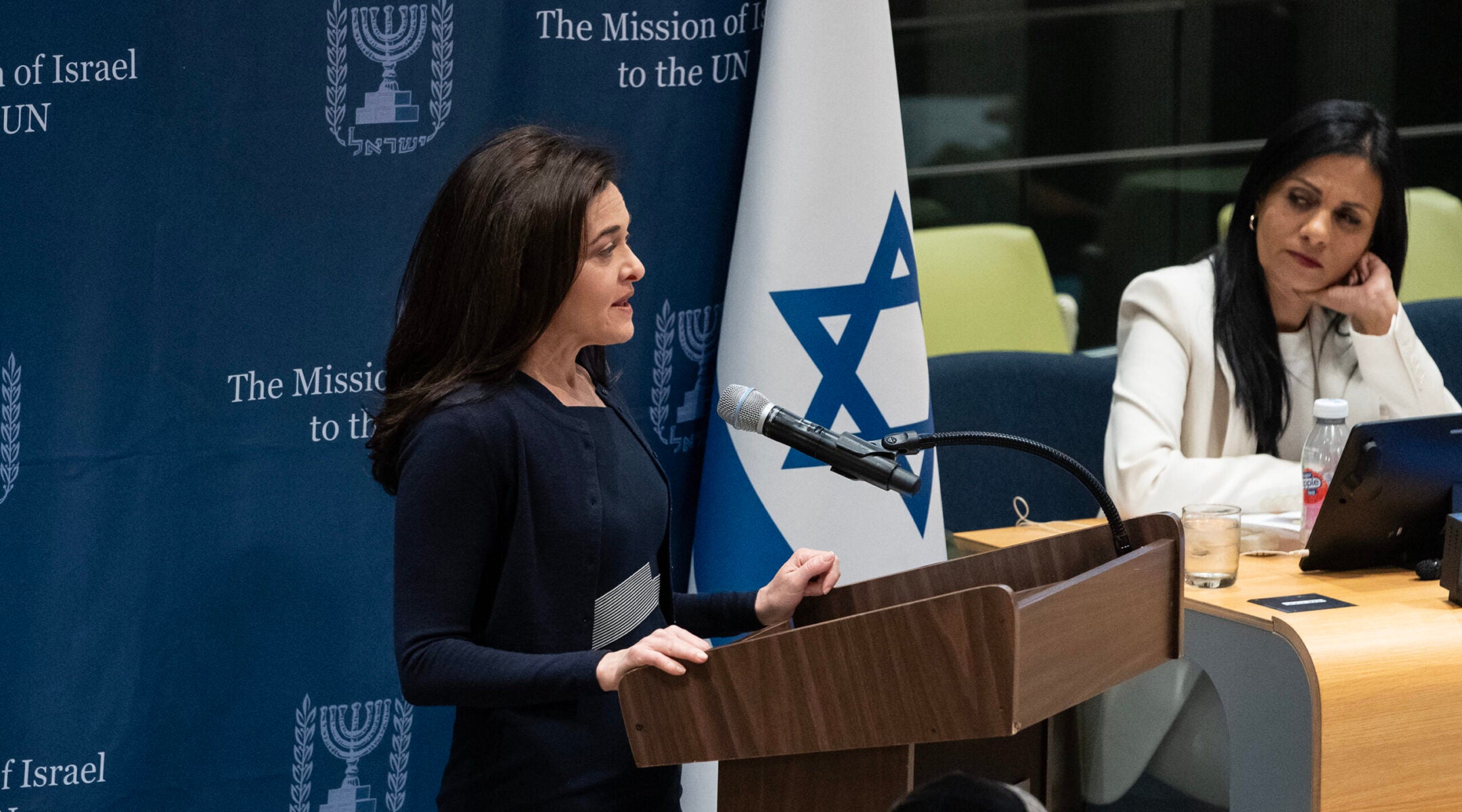
Sheryl Sandberg speaks during special event to address sexual violence on Oct. 7 held at UN Headquarters in New York City, Dec. 4, 2023. (Lev Radin/Pacific Press/LightRocket via Getty Images)
Elkayam-Levy said the backlash she personally experienced was “very scary,” with threats to her life and antisemitic groups circulating her image alongside accusations that she was “lying about Hamas.”
The team, made up of about 20 employees and additional volunteers and contributors, worked from a hidden location, with some researchers choosing to remain anonymous throughout.
Elkayam-Levy said the release of the archive may not stop denial from “social media trolls,” but it changes the evidentiary landscape in ways serious observers can no longer ignore.
She pointed to remarks made early on in the war by philosopher Judith Butler, who cast doubt on reports of rape on Oct. 7, comments Elkayam-Levy said caused deep anguish to victims and those documenting the crimes.
“Every item is now archived and here to stay, for her to feel ashamed of what she did and to be remembered as a person who did not stand with the victims, who forgot the purpose of her work as a feminist,” she said.
Elkayam-Levy is optimistic that prosecutions could result. She said accountability may unfold over years and across borders, with some Hamas leaders and perpetrators already hiding in Turkey and Qatar and others likely to reach Western countries.
“I think it will be the same as the Holocaust, that different Nazi leaders were prosecuted around the world,” she said.
Still, Elkayam-Levy said even successful prosecutions would not be enough to convey the magnitude of the crimes or preserve their place in historical memory.
“You don’t learn about the Holocaust from the prosecution of a single person,” she said. “You learn it from the documentation, from the witnesses, the survivors.”
The report calls for an “incontrovertible judicial record,” citing the Nuremberg trials, recent German prosecutions of ISIS crimes against Yazidis and Ukraine’s war-crimes documentation as models for legal efforts that can establish an enduring record as well as punish perpetrators. It recommends a coordinated strategy combining Israeli proceedings with international cooperation, evidence-sharing, specialized war-crimes units and prosecutors trained in sexual and gender-based crimes.
The Civil Commission is not alone in arguing that the sexual violence of Oct. 7 requires a legal response. The Association of Rape Crisis Centers in Israel submitted an early report to the UN in 2024, and the Dinah Project, led by legal experts at Bar-Ilan University’s Rackman Center, published an 84-page report in July concluding that Hamas used sexual violence as a “tactical weapon” during the attacks and in captivity. A month later, the UN Secretary-General listed Hamas among parties “credibly suspected” of patterns of rape or other sexual violence in armed conflict.
Elkayam-Levy said the new report should not be treated only as a document for prosecutors, legal scholars or women’s rights advocates. Sexual violence is too often treated as an issue that “belongs to women’s committees,” she said, when the findings should also be studied by those responsible for national security and counterterrorism.
Accountability should also extend to social media platforms, after Hamas-led perpetrators filmed and circulated images of victims to “glorify the atrocities in real time,” according to the report.
The commission has drawn support from high profile figures including David Crane, founding chief prosecutor of the UN Special Court for Sierra Leone, former Israeli Supreme Court president Aharon Barak, former Secretary of State Hillary Clinton and tech executive Sheryl Sandberg, who has campaigned internationally for recognition of Oct. 7 sexual violence.
The archive is led by Karen Jungblut, a former archivist at the USC Shoah Foundation. The commission has also been approached by people trying to document sexual violence in other atrocity settings, Elkayam-Levy said, including Druze contacts seeking guidance after recent attacks in Sweida, Syria.
The report’s release came a day after the Knesset overwhelmingly passed a law establishing a special military tribunal to try captured Hamas-led Oct. 7 perpetrators, with authority to impose the death penalty in some cases. But it warns that capital punishment could deter international support and extradition, noting that comparable hybrid courts combining domestic and international elements do not permit capital punishment.
Executions, Elkayam-Levy further argued, could overshadow the legal record, divert attention from victims’ suffering and turn the proceedings into a global controversy. “My fear is that the terrorists will be remembered more in the universal, historical memory than the victims themselves.”
In taking testimonies from survivors, Elkayam-Levy said, one of the final questions her team asked was what gave them strength and what justice meant to them. The answers, she said, were striking for how little they had to do with indictments or convictions.
“More than anything else, they want the truth to be heard and for them to be recognized and believed,” she said.
Reporting the stories that define our era. When history unfolds in real-time, the Jewish world turns to (JEWISH REVIEW). Your support ensures we can document the complexities of war and the resilience of Jewish communities with integrity.