

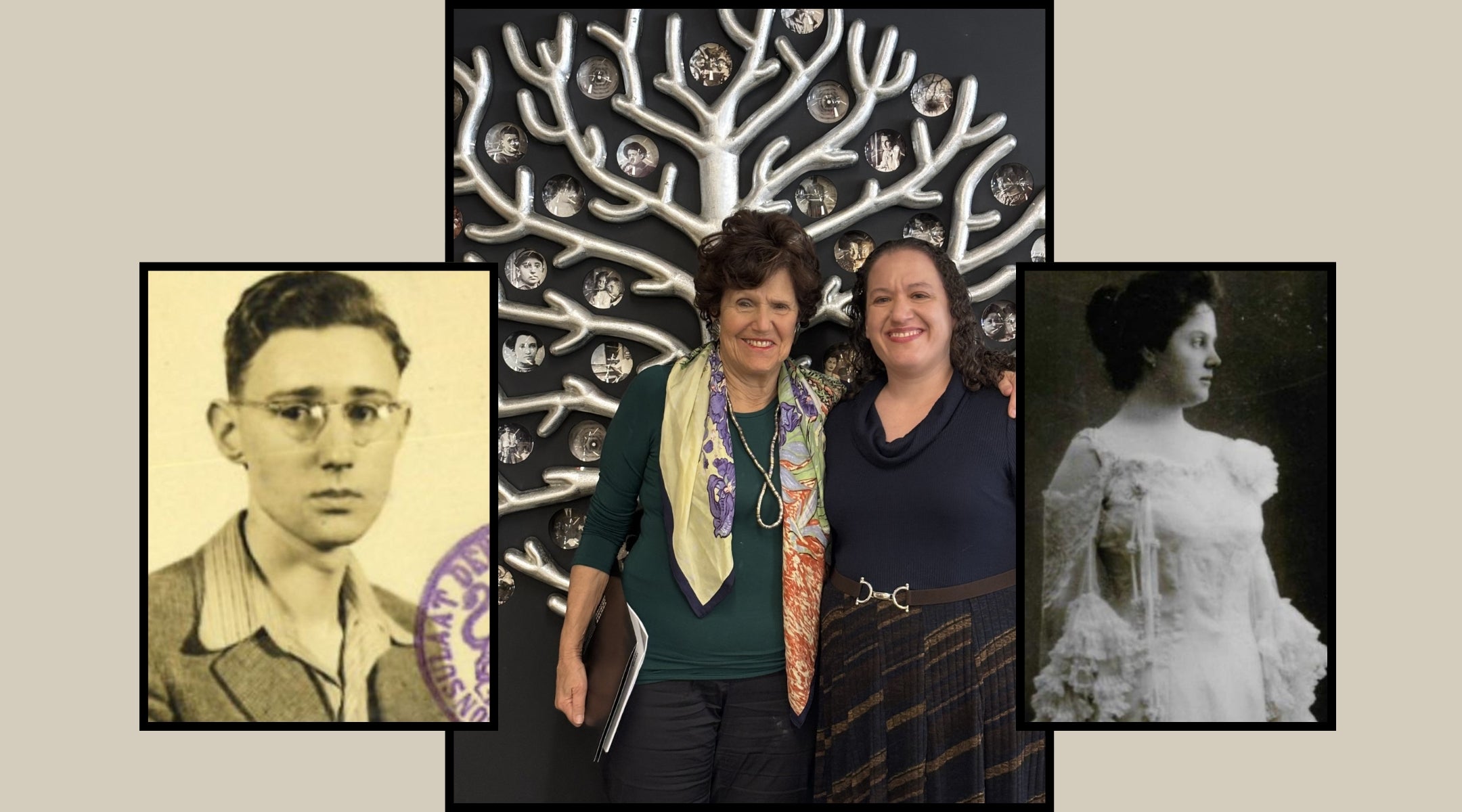
As a Jewish food writer and anthropologist of sorts, Joan Nathan had always been interested in her own family’s history. The “Julia Child of Jewish cooking” has even written about it in her recent autobiography, “My Life in Recipes.”
But many details about her father’s family, most of whom had perished in the Holocaust, were scant.
On a recent Thursday morning, Nathan spent two hours at the Ackman and Ziff Family Genealogy Institute in Manhattan, where those secrets would be uncovered as part of a new program called “Histories and Mysteries.” Nathan learned about the fate of a great-aunt, who was confined at Theresienstadt, and her grandson, who by a circuitous, ultimately tragic path is remembered by Catholics as a martyr.
She discovered not only what happened to those relatives, but saw photographs of them and their homes, and read newspaper articles and letters about them.
“My father talked about his family so much,” Nathan, 83, told the Jewish Telegraphic Agency. “But it seemed far away. And now that I know more, it’s much closer.”
The free program, launched Jan. 7, uses genealogy, crowdsourcing, archival records and photographs, and aims to answer unsolved questions about and restore connections between families that were victimized by the Holocaust. So far, about 50 people have applied to have their families’ mysteries solved, and 12 cases are actively being researched by the team, which includes volunteers, said a representative for the Center for Jewish History, where the genealogy institute is housed.
As long as the research question seems solvable, it may be selected for the program. (Geographic areas where there was little official documentation, or inquiries with unknown or common names may be difficult to research.)
“Histories and Mysteries” is funded by a nearly $300,000 grant from The Conference on Jewish Material Claims Against Germany and is supported by the German Federal Ministry of Finance. It’s an additional service of a center that already offers visitors access to a range of online databases and research guides, with staff available to assist on a search. Holocaust survivors and their immediate descendants can also make appointments for in-depth searches.
Nathan’s story will be shared on the Center for Jewish History’s social media channels on April 14, in commemoration of Yom HaShoah.
“Every name recovered, every connection restored, is an act of remembrance that reaches far beyond a single family,” Gideon Taylor, president of the Claims Conference said in a statement to (JEWISH REVIEW). “By uncovering these histories, we are preserving memory, not only for descendants, but for the world, safeguarding truth against distortion and silence. This work reminds us that remembrance is not static; it is an ongoing responsibility we all share.”
Nathan was curious about two relatives in particular: her great-aunt Marie Bernheim, and Wolfgang Bernheim, Marie’s grandson.
From her own research and speaking to family members, Nathan knew just a few facts about Marie. Marie had married Siegfried Bernheim, the owner of a chemical factory in Augsburg, Germany, and had three sons: Kurt, Willy, and Heinz.
But the lead genealogist on Joan Nathan’s case, Moriah Amit, found additional information and documents that filled in some blanks on the Bernheim family, and helped fit the family into that tragic part of German-Jewish history.
“Joan gave me very little information about the family members that she was interested in me researching,” Amit said. “I was up for the challenge.”
A newspaper article published in 1933 falsely accused Siegfried and his sons of committing tax evasion and foreign exchange fraud. Marie and Siegfried’s middle son, Wilhelm, was imprisoned for two years as a result. The business was among the first in Germany to be “Aryanized,” or seized by the government from the Jews, based on these allegations.
“The primary sources were just amazing to me — and the newspaper accounts,” Nathan said, pointing at a digital scan of the 1933 clipping on Amit’s laptop. “This was shocking to me. The Bernheim family, my family, was not a bad family.”
By 1942, Marie was the only member of her family remaining in Munich. (The others had emigrated or passed away of natural causes.) She was deported to Theresienstadt, where her cremation card shows she died there in January 1944 — just five months before the ghetto and transit camp was liberated.
In Switzerland, Marie’s eldest son Kurt was living a very different life. After the birth of his son Wolfgang, he divorced from his first wife, married again, and converted to Catholicism, along with his son. By 1938, as the Nazis tightened their grip on Germany, Wolfgang’s family made plans to leave, and most of them headed to Switzerland. For unknown reasons, the now 15-year-old Wolfgang remained in Germany, where he lived alone. In 1940, he finished his studies at St. Benedictusberg Abbey in the Netherlands, on the border with Germany.
A path near a church in the German city of Augsburg is named in memory of Wolfgang Bernheim, a relative of Joan Nathan’s who died at the Sakrau labor camp in Poland. (Courtesy Dicese of Augsburg) .
Nathan was especially struck by a photograph of Wolfgang taken around that year. His somber face contrasts sharply with the youthful smile of an earlier family picture from 1936.
“What he had gone through, I want my kids to see,” Nathan said. “The emotions are right in my heart. I just — I don’t think I’ll ever forget that face of Wolfgang.”
Now known as Brother Paulus, Wolfgang began to make a life for himself as a monk. But in 1942, the Nazis began deporting Dutch Jews. The Catholic churches in the Netherlands opposed the policy, and in response, the Nazi Commissioner of the Netherlands declared that all Jews who had been baptized as Catholic be deported. With Wolfgang’s life in danger, his fellow monk Jos Niesen — a member of the Dutch resistance — attempted to smuggle Wolfgang to Switzerland. But when Niesen presented the plans to the abbot of the monastery, he was met with hesitation. The abbot was in a complex situation: save the monastery, or the life of one individual monk.
“He began to pressure Wolfgang to sacrifice himself for the monastery and allow himself to be taken away by the Germans,” Niesen wrote decades later in a letter to a colleague, recalling the events of Wolfgang’s deportation. “I, in turn, tried to convince Wolfgang that with the latter option, there was virtually no chance of surviving. He was reluctant to follow my plan.”
According to a relative of Nathan’s who provided some of the sources Amit worked with, the abbot reportedly also wrote letters to the Vatican and to monasteries in Switzerland pleading for a safe exit for Wolfgang.
But an index card from The Jewish Council in Amsterdam shows that Wolfgang, just 19, was sent to the Westerbork transit camp. From there, he was sent to the Sakrau labor camp in Poland, where he died in the fall of 1942. Niesen described the emotional scene of his deportation.
“Even as I accompanied him to the main road at the foot of Mount Benedict, I pleaded with him until the very last moment, unfortunately without success,” Niesen continued in the letter. “We were both deeply affected and wept, but his decision was unshakeable. I helped him climb into the truck, which was already largely filled with women, men, and children, all wearing the Star of David.”
Though his life was cut short, Wolfgang is memorialized throughout the various places he made a mark. His name is listed in the memorial room for Jewish Holocaust victims in Augsburg’s city hall, and in 2010, he became a martyr of the Catholic Church. St. Benedictusberg Abbey commemorates his life every year on August 25.
In 2018, two memorials were installed at the last homes of Wolfgang and Marie in Augsburg. According to a newsletter documenting the ceremony, four generations of Bernheims were in attendance, as well as Catholic abbots from the area. The ceremony concluded with the multi-faith group singing “Heivenu Shalom aleichem” — “We have brought peace upon you.”
“I’m full of emotion,” Nathan said, still looking at the photos of Wolfgang. “It’s sort of permeated me.”
Passover may be over, but your chance to support independent Jewish journalism isn’t. Help (JEWISH REVIEW) keep reporting the stories that define our era.