

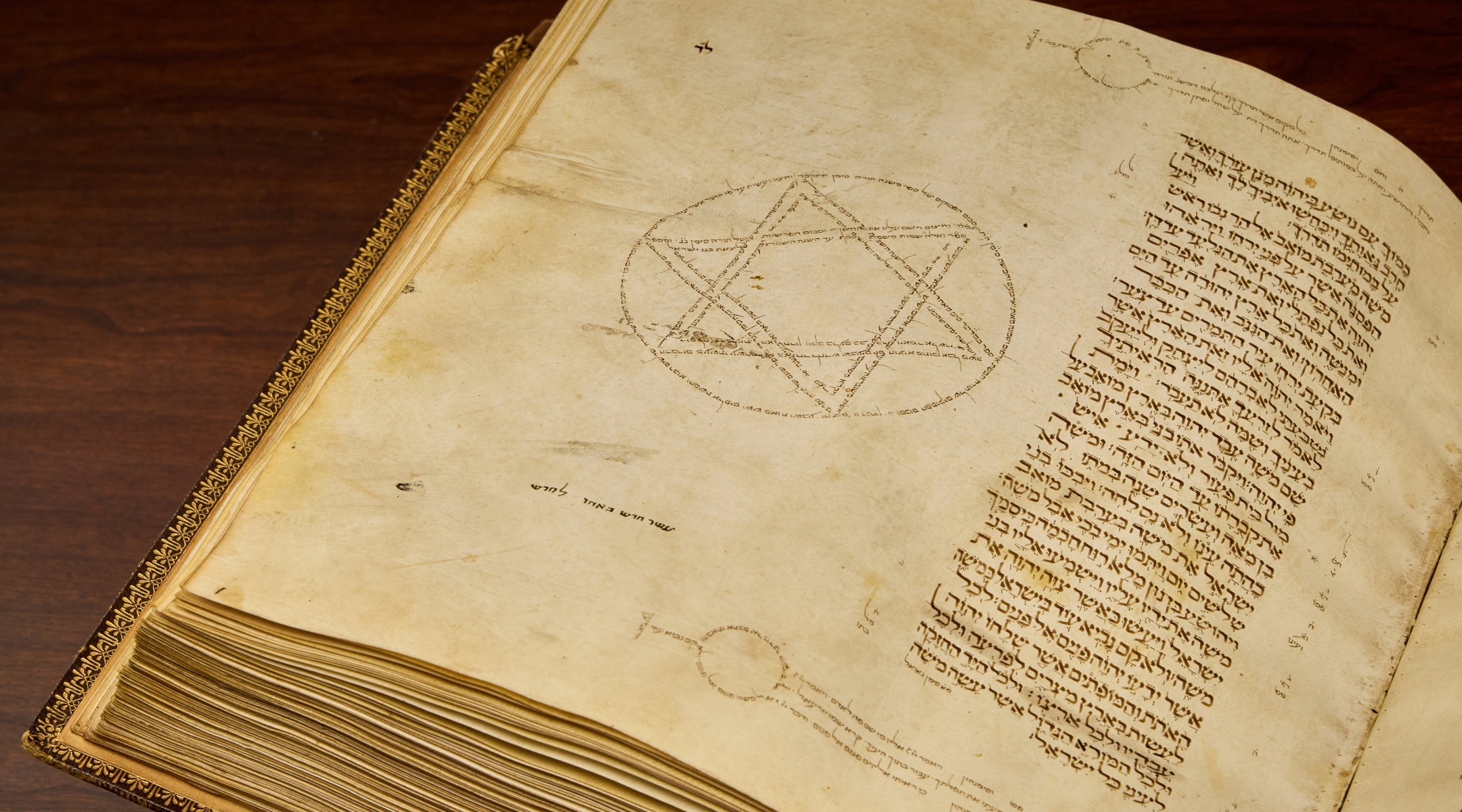
A rare, 14th-century handwritten Hebrew Bible from Spain will hit the auction block at Sotheby’s New York this month.
The medieval work, adorned with calligraphic art, is a Tanakh, or Five Books of Moses plus the Book of Prophets and Writings. It is estimated to fetch between $1.5 and $2.5 million when it is up for sale on Dec. 17.
“Beautifully scribed Hebrew Bibles from 700 years ago are really rare,” said Sharon Mintz, Sotheby’s international senior specialist of Judaica. “They very rarely come up for auction.”
The Spanish Bible is unique, she added, owing to the micrographic designs in the margins featuring Masoretic text — accents, vowels and cantillation, plus explanations that indicate how the Hebrew and Aramaic of Jewish texts should be read.
“A Rare Hebrew Bible with Micrographic Masorah,” as it is called in Sotheby’s catalog, is the highlight of December’s Important Judaica sale. It features 120 objects, including a Persian rug, circa 1900, that was commissioned for the Jewish physician of the Shah of Persia; a portrait of a Hasidic rabbi with an unusual connection to the beginning of World War I, and another Hebrew Bible, this one printed in Italy in 1492, during the first days of the printing press.
All of the items will be on view and open to the public from Dec. 11 through Dec. 16 at Sotheby’s New York, which recently relocated to the Breuer Building, a “once hated, now loved” Brutalist structure at 945 Madison Ave.
“Portrait of a Rabbi,” by Jewish painter Isidor Kaufmann from Austria-Hungary, who had ties to by Emperor Franz Joseph I of Austria. (Courtesy Sotheby’s)
The Bible hails from Toledo, Spain, an ancient city known for its significant Jewish community prior to the expulsion of Jews from the country in 1492. It was also the home of two famous Jewish scribes: Israel ben Isaac Ben Israel and Joseph ben Judah Ibn Merwas, who is possibly the author of this unsigned work, Mintz said.
Merwas was especially known for his skilled star of David lettering, which he drew in signed micrographic copies of at least two other Bibles, according to the Sotheby’s listing.
“It has all the markings of one of the great scribes of Toledo of the early 14th century,” Mintz said. “The Jews in Spain were known for how carefully and how skillfully they wrote manuscripts of the biblical text. They went to a lot of effort and expense to make sure that their texts were as correct as possible.”
Sotheby’s has sold a number of rare Bibles in recent years. In 2024, the Shem Tov Bible — a work from Spain from the same period, bedecked in gold leaf and other illuminations — fetched $6.9 million. The previous year, Sotheby’s sold the oldest and most complete copy of the Hebrew Bible, the Codex Sassoon, for $38.1 million, making it the most expensive book ever sold.
This month’s Important Judaica auction will be the first Judaica sale at Sotheby’s new digs.
“This various owners’ sale is unusual in the richness and variety of the objects that have been brought together,” Mintz said.
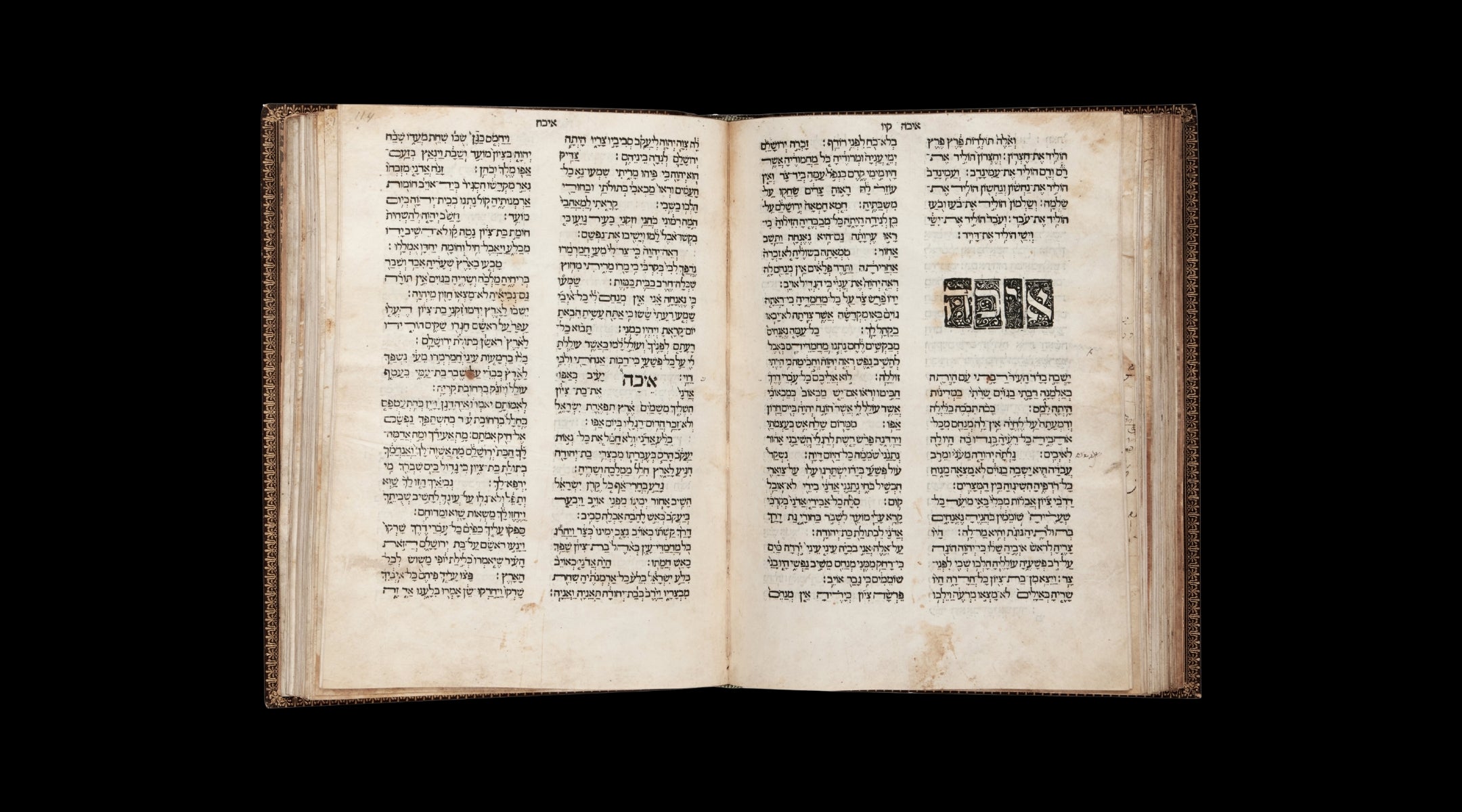
A Hebrew Bible printed on parchment in Naples in 1492 by the Soncino family press. (Courtesy Sotheby’s)
Other items in the sale include dozens of silver and gold Judaica pieces, a first edition copy of “Der Judenstaat,” or “The Jewish State,” the pamphlet published in German in 1896 by Jewish writer and political activist Theodor Herzl, which called for the creation of a national Jewish homeland; and a signed lithograph from the Aliyah series about Israel’s founding by Salvador Dalí.