

This article was produced as part of (JR)’s Teen Journalism Fellowship, a program that works with Jewish teens around the world to report on issues that affect their lives.
Holding up her phone while tossing her hair over her shoulder, a young woman records a TikTok of herself. On the screen appears a list of “Things that are spiritually Israeli: Snapchat, Gracie Abrams, any kind of AI, League of Legends, Jeremiah Fisher, QR code menus, Sigmund Freud, the May 22nd Mustafa Daniel Caesar concert, men, and choice feminism.”
Her TikTok post received almost 80,000 likes.
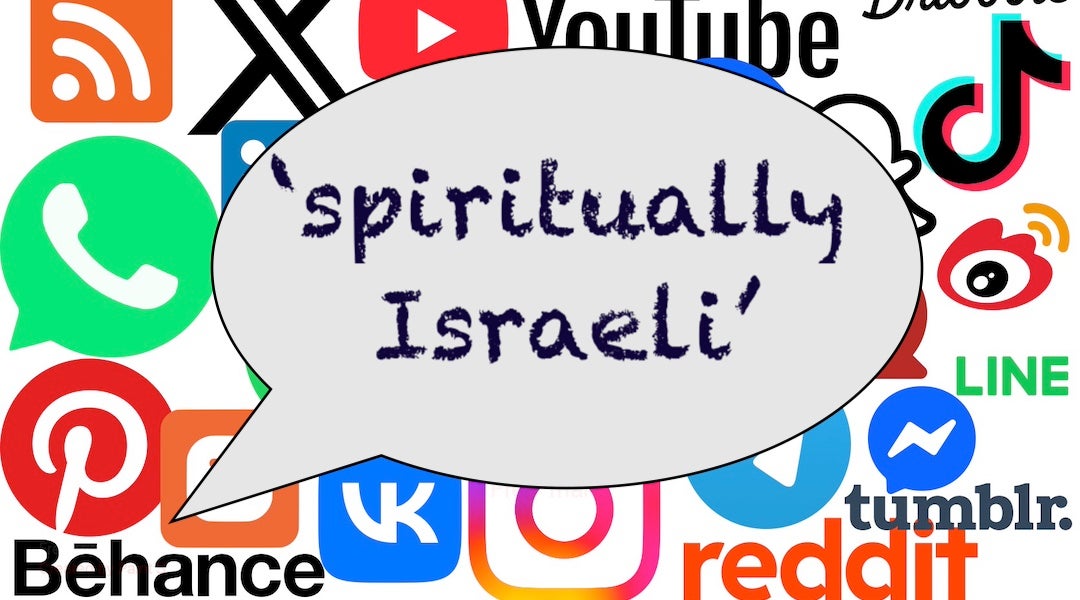
Across a number of social media platforms, posters use “spiritually Israeli” to describe something they find suspicious or soulless, or to assert their dislike of a trend, person or idea. It doesn’t matter if the thing being described has any connection to Israel or Jews. “Israeli” has become its own kind of pejorative.
For Jewish teens encountering this trend online, it has raised some complicated feelings.
Melanie Gross, a Jewish high school student from Harrington Park, New Jersey, is deeply irritated at the rising popularity of the phrase.
“It makes me feel very annoyed, because people just tend to copy whatever they see,” Gross said. “They’re like, ‘oh, this trend is gaining a lot of attention, so it’s probably an accurate depiction of Israelis.’”
The site knowyourmeme.com says “spiritually Israeli” is used as an insult to call celebrities, trends, products and other things “vapid” or “culturally empty.” Examples are seen frequently on TikTok: “I hate when I get a matcha and it tastes spiritually Israeli”; “The way you played the victim felt spiritually Israeli,” and “I can’t explain it but girls who look down on other girls for wearing makeup everyday are spiritually Israeli” are just a few examples.
According to the American Jewish Committee, 73% of American Jews have experienced antisemitism online. As antisemitic language becomes more common across social media, Jewish teens have also been encountering it more frequently in their feeds. This exposure not only affects their comfortability online, but also their sense of safety in their everyday lives.
“Trends like this one make it hard to express my Judaism,” said Gross. “Sometimes if I’m wearing a star of David necklace, there’s certain places where I’d tuck it beneath my shirt.”
As anti-Jewish harassment has risen not only online, but also in schools and public spaces, many Jewish teens are struggling to navigate a reality where online hostility is leaching into their daily lives.
Sixteen-year-old twins Sophie and Julia Ofeck, Israeli-American high school students from Old Tappan, New Jersey, both said that this phrase feels like a personal attack. “This trend gives people a negative perception of Israelis when they see the word ‘Israeli’ being used as a negative adjective,” said Sophie. She sometimes feels uncomfortable sharing her Israeli heritage with people she doesn’t know. “I’m scared of what they’ve seen on social media,” Sophie said.
Her twin sister, Julia, makes the distinction that “the term isn’t ‘spiritually Israeli government,’ it’s ‘spiritually Israeli.’ This difference is incredibly significant because it leads to widespread negative perceptions of Israeli people as this type of language becomes more common.”
More: Read a teen’s guide to the antisemitic memes flourishing on social media.
Some have defended the use of the phrase. Vocal Politics, an Independent media outlet covering the “Global South,” asserted in a TikTok video that the phrase is “a cultural response born from 2 years of witnessing Israel’s genocidal campaign in Gaza and wars across multiple fronts. “
Calling something “spiritually Israeli,” the video continued, “has become shorthand for corruption, deceit, colonial arrogance, or just criticising stuff they hate.”
And yet even if those using the phrase may think they are criticizing the Israeli government, the language is still dangerous because it is so vague, the Ofecks and other Jewish teens told (JR).
“People online need to draw a line between ‘dark humor’ and hate.” Sophie said, “People shouldn’t be talking about things they aren’t educated about. None of this is a joke, and it’s very hurtful to see.”
Meanwhile, some proud Israelis and Jews are responding by embracing the label as an ironic badge of honor.
On Reddit’s r/Israel community, a user recently suggested that Jews should “push back” and use the phrase “to describe odd quirks of Israeli culture that we love nonetheless.”
The suggestions poured in, from the Israeli love of cucumbers, to the average Israeli’s aversion to rain, to wearing shorts and a t-shirt to a wedding.
“They’ll get tired of using this phrase soon,” wrote a Redditor describing themselves as an “American-Israeli.” “I don’t think it’s going to become mainstream and it’s better that we just ignore it in my opinion.”
Nevertheless, although she was raised to be proud of being an Israeli, New Jersey high school student Zoe Geallat said that trends like these leave her “often ashamed and embarrassed, even though that shouldn’t be the case.”
“It’s very upsetting when I see things being said about my heritage,” Geallat said. “People just believe whatever it is they see, and then the hate keeps rising.”
Reporting the stories that define our era. When history unfolds in real-time, the Jewish world turns to (JR). Your support ensures we can document the complexities of war and the resilience of Jewish communities with integrity.