

This article was produced as part of (JEWISH REVIEW)’s Teen Journalism Fellowship, a program that works with Jewish teens around the world to report on issues that affect their lives.
Earlier this year Roberto, a high school student in Chicago, liked an Instagram post that called someone “low-key spiritually Israeli.”
Roberto, who isn’t Jewish, had seen many videos using the phrase and viewed it as an ordinary meme. He understood that the phrase wasn’t a compliment, but it wasn’t until a Jewish friend pointed out that the phrase “spiritually Israeli” is meant as an insult to Israeli and Jewish culture that he regretted his actions. (Roberto asked not to have his full name published to keep his personal information private.)
In recent years, “spiritually Israeli,” a way of indicating that something is culturally hollow or inauthentic, joined a growing list of dog whistles, or phrases designed to circumvent censors and subversively spread antisemitism.
For teens active on social media, it is hard to escape such coded language, which can be used to describe people and things not even associated with Israel or Palestinians. As criticism of Israel exploded after the Oct. 7 attacks and the war that followed, these dog whistles multiplied.
According to a 2025 Pew Research Center Study, almost half of young adults get their news off of TikTok. Moreover, a 2023 American Jewish Committee survey analysis found that “62% of American Jews reported seeing or hearing antisemitism online or on social media in the past 12 months.”
TikTok and Instagram posts spread and validate antisemitism to millions, with coded language that often escapes the attention of content moderators.
“Without additional context, no social media platform is going to move against [coded language] at scale,” said Tal-Or Montemayor, CEO of Cyberwell, a company that works with social media platforms to help them enforce their policies against anti-semitism.
Here’s a glossary of some of the more common social media phrases and trends that many users and Jewish watchdog groups consider antisemitic.
Coded Phrases
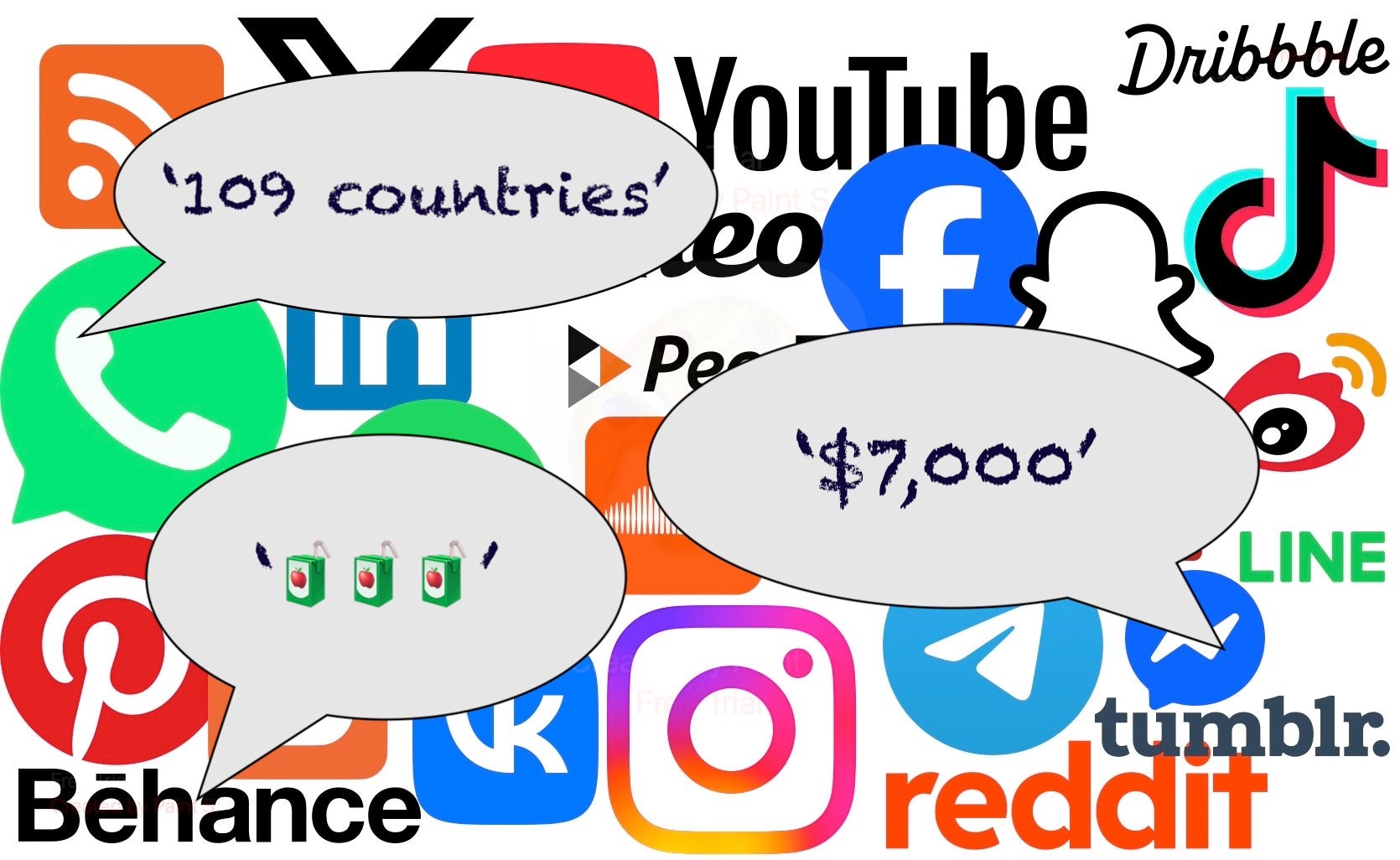
“109 countries”
The phrase “109 countries” is a reference to the false claim that Jews have been expelled from 109 countries, and a suggestion that they deserved it.
In one typical use of this phrase, a creator says, “If a person gets banned from 109 bars, is it the person’s fault, or is it the bar’s fault?”
Raphael Jankelovics, a Jewish teen from Chicago, often hears such jokes online.
The phrase, he said, “removes nuance from a situation and it frames it in a way that puts the blame on the Jews. That’s obviously hateful.’”
“3,000 years ago”
“Promised 3,000 years ago” is a sarcastic reference to the Jewish connection to Israel, mocking the Jewish claim that their attachment to the Holy Land is as old as the Torah.
It is meant to ridicule the idea that someone deserves something because it was “promised [to them] 3,000 years ago.”
The phrase does double duty: It questions the Jewish connection to Israel, and it suggests that Jews use history to create a false sense of entitlement. That message is compounded when the phrase is used in videos that mimic Jewish culture by featuring characters wearing fake payes or ironically playing “Hava Nagila” in the background.
The phrase “3,000 years ago” was spread by users who leveraged the generative-AI model Veo3 to transform the antisemitic trope into video and other content, said Cyberwell’s Montemayor. “The guardrails around the specific generative AI tool were not in place in order to identify that this is actually promoting antisemitism,” she said.
“Only 271,000”
“Only 271,000” is a popular meme meant to deny the Holocaust. It claims that only 271,000 Jews were killed in the Holocaust, supposedly based on death certificates issued by the Nazi concentration camps, instead of the true 6 million.
Some use the phrase unironically to deny the extent of the Holocaust; others drop it into a comment to taunt a Jewish post or account. According to the Blue Square Alliance, from 2022 to 2024, the use of the phrase “271,000” increased by 1250% on social media.
Creators use this number in either text on top of a video or in a hashtag in the captions of the video. The numbers seem random, but it signifies their hateful intention to other users who understand the meaning.
“A lot of coded language that Cyberwell has detected has been around Holocaust denial,” Montemayor said. “Why people psychologically get behind numbers or expressions without a lot of context is connected to AI slop of phrases that become catchy, easy to throw out, and are not meant to actually produce discussion. They’re meant to produce mockery, rejection and dehumanization.”
“7k” or “$7,000”
In October, the Quincy Institute for Responsible Statecraft alleged that a pro-Israel, “influencer campaign” initiated by the Israeli government was paying creators up to $7,000 per post to promote Israel on social media. Critics of the report acknowledged that Israel had a budget for a pro-Israel marketing campaign, but denied that direct payments were being made to influencers.
Nevertheless, “$7,000” became a way to discredit anything positive posted about Israel, or any Jewish videos in general. Comment sections of Jewish posts on social media are flooded with “+7k.”
“When people in any kind of way criticize antisemitism, people comment ‘+7k’,” said Carlos Munoz, a student at Chicago’s Northside College Prep High School.
“It seems like a dismissive and antisemitic way to respond to any statements” about Jews, said Renee Rakowitz, a student at Northside College Prep.
Visual Dog Whistles
A new TikTok photo commenting mode now allows users to comment on posts with photos, enabling unchecked antisemitism by giving users a chance to bypass community guidelines.
Montemayor explained that after the Bondi Beach attack, social media saw “repeat images and GIFs comparing Jews to pigs.”
In response to antisemitic GIFs, CyberWell alerted the oversight board at Meta — Facebook and Instagram’s parent company — noting how users were using rat, monkey and pig emojis to make coded reference to Jews, said Montemayor.
According to the Anti Defamation League, “The prevalence of hateful content in Photo Mode suggests that TikTok enforces its policies more effectively in videos.” Here are some trending photos and phrases that have taken over countless comment sections:
“🧃🧃🧃”
The juice box emoji is a frequently used way of substituting the word Jew without being filtered out by moderation guidelines. This is because the word “juice” sounds similar to the word “Jews.”
“It’s just a way to get around a video being taken down for explicitly using the real word,” said Jankelovic from Chicago.
For Aviva Rubenfel, a Jewish teen from Chicago, these dog whistles are just a new iteration of a constant struggle for Jews.
“The way that I was taught to think about these things,” she said, “is that antisemitism is always going to be there, and that should feel hurtful, but it’s more a strength because they can’t break us down.”
Reporting the stories that define our era. When history unfolds in real-time, the Jewish world turns to (JEWISH REVIEW). Your support ensures we can document the complexities of war and the resilience of Jewish communities with integrity.