
In a recent speech on nutrition, the nation’s top health official offered a perhaps surprising explanation for what is ailing Americans.
“We’re engaged right now in spiritual warfare and … the malevolent forces want to drive us apart and end our connection to each other,” Robert F. Kennedy Jr. said on March 5.
It’s not clear if Kennedy was speaking metaphorically, having frequently talked about his own spiritual crises over the years. But he was using language many thought was targeted at those who believe that modern science is no match for the unseen “malevolent forces” assailing Americans’ physical and mental well-being.
According to recent polling, 54% of Republicans and 37% of Democrats believe in the literal existence of demons. A Marist Poll found that the number of Americans who claimed to have actively been in the presence of a ghost or spirit doubled between the 1990s and the 2020s from roughly 24% to 30%.
TikTok is awash in tarot readers, crystal healers, astrology influencers and wellness gurus promising access to unseen forces. Influencers peddle alternative COVID cures and supernatural explanations for current events. Essayists and social sciences are attributing the popularity of the occult, the supernatural and conspiracy-minded thinking to a rejection of institutional authority. In a period of profound economic and political instability, they suggest, people seek metaphysical answers when the official explanations feel insufficient.
But if this all feels very 2026, a new exhibit at YIVO Institute for Jewish Research suggests we’ve been here before.
“Jews Are Magic,” opening this month at YIVO’s Manhattan headquarters, explores the Jewish fascination with mysticism, fortune telling, amulets, psychics and occult practices. While the exhibit reaches back to the biblical and Talmudic periods, its main focus is on the mid-19th century to the early 20th century. In the face of increasing urbanization, oppression in Russia and the pull of assimilation, Jews in Eastern Europe and New York’s Lower East, no less than their non-Jewish neighbors, found solace in the occult.
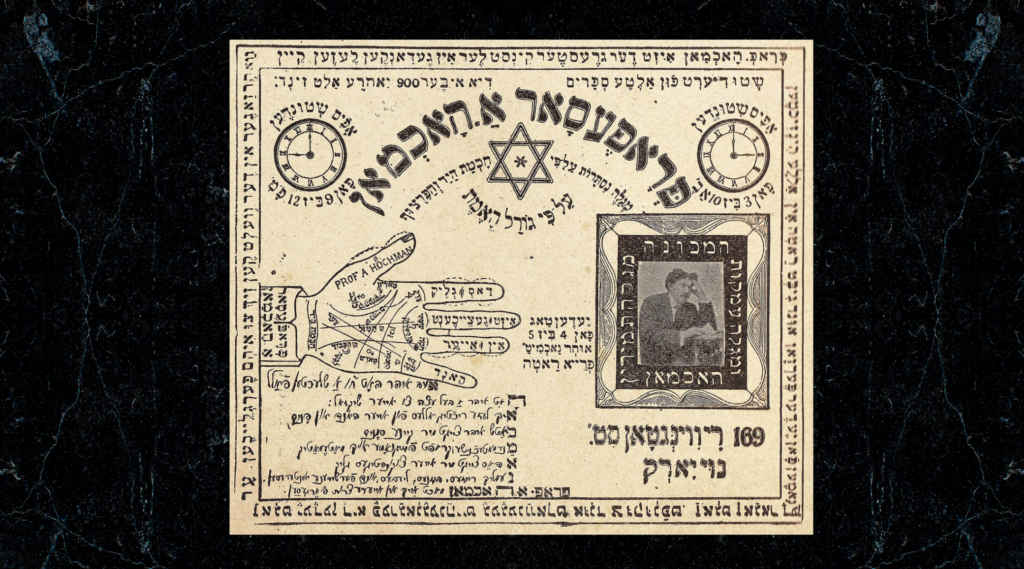
YIVO’s Eddy Portnoy, who curated the exhibit “Jews Are Magic,” with a reproduction of a High Holiday card featuring a Jewish palm reader, Warsaw c. 1910. ((JR))
“In this time period, when people commonly think that sort of magic is getting left at the wayside and people are becoming more modern, they’re just as engaged with these unseen realities as they were beforehand,” said Samuel Glauber, a specialist on the Jewish occult and adviser to the exhibit.
And it wasn’t just the huddled masses. Writers, intellectuals and scientists were fascinated by the supernatural, adding a sheen of respectability to fortune-telling, seances and what Sigmund Freud called the “uncanny.”
The exhibit includes palm-reading manuals, amulets against the evil eye, fortune-telling guides and advertisements for Jewish psychics drawn from YIVO’s archives. They promise to help readers and clients find romance, settle lawsuits and cure illness. One display includes heavily used Yiddish divination books whose margins still contain penciled calculations from long-ago readers trying to conjure their futures.
At least in theory, Jewish tradition forbids such practices. The exhibit opens with an admonition in Deuteronomy against consulting with an “enchanter, or a witch, or a charmer, or a consulter with familiar spirits.” Nevertheless, folk religion flouted these prohibitions, and many rabbis went along.
“Officially these kinds of materials are, at some level, considered unacceptable,” Eddy Portnoy, YIVO’s senior academic advisor and director of exhibitions, said on a tour of the exhibit Wednesday. “Yet a lot of rabbis participate in this.”
Some of the exhibit’s most poignant artifacts are drawn from a cache of roughly 5,000 kvitlekh, or handwritten petitions, sent to Rabbi Eliyahu Guttmacher, a 19th-century Polish rabbi and mystic known as the “Tzaddik of Grodzisk.” The letters were discovered in an attic in 1932 by YIVO collectors and offer an intimate archive of Jewish anxiety on the edge of modernity.
After Guttmacher reportedly cured a child believed to be possessed by a demon, Jews from across partitioned Poland began writing to him seeking help with illness, infertility, poverty, bad luck and psychological torment. The letters blur the line between religion, folk healing and occult practice. Guttmacher’s responses haven’t survived, but a nearby display case includes various spells written by other rabbis, meant to ward off the evil eye and often invoking kabbalah, the Jewish mystical practice that offered rabbis an acceptable foothold in the esoteric.
The stars of “Jews Are Magic,” though, are the flamboyant hustlers, healers and self-invented mystics who turned Jewish occultism into performance art and entrepreneurial spectacle.
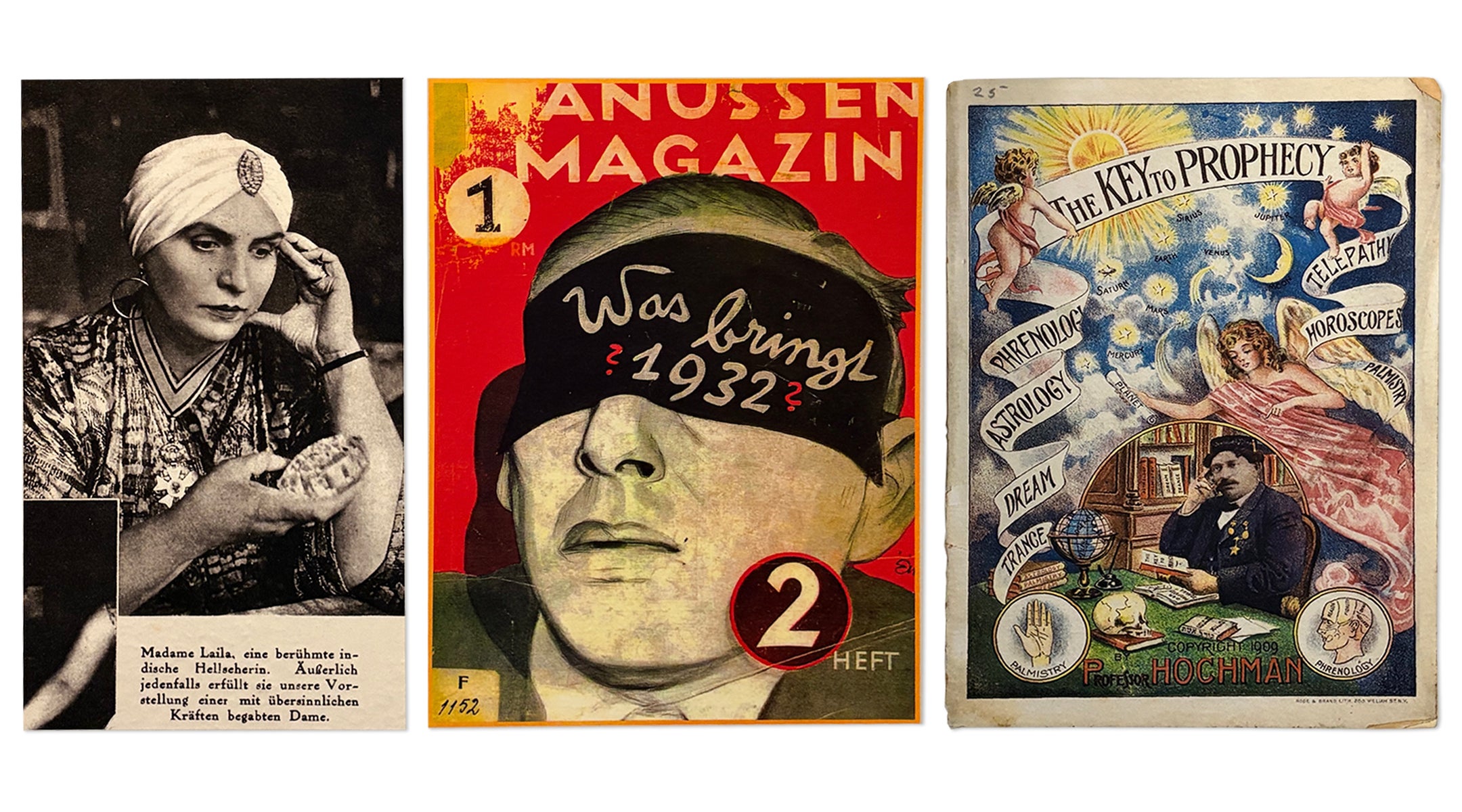
Artifacts featuring three early 20th-century Jewish psychics — from left, Terfren Laila, Erik Jan Hanussen and Abraham Hochman — are featured in the YIVO exhibit, “Jews Are Magic.” ((JR))
Among the most colorful is Naftali Herz Imber, best remembered today as the poet who wrote the words that became “Hatikvah,” Israel’s national anthem.
Long before that, however, Imber was touring America in flowing robes as a clairvoyant known as “The Mahatma” and “The Apostle of the Kabbalah and the Emissary of the 37 Masters.”
Imber’s career as a clairvoyant eventually collapsed into alcoholism, bar fights and arrests, but his wit apparently never deserted him. Thrown out of a Zionist congress for bad behavior, he reportedly shrugged and said: “They still have to sing my song.”
Another standout is Khayem-Mordkhe Shiller-Shkolnik, perhaps the closest thing prewar Poland had to a celebrity psychic.
Born in a shtetl near Lublin in 1874, Shiller-Shkolnik fused occultism with the language of modern science and self-improvement. He advertised expertise in hypnosis, telepathy, handwriting analysis, phrenology (skull-reading) and “psycho-phrenology,” a discipline of his own invention.
Glauber, the Miriam Barr Librarian for Jewish & Near Eastern Studies at Washington University, said practitioners like Shiller-Shkolnick took advantage of the burgeoning market for mass-market periodicals and books to become their era’s influencers.
“He was a master of press advertisement,” Glauber said. “The amount of coverage he was able to generate for himself was really incredible.”
On the Lower East Side, celebrity psychic Abraham Hochman operated out of 169 Rivington Street, where he dispensed prophecies, published manuals and built a small business empire that included custom wedding contracts, a wedding hall and a Catskills hotel.
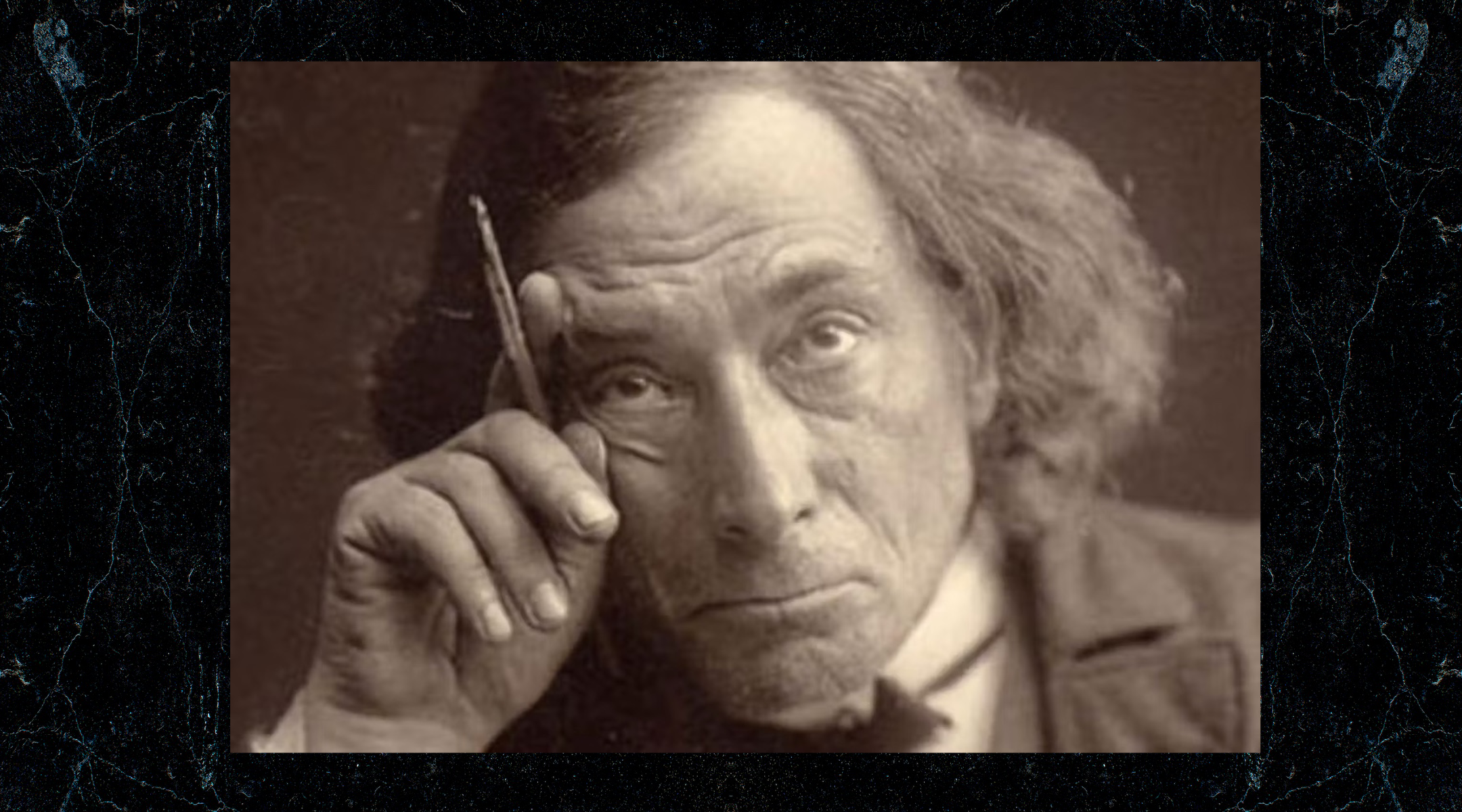
Naftali Herz Imber, before writing the poem that became “Hatikvah,” worked as a clairvoyant known as “The Mahatma” and “The Apostle of the Kabbalah and the Emissary of the 37 Masters.” (YIVO)
Hochman specialized in finding runaway husbands — a genuine social crisis in immigrant Jewish New York.
In one celebrated case, Hochman told a woman exactly where and when she would find her missing husband: on the corner of Pitt and Grand Streets at 10 p.m. She arrived with a police officer and found the man leaning against a lamppost precisely where Hochman “predicted.”
Portnoy acknowledges that many such stories are almost certainly exaggerated or invented. But that, he says, misses the point.
“These people are having real problems, and they haven’t had solutions,” he said. “Having tried other things, they finally decide to approach these wonder workers who can work their magic.”
The exhibit’s most tragic figure may be Erik Jan Hanussen, born Herschel Steinschneider to a Jewish family in Vienna. Reinventing himself as a Danish aristocrat and celebrity clairvoyant, Hanussen became one of Europe’s most famous hypnotists during the Weimar years, hosting lavish séances and publishing a newspaper called The Clairvoyant News.
By the early 1930s he had insinuated himself into Nazi circles and allegedly befriended members of the SS. Communist journalists exposed his Jewish origins, and Hanussen’s body was later found dumped by the roadside, apparently by the very movement he thought he could manipulate.
It is tempting to treat these stories as colorful relics of an immigrant past — quaint tales of gullible Jews and charismatic hucksters. But “Jews Are Magic” insists on something more unsettling: The allure of the occult never disappeared.
The Hasidic press continues to carry advertisements for spiritual healing, and Sephardic Jews in Israel have an ongoing tradition of seeking help and protection from wonder rabbis.
And both Glauber and Portnoy see a poignant similarity between the Yiddish-speaking amulet-makers and Jewish fortune-tellers and today’s wellness influencers and conspiracy mongers.
“Anytime people feel the pressure of the world, this is something they always turn to,” he said. “Because it’s entertaining, but it also provides a hopeful window into something else.”
Jews Are Magic: Occult Practices from Palmistry to Professional Psychics opens May 26 at the YIVO Institute for Jewish Research, located at the Center for Jewish History in New York City.
Reporting the stories that define our era. When history unfolds in real-time, the Jewish world turns to (JR). Your support ensures we can document the complexities of war and the resilience of Jewish communities with integrity.