

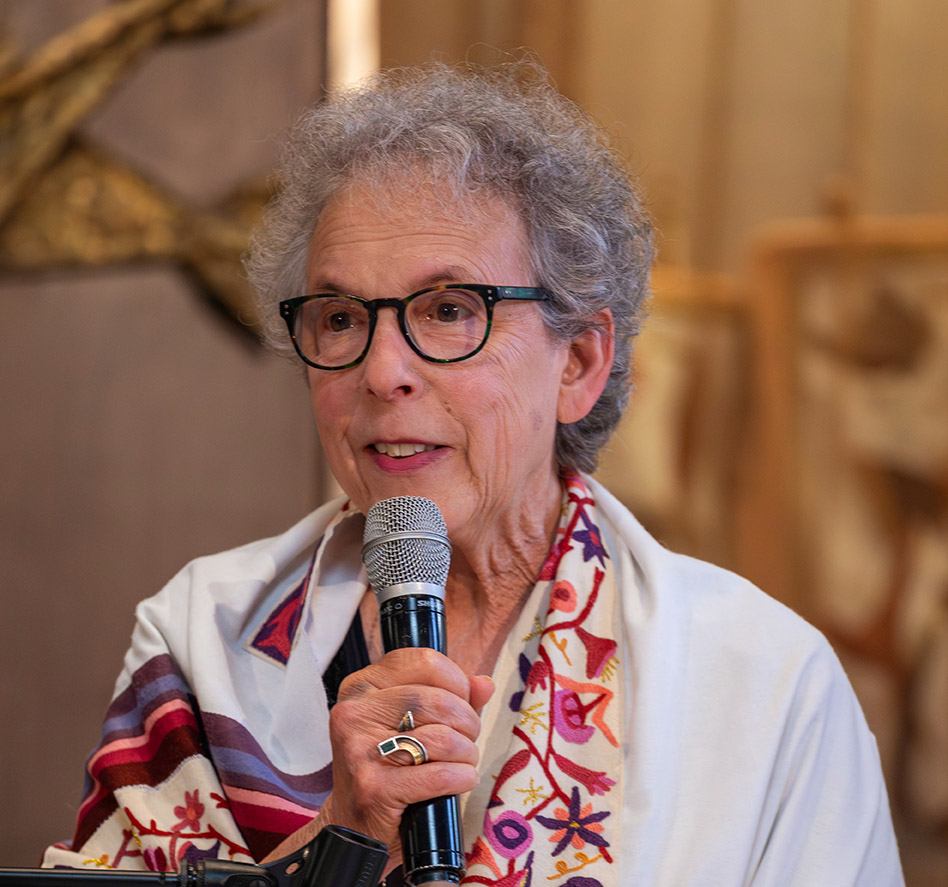
Rabbi Laura Geller, who has been breaking down barriers for Jewish women since becoming the Reform movement’s third woman rabbi 50 years ago, told The Journal a story only a woman could tell.
“Picture this” she began. “I am 23 years old, in a class [at Hebrew Union College] where the other 29 students are guys – nice guys – and a wonderful professor. My mind went back to when I was a 13-year-old girl. I had just gotten my period. I knew what was happening in my body and I said ‘Mom, I just got my period.’ My mother said, ‘When I got my period, my mother slapped me. I asked why? She said ‘I have no idea. Go ask her.’
“My grandmother lived not far. I got on my bicycle, rode to her house, and I said ‘Nana, why did you slap Mom when she got her period?’ My grandmother said, in a strong Yiddish accent, ‘She was losing blood. She was a little pale. She needed color in her cheeks.’”
The incident made a lifetime impression on Rabbi Geller, who made Jewish history in 1994 when Temple Emanuel of Beverly Hills chose her to become the first woman rabbi to lead a major metropolitan synagogue.
“At that moment sitting in class at HUC, I asked ‘what if my mother and I had prepared for that moment? What if we said a blessing thanking God for making me a woman? Thanking God for my body working properly? How transformative would that have been?
“I realized then ritual matters. The message of the slap is mixed: One is a connection between generations – the other message is, you have to be careful because this is something you could get into trouble for because of sexuality and you could have a baby.”
Rabbi Geller, product of a Reform home in a Boston suburb, said, “It wouldn’t have occurred to my mother to prepare me in a spiritual way [for her first period] because that was not her understanding of Judaism. As she grew older and more aware of the power that ritual has to create grounding in a world so out of control, she realized ritual gives you a sense of order, connection to something bigger. I also see this now in work I do with older people. Rituals that weren’t important when they were younger now are.”
Rabbi Geller was just warming up, explaining why her second book, “Moments That Matter,” … matters. “What is it like to retire?” she asked, although the energetic 78-year-old rabbi feels like her retirement is years away. “What are the spiritual dimensions of that? What is it like to celebrate a long-term relationship, if you are lucky enough to be with the same partner 40 years? What is it like to meet someone new later in life? How do you ritualize meeting someone new later in life?”
The question, she said, is “How might we mark such moments through ritual? What it was like to be in school during those days – I did two years at HUC in New York, my third and fourth years in Los Angeles. I went back to HUC New York for my fifth year because they didn’t yet ordain people here in the mid-‘70s.”
As the lone female in class, “there were real challenges around certain misogynistic texts,” she recalled. “In school I studied with Prof. Stephen Passamaneck. He was extremely abusive to me, not physically abusive, but he chose the pieces of text that would be most embarrassing for me to read out loud. One morning when we were studying circumcision, I was having trouble following the discussion. It was horrible, and I left the classroom crying.”
At that moment, she decided, “I am out of here.” But then, one guy from her class “came out and said, ‘The guy is a mess. Don’t let him ruin your career.’ That was it. I didn’t complain to anyone at school because he was a tenured professor – and he carried a gun.”
Jump forward 30 years, and Rabbi Sarah Bassin, who later became the associate rabbi at Temple Emanuel, was in an independent study with Passamaneck. “He also was abusive to her, not touching her, but in the same really horrible way. She went to the dean of the college, complained, and two years later, he was gone. It turns out, a lot of other women had similar experiences.”
Rabbi Geller tells that story to point up the one regret she had in her career: “That I wasn’t courageous enough, clear enough to push this because many other people suffered along the way. I am very proud of Hebrew Union College for acknowledging when the whole thing came out about abuse at HUC, the leader said, ‘We need to do teshuvah for this.’ There was a very thoughtful process of acknowledgement.”
How did this experience affect Rabbi Geller’s learning?
“When you read these texts from a feminist perspective,” she said, “they are painful even if you would argue that what the rabbis did was to try to make them less horrible. For example, we recently read in Tanach about an accused woman, and what is her punishment? She has to drink some dirty water. If she is found not to be guilty (because all you would do is throw up), then your husband cannot divorce you. It probably was meant to be a protection for women since in those days a man could divorce his wife for any reason.”
Rabbi Geller recalled a powerhouse question that male classmates might have shrugged off: What was the bride price for a woman who had been violated as a child? “The rabbis say she really is still a virgin because it was like a finger in your eye. I am sitting in class horrified by that. None of the guys are.” But she was the only one who “was once a two-year-old girl.”
Today, she said, you read these texts from a different perspective. “Over the years, there have been more women joining the faculty — and more feminist men teaching. How you read tradition changes when you bring experience, the Torah of our lives, the life story of people, to these texts. That’s what it was like to be in school (in the ‘70s).”
Asked if things have changed, Rabbi Geller explained that in the late ‘70s, “the early years of women rabbis, when there was just a handful of us, the Central Conference of American Rabbis convention was in Arizona, a non-ERA state. There was a handful of women rabbis at the time – six or eight – few enough so we could be in one hotel room. The question was, should we not go to the convention or should we go because we want to make our colleagues think things are changing now that there are women in the rabbinate. Good arguments on both sides. It turns out my younger brother was friends with Jonathan Friedan, son of Betty Friedan,” the feminist superstar. They attended the same high school. Rabbi Geller knew Ms. Friedan.
“I called Betty and told her about our dilemma,” the rabbi said. Friedan’s advice was “’You should go and invite me to speak.’ So this small gaggle of women rabbis arranged for Betty to come. The entire convention went to her talk. It was the first time she connected her feminism to her Judaism, making it an important historical document.”
Friedan’s appearance sparked people talking about women as leaders. “There always were people who said your skirts are too short or too long,” Rabbi Geller said. “Women’s voices are too soft. This still is an issue.”