

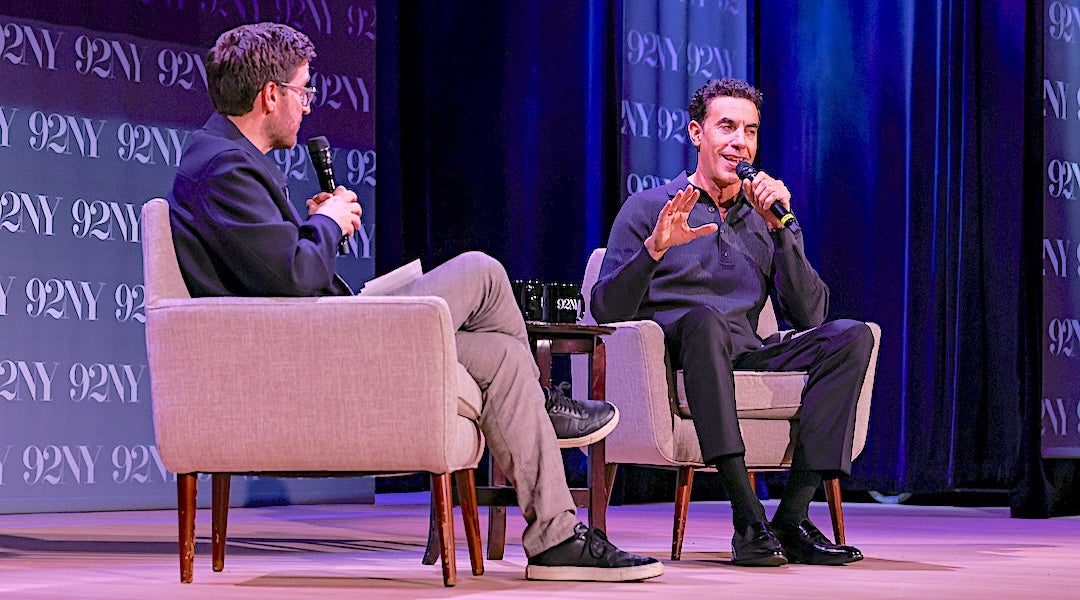
When Marvel offered Sacha Baron Cohen the role of Mephisto, the demonic figure he played in the 2025 series “Ironheart,” the creative team behind the show had a concern.
The mostly Black team, he recalled, was aware of the long history of associating Jews with the devil and wanted to make sure the Jewish actor would not be offended by the offer.
“It was such an amazingly considerate, empathetic thing to say,” Baron Cohen recalled at a live taping of the “Happy Sad Confused” podcast at New York’s 92nd Street Y last week. “And I was like, ‘Yeah, I’m good.’”
He then added, “I think for the Jews out there, sometimes we don’t feel seen.”
The audience at the Upper East Side bastion of Jewish culture certainly felt seen: At a time when many Jews say they could use a little consideration and empathy, Baron Cohen repeatedly acknowledged his and the audience’s shared Jewishness — and their anxieties. At one point he remarked how friendly and relaxed the mostly Jewish crowd seemed, presumably compared to their angst about rising antisemitism and anti-Zionism.
“It’s gonna be exactly the same when you go on to the streets of the new New York,” he joked. “We solved it all tonight, right here. Look at us.”
Baron Cohen appeared at the 92NY to discuss his career with podcast host Josh Horowitz and promote “Ali G: Who Iz I?” His new film brings back the tracksuit-wearing, faux-Jamaican hip-hop enthusiast he created in the late 1990s. The character returns after more than two decades away from the big screen; in the interim, Baron Cohen, 54, became a sensation with hits such as “Borat,” featuring his sweetly inept and provocatively antisemitic Kazakhstani journalist character. He also brought to life “Brüno,” a flamboyantly gay and aggressively shallow Austrian fashionista.
But the event, like the release of the new film, became an occasion to consider the British comedian’s enterprise, which essentially asks if bigotry and prejudice — including antisemitism — can be fought by leaning into ethnic and gender stereotypes. That has made for a curious press tour, in which the Oscar nominee three times over, who has started a campaign against online bigotry and wrote his undergraduate thesis at Cambridge on the U.S. civil rights movement, must defend his characters against charges that they are spreading hate.
A chameleon and prankster, the actor’s stock in trade is fooling unsuspecting celebrities and ordinary folk into letting their guards down in the presence of his clownish alter egos, and thereby reveal their own prejudices and occasional better natures. (In “Borat,” he got the crowd at an Arizona honky-tonk to join him in the chorus of “Throw the Jew Down the Well.”)
And because his characters also trade in stereotypes, he has regularly been criticized for propagating the attitudes he says he is trying to deflate.
A British campaign called for cinemas to boycott the new film, arguing that Ali G’s appropriation of Black culture and Baron Cohen’s comedy risk making racial caricatures acceptable under the cover of satire. Black British comedians have criticized the character as far back as 2000, and the debate over whether the joke punches up at the powerful or down at marginalized groups has followed him ever since.
On Thursday night and in recent interviews, he defended Ali G, saying the culturally confused and confusing character was an ideal vehicle for exposing the new and insidious explosion of bigotry.
“Ali G is a character that cannot exist in 2026 because he’s a cultural appropriator, because he’s so problematic,” Baron Cohen told Horowitz. “And that’s exactly why I wanted to bring him back.”
However, compared to the conspiracy theorists, Islamophobes and racists who populate the new film, “fundamentally, he’s actually a good guy. And he believes in increasing the peace. He believes in respect… He’s this naive idiot who has these horrific views, but he really does want the world to be better.”
Baron Cohen also offered a defense of his films in a recent Time cover essay.
“I’ve always designed my characters and comedy as vehicles to expose prejudice, bias, and stupidity, though I realize not everyone sees them that way,” he wrote.
Off screen, Baron Cohen has buffed his humanitarian, anti-racist bona fides with the launch, in 2020, of the Stop Hate for Profit campaign with the NAACP and Color of Change, which pressured social media companies to address racist content and hate speech on their platforms. At the Anti-Defamation League’s 2019 “Never Is Now” Summit, Baron Cohen delivered a sharp keynote address calling social media platforms “the greatest propaganda machine in history.”
In his Time essay, Baron Cohen sounded more like an activist than an actor and filmmaker. “We are once again entering an age of ‘virtuous’ violence, where any atrocity — by racists, Jew haters, or Islamophobes, the right or the left — can be somehow justified,” he wrote. “It is not a place any of us should want to live.”
In a Hollywood Reporter interview this month, Baron Cohen connected the negative social media campaign against Ali G to boycotts and blacklists facing other Jewish artists.
“So, I’m not surprised that prominent Jews are being targeted,” said Baron Cohen, who has been relatively quiet in commenting about Israel. “The level of organization is surprising, but this is a trend of Jews being portrayed in certain ways and trying to be silenced.”
When the interviewer raised the possibility that the controversy might be connected to Baron Cohen’s perceived pro-Israel views, he pushed back: “I haven’t said anything about Israel.”
Israel did not come up during his 92NY appearance either. But neither did he and Horowitz dig deeply into the central paradox of his work: a Jewish comedian defending a character that critics say fails to recognize the history behind racial stereotypes, who in the same interview thanked the Black filmmakers who recognized the history of antisemitic stereotypes when they offered him the Mephisto role.
A Season of Big Decisions. From the Knesset campaign to American midterms, Jewish communities are weighing what comes next. Help (JR) keep delivering the deeper context.


