

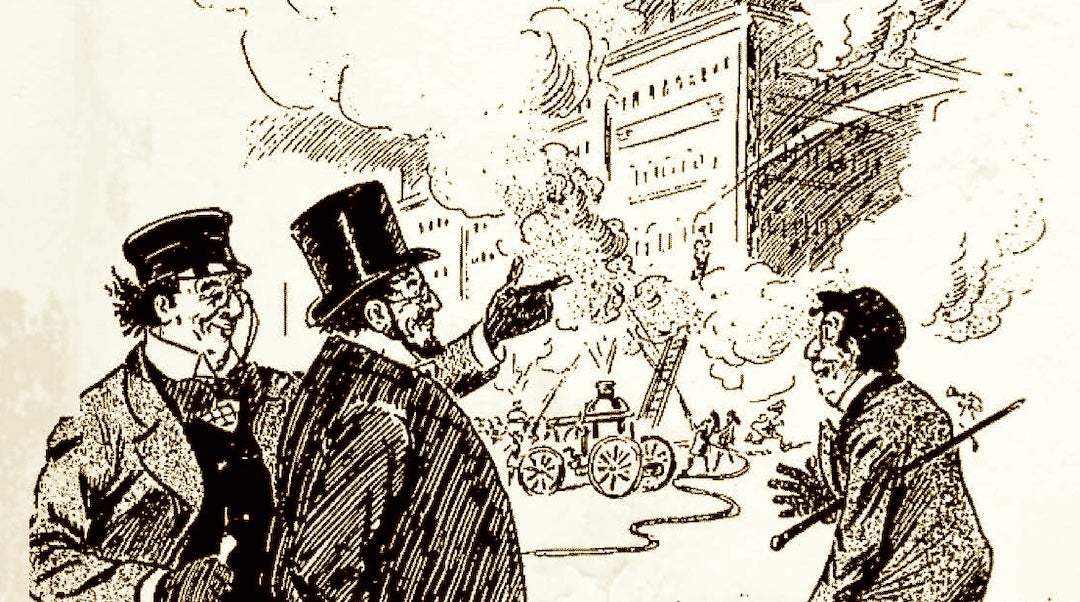
In the first episode of its second season of “The Bear,” Hulu’s acclaimed series, the character Richie describes damage at the titular restaurant as “the result of some failed Jewish lightning.”
As far as antisemitic slurs go, that’s a pretty deep cut. “Jewish lightning,” for the uninitiated, is a derogatory euphemism for arson, based on a historical accusation that Jews are predisposed to torch their homes and places of business for the insurance money.
How historical? That’s what independent scholar Jeffrey Marx set out to find out a few years back. In his new book “Jewish Firebugs: Arson and Antisemitism from the Civil War to World War I,” Marx examines the origins of the stereotype, why it entered popular culture and — and this was touchy — whether there was any truth to the charge that arson was a particularly Jewish thing.
The result is either the book we need right now — at a time of economic anxiety and renewed scapegoating of immigrants — or, given the rise in antisemitism, the last thing we should be talking about.
In an interview Monday, Marx said he was aware that the project involved a delicate balance: examining antisemitic accusations without reinforcing them.
“I’m not sure, given the climate now, it’d be something that I’d be jumping feet first into,” said Marx, a former congregational rabbi. “There’s a little bit of hesitation of, again, is this good for the Jews?”
Ultimately, he thinks it is: “My research shows that arson is not an essentialist Jewish activity, it was practiced by a very small number, and again, in times of all sorts of economic ills and identity issues, the Jews are often the first to get blamed.”
Marx said the book began as an extension of his earlier book on “Abie the Agent,” the first American newspaper comic to feature a Jewish protagonist. (The strip’s creator, Harry Hershfield, hoped a sympathetic Jewish character would defuse antisemitic stereotypes.) In that research, he said, he kept encountering recurring stereotypes attached to Jews in late 19th- and early 20th-century American culture.
“Either cheap clothing salesmen or pawn brokers and arsonists,” he said.
In “Jewish Firebugs,” Jeffrey Marx examines the origins of the Jew-as-arsonist stereotype, and why it entered popular culture. (Courtesy Jeffrey Marx; NYU Press)
What began as an observation about cultural tropes became a historical investigation into how those tropes spread — through “photograph records and silent movies, cartoons, newspapers and comic journals.” News syndicates had a field day with figures like “Sam the Burner,” a Brooklyn sewing machine operator turned arsonist for hire, and Ida Lieberman, a widowed mother of two who served four years in prison after torching her tenement apartment in 1893.
“Wherever I looked,” he said, “it seems I kept finding evidence of arsonists.”
The project also expanded beyond antisemitic caricature into the messy intersection of immigration, poverty and prejudice.
“I started out by [examining] sensational stories about the Jews and antisemitic stories about the Jews and the anti-immigration push against the Jews,” he said. “But I also discovered there actually were Jewish arsonists.”
That discovery, he said, forced a shift in approach.
The poor, crowded and highly flammable Lower East Side and similar neighborhoods in Brooklyn and Harlem, into which Jews packed starting in the 1880s, offered the right conditions for the crime to flourish. At the turn of the century, Marx writes, most of those accused and convicted of arson crimes in New York were Jews.
And there certainly were what he calls in one chapter “Jewish arson gangs and trusts.” Don’t think Murder, Inc., however: What the tabloids called “gangs” often consisted of a fire “broker,” a public adjuster (essentially an agent of the insuree) and a “torch,” who was hired to do the deed. These were opportunists who came together in teams to defraud insurance companies offering large payouts on fairly modest policies.
“That’s it,” Marx said. “No gang here.”
It might be fair to say that arson was a “Jewish” crime the way the garment industry had become a “Jewish” occupation and, in the 1920s, boxing a “Jewish” sport. But Marx offers a caveat: Unlike the rag trade, which by 1897 employed approximately 60 percent of the New York Jewish labor force, the number of known convicted Jewish artists constituted “less than one ten-thousandth of one percent of the million and half Jews living in New York City in 1917.”
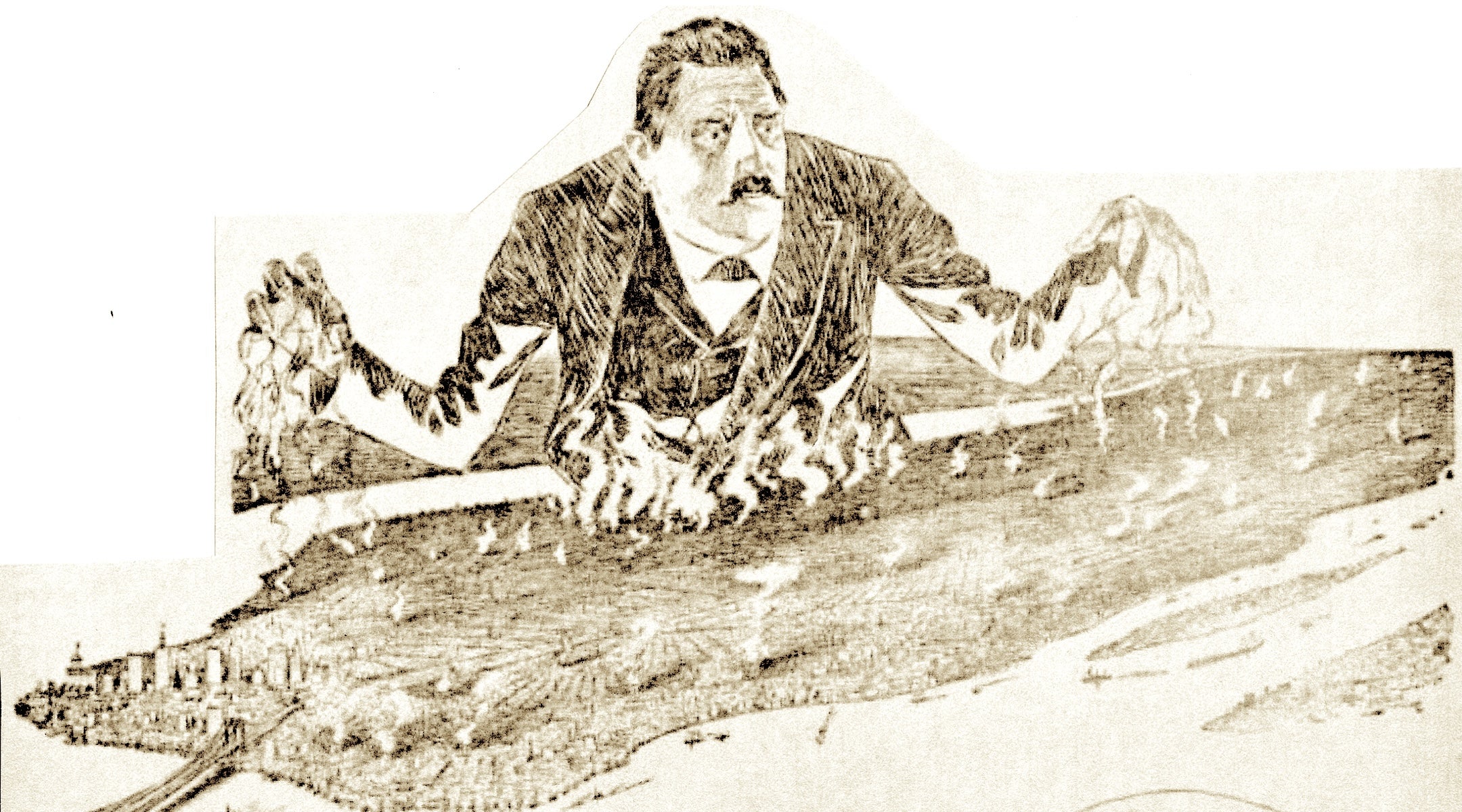
An illustration from the New York Journal depicts Isaac Zucker, a notorious arsonist, as “A Terrible Insidious Evil That Menaces Every Life in New York,” Jan. 10, 1897. (Courtesy NYU Press)
Nevertheless, accusers were keen on tarring the entire community for the crimes of those few. Even before the great waves of immigration, figures like Charles C. Hine, publisher of an influential trade newspaper for the insurance industry, would fan the flames, as it were, by asserting without evidence that “Jew risks” made the immigrant customers a liability, and urged brokers not to offer them policies.
In that post-Civil War period, when many Jewish immigrants were working as peddlers, the expanding insurance industry told itself that such advice was rational, not bigoted. “People who have been residents for long periods of time in your towns, they are acceptable risks,” Marx said, describing the insurance companies’ logic. “But Jewish peddlers aren’t. They don’t stick around, right?”
That logic, he said, gradually hardened into something more explicitly antisemitic — especially as Jewish immigration increased in the late 19th century. The accusers drew on the usual bank of classic Jewish stereotypes of calumny and clannishness, on nativism, and on WASPY snobbery. The yellow press piled on: In 1896, the New York Journal wrote of one “convict firebug,” Isaac Zucker, that his “hooked nose projects aggressively.”
“The real antisemitic charges begin with the Eastern European immigration,” Marx said.
An entire genre of anti-Jewish jokes and tropes in popular culture began depicting Jews as arsonists. In one cartoon from 1896, in the satirical magazine Judge, a stereotypical Jew looks on in satisfaction as the “Moses Cohen” clothing store spews smoke shaped like dollar signs. Marx also includes what may be the first citation, from 1922, of a joke that was still being told by hacky Catskill comedians when I was kid: “Ikey: Wasn’t there a fire in your store last Wednesday?” Jakey: “Shh! It vas next week!”
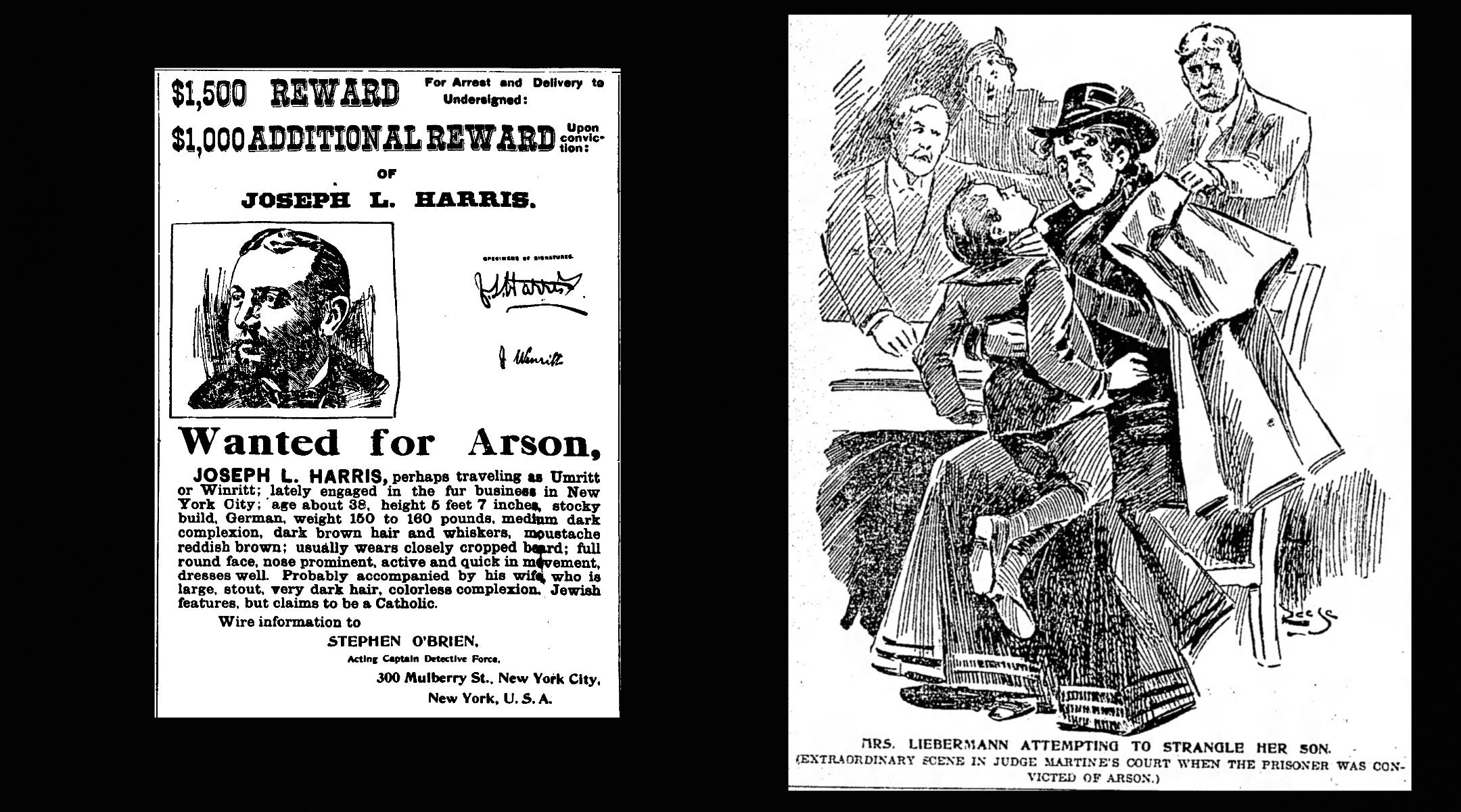
At left, a wanted poster from the New York Evening Journal says arson suspect Joseph L. Harris has “Jewish features, but claims to be a Catholic,” Sept. 14, 1897. Harris represented businesses that earned tens of thousands of dollars in fire insurance payouts. At right, the convicted arsonist Ida Lieberman is depicted (falsely) of attempting to strangle one her children after a jury found her guilty of torching her tenement apartment, The World, Feb. 17, 1895. (Courtesy NYU Press)
The term “Jewish lightning,” perhaps surprisingly, seems to appear only much later, with the earliest usage Marx identified dating to 1934. By then, he said, most of the reporting on Jewish involvement in arson had already faded from front pages.
That decline probably owed to the same factors that explained the stereotypes’ former popularity: economics, social class and opportunity. As Jews and other immigrants left the tenements and gained a toehold in the middle class, there was less temptation to cheat the insurance companies, and less cause for the companies to blame Jews. Meanwhile, modern firefighting techniques and building codes left homes and businesses more resistant to devastating fires.
And yet even if it faded, the Jewish firebug stereotype persisted — not just on the tongues of antisemites, but among Jews as well.
“When I would tell anyone in the Jewish community I was working on this project,” Marx said, “they immediately would tell me an arson joke.”
He sees that persistence as part of a broader cultural phenomenon: the way ethnic groups absorb prejudice into self-deprecating humor. Collections of Jewish humor, written by Jews, often include gags in which Jewish businessmen (almost always men) get one over on a (usually gentile) mark.
“I don’t want to say pride,” said Marx, describing the tone behind some of the self-deprecating humor, “but it’s kind of like [admiration for] the Jewish cleverness in being able to pull this off.”
While he wrestled with the subject matter, Marx came to see the book’s timing as apposite. At a time when mainstream politicians are again blaming immigrants for crime, economic hardship and social decline, Marx argues that history offers a cautionary tale about how stereotypes harden into accepted “truths.”
“Whenever you have these stereotypical charges, when an entire group is being labeled, and as soon as we start hearing things like ‘all immigrants are drug dealers and criminals,’ our antennae need to go up,” he said. If “Jewish Firebugs” establishes nothing else, he added, it is that “we’ve heard this before, and then we’ve been through this before.”
Reporting the stories that define our era. When history unfolds in real-time, the Jewish world turns to (JR). Your support ensures we can document the complexities of war and the resilience of Jewish communities with integrity.