

This article was produced as part of (JR)’s Teen Journalism Fellowship, a program that works with Jewish teens around the world to report on issues that affect their lives.
After a slight dip last year, participation in gap year programs in Israel is on the rise, according to Masa Israel, an umbrella organization for the post-high school programs.
More than 3,000 Jewish teens from around the world are beginning gap years this September, and applications are still open. Last year, roughly 2,500 Jewish teens were enrolled in gap year programs.
Enrollment numbers match participation from before the Oct. 7 attacks in Israel, when in 2021-2022, over 3,000 Jewish teens were enrolled.
Masa credits the trend to teens’ shifting attitudes about the importance of visiting Israel in a post-Oct. 7 world, where students regularly encounter harsh criticism of Israel and even their Jewish identities.
Most notably, more teens who say they had an attenuated affiliation with Jewish life are opting into gap-year programs, said Masa Israel’s recruitment manager, Shira Rosen. Many were forced to come face-to-face with “an identity they might not have engaged with” following Oct. 7, she said.
Ary Hammerman, 18, didn’t specifically decide to go to Israel on the Shalom Hartman Institute’s Hevruta gap-year program because of Oct. 7. But the New Yorker finds that her gap year, which began this past summer, has been more impactful and important in the wake of the world-wide eruption of anti-Israel sentiment that came with the war in Gaza and ongoing conflicts with Iran and Lebanon.
The temporary decline in participation seen last year is normal after major security concerns like those prompted by Oct. 7, said Rosen. But, Rosen finds, “these periods are typically followed by a rebound stronger than years prior, with increased interest and higher participation.”
These recent conflicts in Lebanon and Iran have not proven to be a barrier to gap-year participation, however.
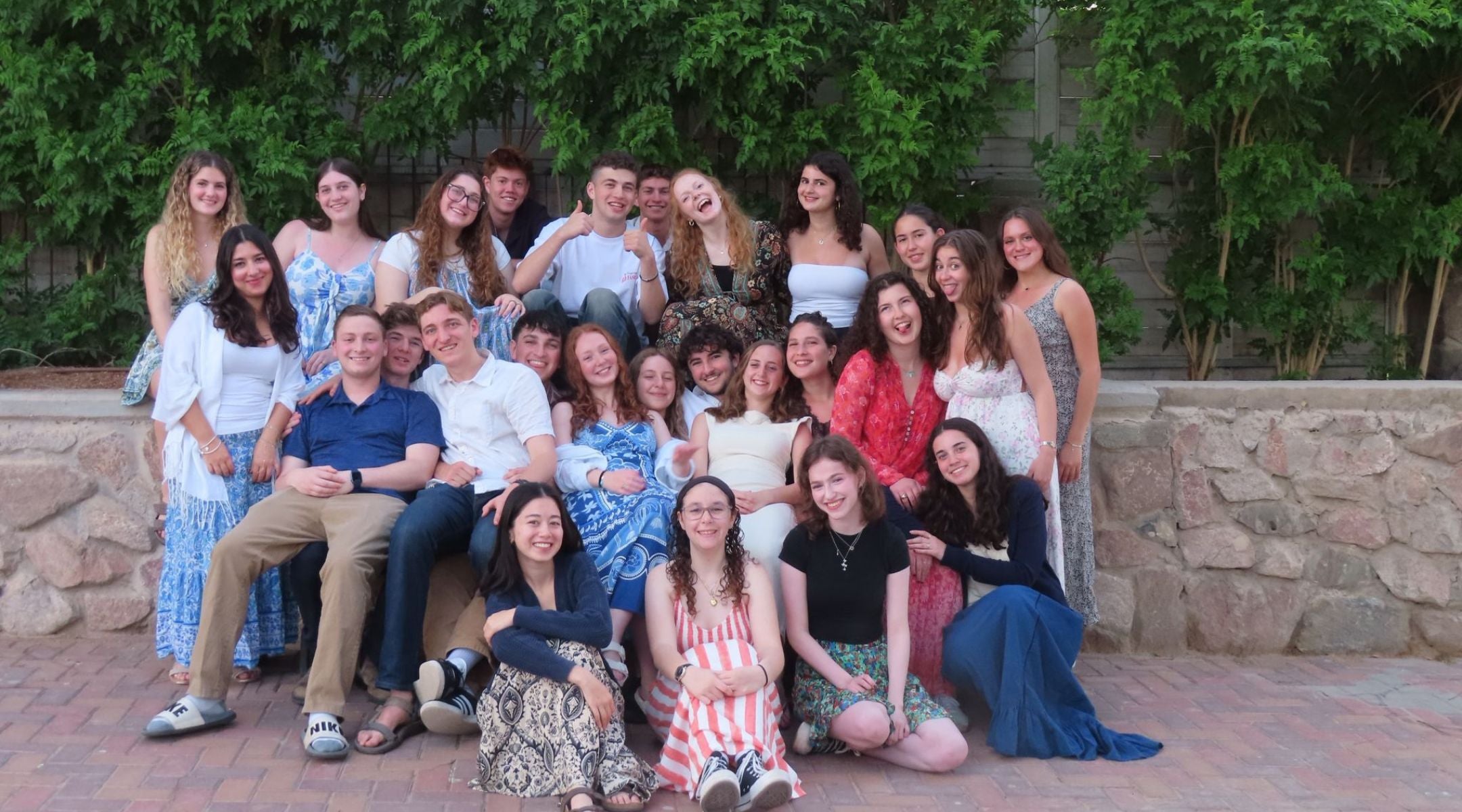
The Hevruta program includes study at the Shalom Hartman Institute campus in Jerusalem, with participants living in nearby neighborhoods. (Ary Hammerman)
Masa’s experience in handling security concerns has “built a layer of confidence among participants and parents, reinforcing that while the environment is complex, our strong safety infrastructure and constant adaptation ensure that participants are supported and informed at all times,” Rosen said.
Rozeta Mavashev, executive director of Masa Israel Journey, said that she has observed that teens coming to Israel now have a strong desire to give back to their people and have more “conviction” in their reasons for coming.
It isn’t just the number of gap year participants that has changed in recent years, but also the type of teen interested in gap years, according to Mavashev.
Indeed, non-Orthodox gap-year programs, such as Aardvark Israel and Hevruta, are among the most popular today, according to Masa Israel. The Conservative movement is also in the process of reviving its gap-year programs for the upcoming summer after it failed to meet recruitment and budget goals in previous years.
Newly committed teens are the focus for several Israel programs that have partnered with Masa to “strategically engage the unengaged” throughout high school, Mavashev said. They include programs that bring high schoolers to Israel on short-term trips, including Root One, March of the Living, and Bnei Akiva. The goal is to encourage these students to consider the extended gap-year experience after graduation.
Strongly affiliated teens are also feeling the pull of gap-year programs. Esther Davis, a Modern Orthodox Jewish teen from London, decided to go on a gap year through Aardvark Israel after encountering antisemitism in school.
Davis switched from a Jewish school to a secular state, or public, school in September of 2023, a month before Oct. 7. That first year, not many of her classmates knew she was Jewish. But the year after — her last year of high school — Davis decided to run her school’s Jewish Society after the previous leader “got a lot of hate” for being Jewish and stepped down.
After that, the whole school knew she was Jewish. “I got lots of weird comments and some death-threat sort of things,” said Davis, who had an active Jewish life through the youth group Bnei Akiva throughout her childhood. “After that, I wanted to do it [a gap year to Israel] because I wanted that break from antisemitism.”
Davis now says that Israel gap years are important for all Jewish teens. “Coming to Israel on a gap year strengthens your connection with the land and the people, and it also allows you to understand your religious identity better,” she said.
In the Orthodox world, trends in gap-year attendance remain largely unchanged. For these communities, Mavashev said that spending a gap year to Israel is “very much in their lifecycle.”
Eli Benel, an Orthodox senior at Denver Jewish Day School, said that gap years in Israel are a “part of the culture I grew up in.” His parents met on the gap-year program Nativ, which is now run by Aardvark Israel.
Benel will go on the Kivunim program after he graduates in May. The program appeals to him because Kivunim takes its participants to 12 different countries, not just Israel. Benel is excited for the opportunity to “understand the world around me” and form meaningful relationships with like-minded Jewish teens.
Daphna Refaeli, director of World Bnei Akiva’s gap year programs, says that for many Orthodox teens, a gap year is “just the path you take.” World Bnei Akiva runs multiple year-long Israel gap-year programs, all of which are Orthodox. Accordingly, the number of applicants to their programs has remained fairly steady since Oct. 7, with one notable exception—their Mechina program, which prepares participants for service in the Israeli army. This program has seen a notable increase in interest in recent years.
These numbers still hold even during the current regional conflicts in Lebanon and Iran, which have seen travel in and out of Israel and a nationwide alert for missile attacks and other hostilities. Danny Sack, Bnei Akiva’s Director of Marketing and Recruitment, says that many applicants “hope things will be quieter” by the time they actually begin their gap years in September, and therefore the current conflicts aren’t having such an impact on the applicant pool. But it also may be too soon to tell about the current conflict’s real impact.
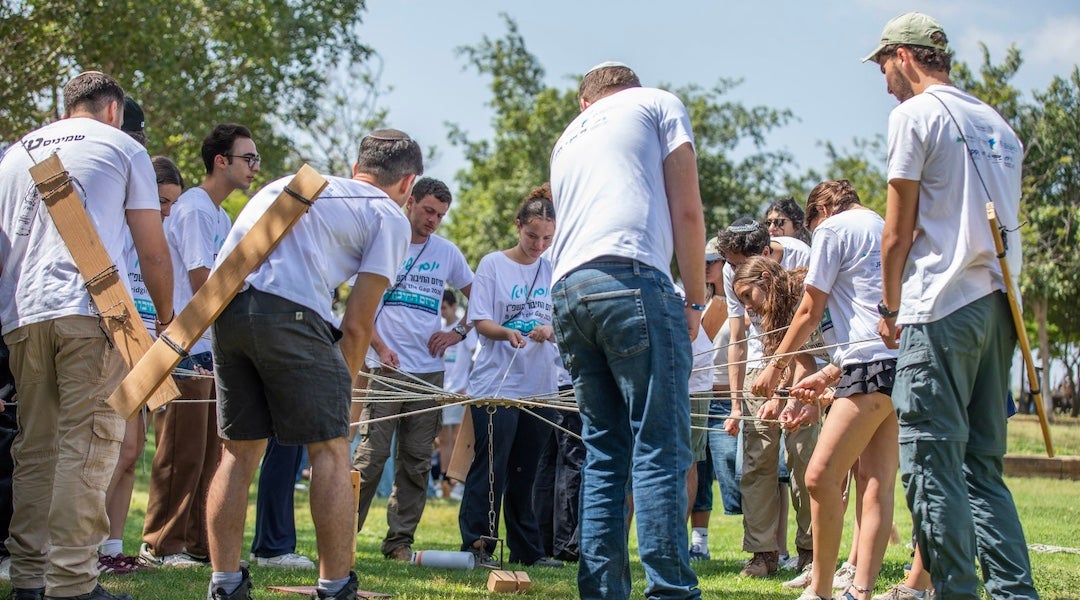
Aardvark Israel participants take part in a team-building program. (Courtesy Aardvark Israel)
“There’s been a change of understanding between the Jewish Diaspora and their connection to the land of Israel” since Oct. 7, said Refaeli. “This makes gap years more meaningful and relevant for many Jewish teens.”
Benel, who is attending a gap-year program this coming year, said that it is especially important for Jewish teens today to go on gap years because of the opportunity it offers to connect to Jewish heritage, history and identity. That “doesn’t mean learning about it, but actually go[ing] to Israel,” Benel said.
Masa’s Mavashev agrees that gap-year participants “are now seeking a deeper understanding of Israel.” Many gap-year programs have recognized this, and are reckoning with how to properly discuss and understand Israel politically, geographically and religiously. She said that this has resulted in many programs emphasizing Zionism more publicly than they did prior to Oct. 7.
Hammerman, whose decision to do a gap year in Israel was sealed when she was deferred from her top college, is looking forward to engaging with the country in a way that is more nuanced than the discourse she is used to at home.
A former (JR) teen fellow, Hammerman grew up in New York, where she attended the Leffel School, a pluralistic Jewish day school in Westchester County. Hammerman felt that her views were often criticized in high school by her classmates. “I am definitely a Zionist,” she says, “but I tended to have a much more liberal view than a lot of my peers,” she said.
Now, on Hevruta, she found a space where she can “really feel comfortable in my own opinions and engage in meaningful discussions.” She finds that her Hevruta peers want to learn “as much as possible and [be] critical thinkers about the country.”
Hammerman thinks that gap years are critical for any American Jewish teens who are headed off to college. “You can’t really understand the criticism or be able to thoughtfully and justifiably engage with discussion about Israel until you’ve really lived here,” she said.
Reporting the stories that define our era. When history unfolds in real-time, the Jewish world turns to (JR). Your support ensures we can document the complexities of war and the resilience of Jewish communities with integrity.