
TEL AVIV — A raucous crowd of football fans filled the narrow strip of grass between Tel Aviv’s music center and Bloomfield Stadium, home to the Maccabi and Hapoel Tel Aviv soccer teams. Threading their way through them toward the concert hall was an incongruous procession of young musicians in eveningwear, lugging cases of every shape and size for contrabasses, violins, ouds, cellos and darbukas.
Inside the concert hall, a small audience of friends, siblings, parents and music lovers let out a swell of whoops and claps more in keeping with a soccer game than the polite demeanor usually reserved for orchestras.
The concert was the public culmination of a youth project composed of Jewish and Arab performers run by the Jerusalem Orchestra East & West, known as TJO, the Israeli orchestra led by conductor Tom Cohen that blends Western orchestral music with Middle Eastern, North African and Andalusian traditions. TJO has shared the stage with major Israeli artists including Matti Caspi, Danny Sanderson and Ehud Banai, and is due to perform at the Concordia Summit in New York in September.
The program brings youth orchestras from across the country under TJO’s guidance, training young musicians to carry forward the musical language Cohen has spent years developing. He describes that language as part of an evolving “Israeli sound,” made up of “everything that began with our grandparents in the various diasporas around the world and arrived with them here in waves of immigration.”
It grew out of his own journey from Western classical music into the music of the Maghreb and the Middle East, and “brings together elements from East and West without losing the identity and distinctiveness of either one,” he said.
“We’re creating something new that is greater than the sum of its parts,” Cohen said. Still, he was careful to add that the sound was not his orchestra’s invention, but part of “an evolution, not a revolution that erases what came before it.”
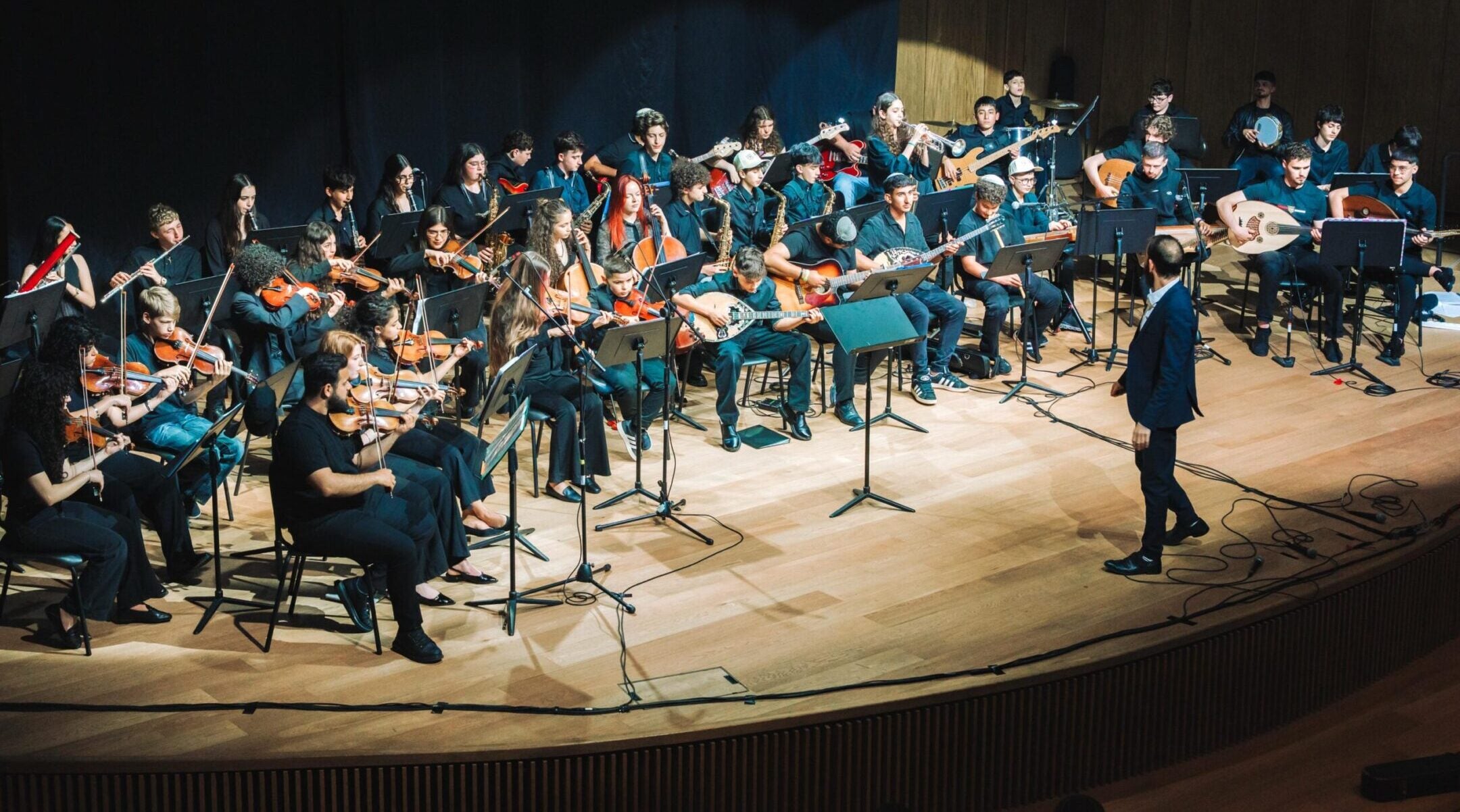
Last week’s concert brought together 80 musicians, ages 9 to 20, from half a dozen youth orchestras around the country, with some ensembles numbering in the dozens and others only a handful. Cohen said the project is meant to train a next generation of musicians who could one day join TJO, named the country’s leading orchestra by the Culture Ministry in 2022, while also sending them out as “ambassadors of its language” in their own work.
“Throughout the process, we placed special emphasis on artistic excellence, direct professional encounters and a connection to the adult orchestra as a mentoring body that sets the path,” he said of the youth project.
Ensemble Sdot, a nine-member group from the Sdot Negev Regional Council in southern Israel whose players mostly wore kippot, took the stage first to perform a reworked song by the late Israeli singer-songwriter Meir Banai. In the audience, waiting for his own performance, Youssef Sarhan, a 9-year-old violinist from Majd al-Krum, an Arab town in northern Israel, bobbed his head along from his seat. He had begun studying a year and a half earlier with Fadel Maana, a veteran violinist in the Arabic tradition from the same town and one of TJO’s senior musicians, who later brought him into the youth orchestra.
Addressing the young musicians from the stage, Cohen said he usually resists the familiar exercise of identifying who came from which community.
“This nonsense of saying who’s from where, it’s so unnecessary,” he said. But the mix was part of what made the music work, he told them, with Jewish, Muslim, Christian and Druze youth “backstage trading information about Umm Kulthum,” the revered Egyptian singer; maqams, the melodic modes used in Arabic and other Middle Eastern music; and other musical references.
“Even if you’ve never spoken to each other in your lives, when two children sit together on stage, catch each other’s eyes while they’re playing and creating something together, the connection that’s forged there is as deep as family,” Cohen told them.
Cohen, who lives with his family in Brussels, said the years of war had changed his relationship with his work, which had always been his greatest source of joy.
“It’s a feeling I can’t describe, a feeling of being outside of time,” he said by telephone after the concert. “But the last three years took that away from me.”
As an Israeli conductor who plays Arabic music, Cohen said, his international career went quiet amid growing hostility toward Israel abroad, while in Israel it became harder to enjoy performing when, as he put it, “half an hour away, the world is falling apart.”
The youth project offered a way back. Cohen said he found comfort in the connection between musicians “who come from completely different religions, backgrounds and places,” and came to see the orchestra as “a symbol of real hope, not just a professional artistic institution.”
Tom Cohen conducts the youth project of The Jerusalem Orchestra East & West. (Deborah Danan)
Malak Aboufdaly, a teenage bassoon player from Acre, said that after years of war, she felt a responsibility to give the audience a measure of relief.
“It’s my job to make you feel how I play. Sad or happy,” she said. “But I think it’s really important that we can make people happy after two or three years of war.”
Outside the concert hall, 17-year-old Shoval Hayak, wearing a black evening gown, was being scolded to go back inside. She was excitable and effusive, not long removed from being a regular high school student in Moshav Hosen, near Israel’s northern border. After Oct. 7, her family was evacuated to Tel Aviv, where she threw herself into singing. She joined the youth orchestra framework and later performed with the Israeli hip-hop and funk band Hadag Nahash.
At the concert, she was preparing to sing “Hallelujah” with Nihaya Safadi, a singer and viola player also from Acre, in an arrangement Cohen wrote during the orchestra’s first summer seminar.
“I didn’t believe I could ever be a singer,” she said.
Some of her peers, she said, tried to escape the reality of war and displacement through recreational drugs. Hayak found her escape in music.
“I gave my heart and soul to this project. I got sucked into it more and more,” she said. “I truly believe that if I give my whole heart, all the small details that make everything shine come to the surface. Each time I go on, there are tiny improvements that I’m not even aware of at the time.”
She spoke quickly and warmly about the people around her: her mother, who she called “my support system”; Cohen, who she said had become like a father to her; and her boyfriend Yair, who could not attend because he was observing the Omer, the traditional mourning period between Passover and Shavuot when many observant Jews avoid live music. “Bless his soul, I adore him,” she said.
The same affection extended to the other young musicians she performed with. “They’re the best family I could ever ask for,” she said.
Cohen said watching young musicians like Hayak “become professional and be captivated by the magic of music” is part of what kept him invested in the project, which he took on as a volunteer effort. The next step, he said, is to give the program a larger stage and bring in more students.
The adult orchestra returned to the same East-West language last week in a concert about mixed identity at the Israeli Opera in Tel Aviv, with additional performances scheduled elsewhere. The program centered on “matrouz,” Arabic for “interweaving,” a Judeo-Arabic tradition of placing Hebrew lyrics over Arabic melodies billed by the orchestra as the “original Jewish mash-up.”
Its pre-recorded guests included Dana International, the Israeli pop star who became the first transgender singer to win Eurovision in 1998, and Yousef Sweid, the Arab Israeli actor – performers who mirror the orchestra’s interest in what it calls “both/and” identities that can be Arab and Jewish, left-wing and right-wing, religious and secular.
The youth evening ended with all the young musicians together playing “Fatouma,” a Lebanese piece arranged and led by Cohen, who bounced on the balls of his feet, twirled on stage and flashed theatrical expressions at the players as he conducted.
“I was looking for a way back to my happiness and I found it in this world of children,” he said. “When I’m with them and making music, I go back to real, deep joy. Like a child.”
Reporting the stories that define our era. When history unfolds in real-time, the Jewish world turns to (JEWISH REVIEW). Your support ensures we can document the complexities of war and the resilience of Jewish communities with integrity.