

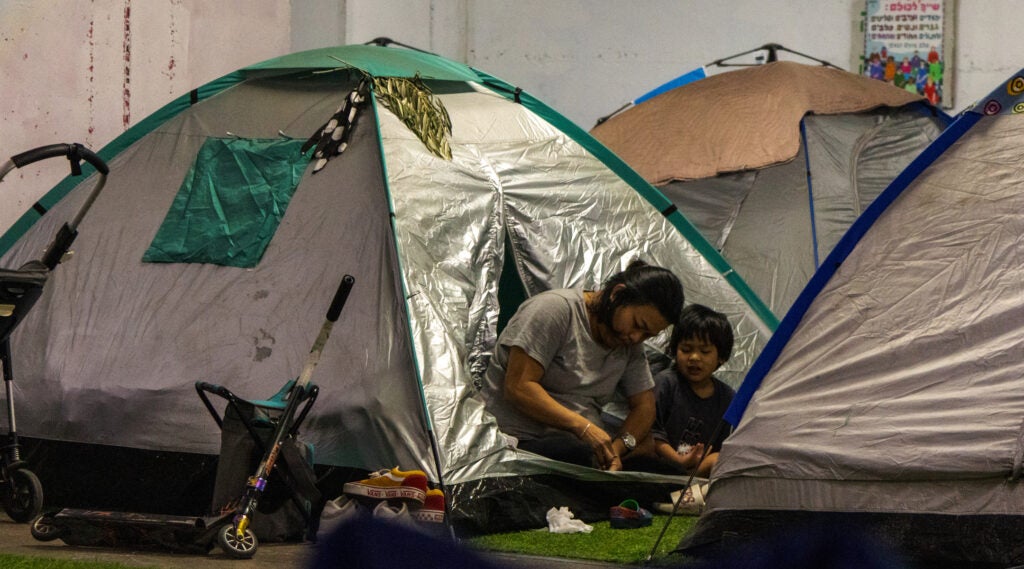
TEL AVIV — Two floors underground, past dumpsters and oil-laden puddles, through a reinforced Cold War-era door, a bomb shelter is buried underneath Tel Aviv’s Central Bus Station.
Built in 1993 to accommodate more than 16,000 Israelis, the shelter found a new life during the Israel-Iran war as a public refuge for residents of Neve Shaanan, among Tel Aviv’s most diverse neighborhoods and one of its poorest, home mainly to asylum seekers and foreign workers.
With few other options for public shelters in south Tel Aviv, residents pitched tents in the squalor of a space that had fallen into disrepair — with pipes dripping and rats scurrying — for more than 38 days as Israel and Iran exchanged missile fire until a ceasefire that began on April 8 halted the fighting.
“It’s very difficult. Not just because of the war, but because of the conditions we’re living in,” Gloria Arca, who took refuge inside the shelter with her son, Noam, said in Spanish during an interview in April. “We’re protected from the missiles, but inside we’re not safe.”
For many Israelis, the bus station occupies a space that balances between nostalgia and revulsion. Until 2018, the station was a main node for travel into and out of Tel Aviv. Since then, ridership has dropped, and now the hulking structure is seen as little more than an eyesore. During Israel’s 12-day war with Iran last year, a short video by Israeli comedians went viral for sharing the station’s GPS coordinates in a video that jokingly urged Iran, “Please don’t bomb this bus station.”
The entrance to the bomb shelter beneath Tel Aviv’s Central Bus Station. (Theia Chatelle)
Yet the station also offers a concrete window into Israel’s widening reliance on foreign workers, which has surged in the wake of the Oct. 7, 2023, Hamas attacks.
When there is no war on, the shelter functions as a community center, complete with a Filipino church, a refugee health clinic, and retailers catering to customers in more than a dozen languages.
During wartime, the station takes on a new and vitally important role as a shelter for those who have none in their homes or neighborhoods, no family in the country whose homes they can flee to and little ability to pay for temporary accommodations somewhere safer.
Arca, who came to Israel more than two decades ago from Colombia and is in the country legally, knew that it would take her and Noam more than 10 minutes to get to a shelter from their home — longer than Israel’s advanced missile warning system allows. So they decided to move into the bus station, pitching a tent alongside some of their neighbors.
Depending on the day, more than 200 residents spent their nights in the shelter during the war, according to Sigal Rozen, public policy coordinator at the Hotline for Refugees and Migrants.
“It’s not easy, especially with young children and families with special needs,” she said. “You can’t get up in the middle of the night and just run.”
The Hotline, with funding from the Tel Aviv Municipality, worked to improve conditions in the shelter, but the starting point was dire. During a visit in April, rats could be seen scurrying across newly installed artificial turf meant to brighten the space, and mosquitoes landed on visitors’ ankles before being chased off.
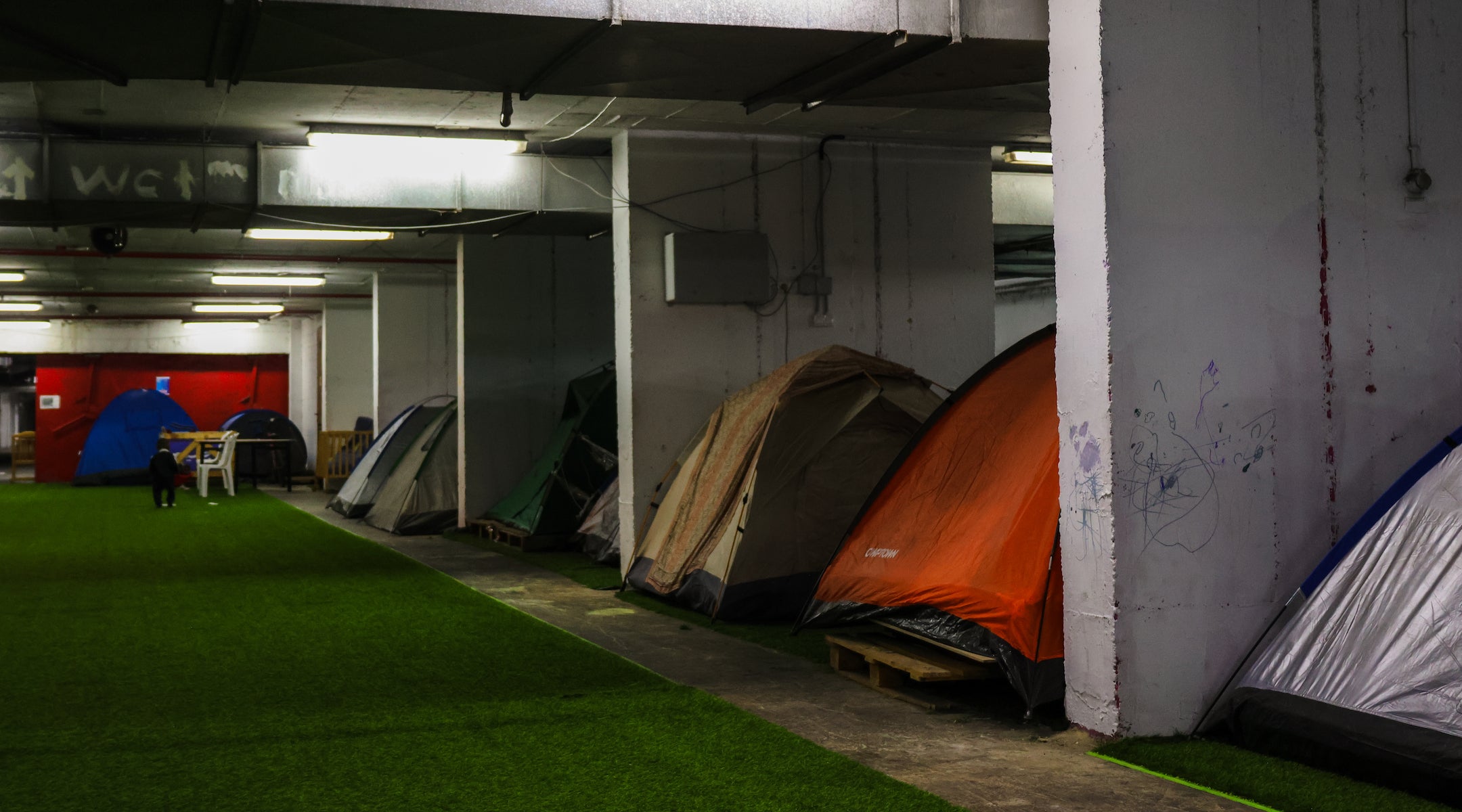
Rows of tents, pitched after the start of the Israel-Iran war on Feb. 28, shelter residents as they take cover from incoming missile barrages. (Theia Chatelle)
More than anything, Arca worries about safety in the shelter — but not from the war. “We’re protected from the missiles, but inside, we’re not safe,” she said. “Security is there, but they don’t do their job. Drug users come in and use the bathrooms. There are many children here, and we’re afraid.”
The challenging conditions were nothing new to many of the people who moved in, who represent an often unseen but growing sector of workers in Israel.
The category of “foreign worker,” a term used in Israel to describe non-citizen laborers, most of them from countries such as the Philippines, India, and Thailand, who enter the country on temporary work visas tied to a specific employer, has long been a fraught designation.
Dominant in some industries, such as home health care, where there are so many foreign workers that the role is known as “filipina” in Hebrew, foreign workers have taken on greater shares of other sectors in recent years, particularly after Israel banned Palestinian workers from Gaza and the West Bank after the Hamas-led Oct. 7 attack. With Israelis increasingly reluctant to take low-paying manual labor jobs, the Israeli government has moved to fill the gap by permitting employers to hire more foreign workers.
Israel’s foreign worker population rose by 41% in 2024 alone to more than 156,000. By 2025, the total had reached 227,044. It is expected to grow even more in the coming years, as the government has set a ceiling of 300,000 workers.
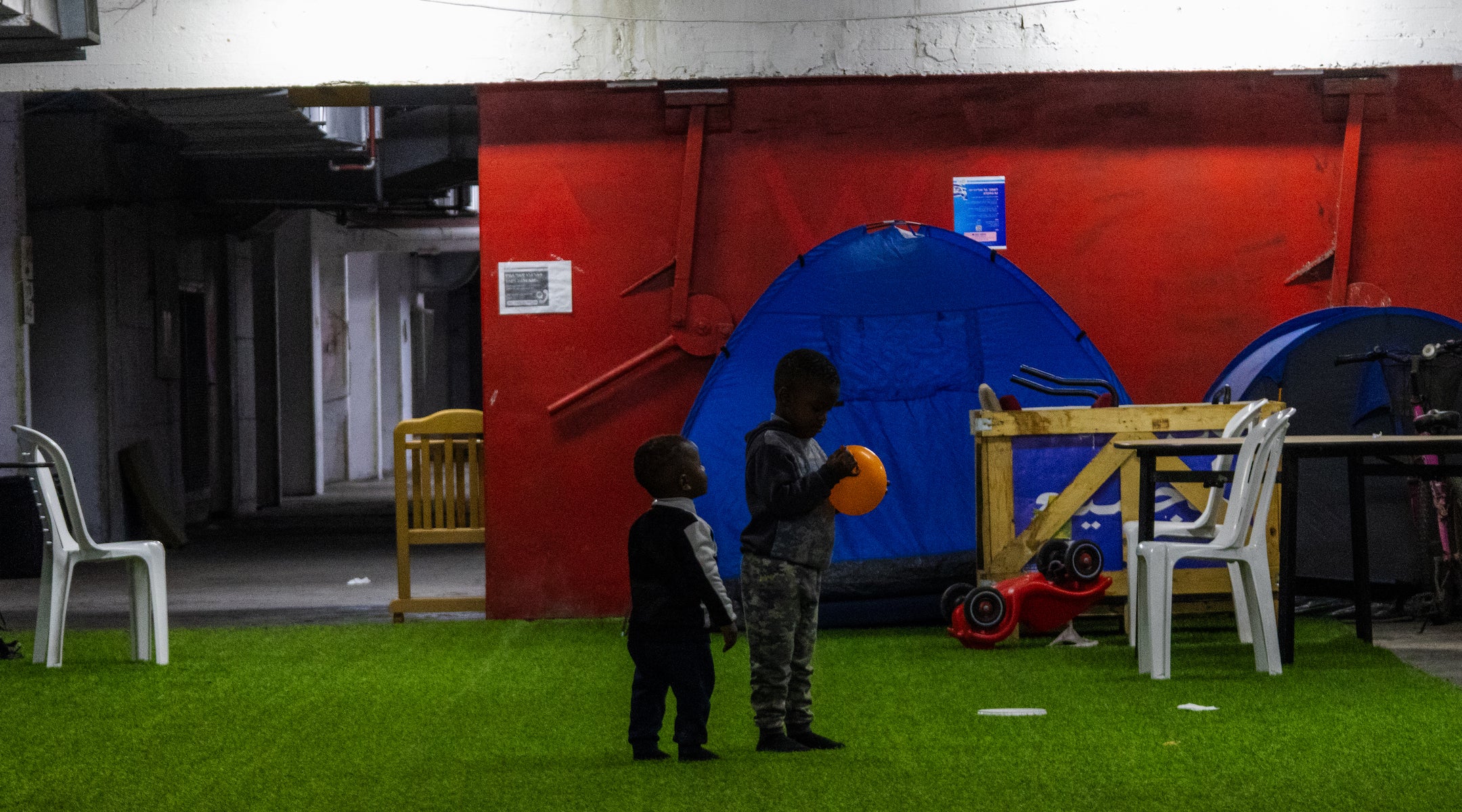
Two children stand, playing on astroturf recently installed with the help of the Workers Hotline. (Theia Chatelle)
For many Israelis, footage that circulated after the ceasefire showing long lines of foreign workers arriving at newly reopened government offices to renew their visas offered a stark illustration of the growing sector.
It is not uncommon around the world for people from impoverished countries to migrate to countries with more work and higher pay. For the workers, occupying a tenuous legal status can be worth it to be able to support their families, send their children to stronger schools and earn wages on a different scale than in their home countries.
Evelyn, a Filipina caregiver sheltering with her three children beneath the Central Bus Station, declined to give her last name out of fear of deportation. “In Israel, I can earn 10 times what I do in the Philippines. So I have money to send back to my family — not just taking care of my kids here, but my parents in Manila.”
But advocates for the workers say foreign worker status, and Israel’s increasing reliance on foreign workers, creates conditions that are ripe for abuse. Ohad Amar, executive director of Kav LaOved, a nonprofit that works to uphold equal labor rights for all workers in Israel, said the workers are “enduring conditions akin to modern slavery.”
Many foreign worker visas in Israel are tied to a specific employer and are non-transferable. Kav LaOved has documented numerous cases of delayed or unpaid wages, as well as workers who feel pressured to remain silent about abuse from their employers lest they lose their immigration status.
“Israel had not relied on migrant workers in the same way before. This is the first time at this scale,” Amar said. “Every day we are getting reports of workers’ rights violations, and we are completely overwhelmed.”
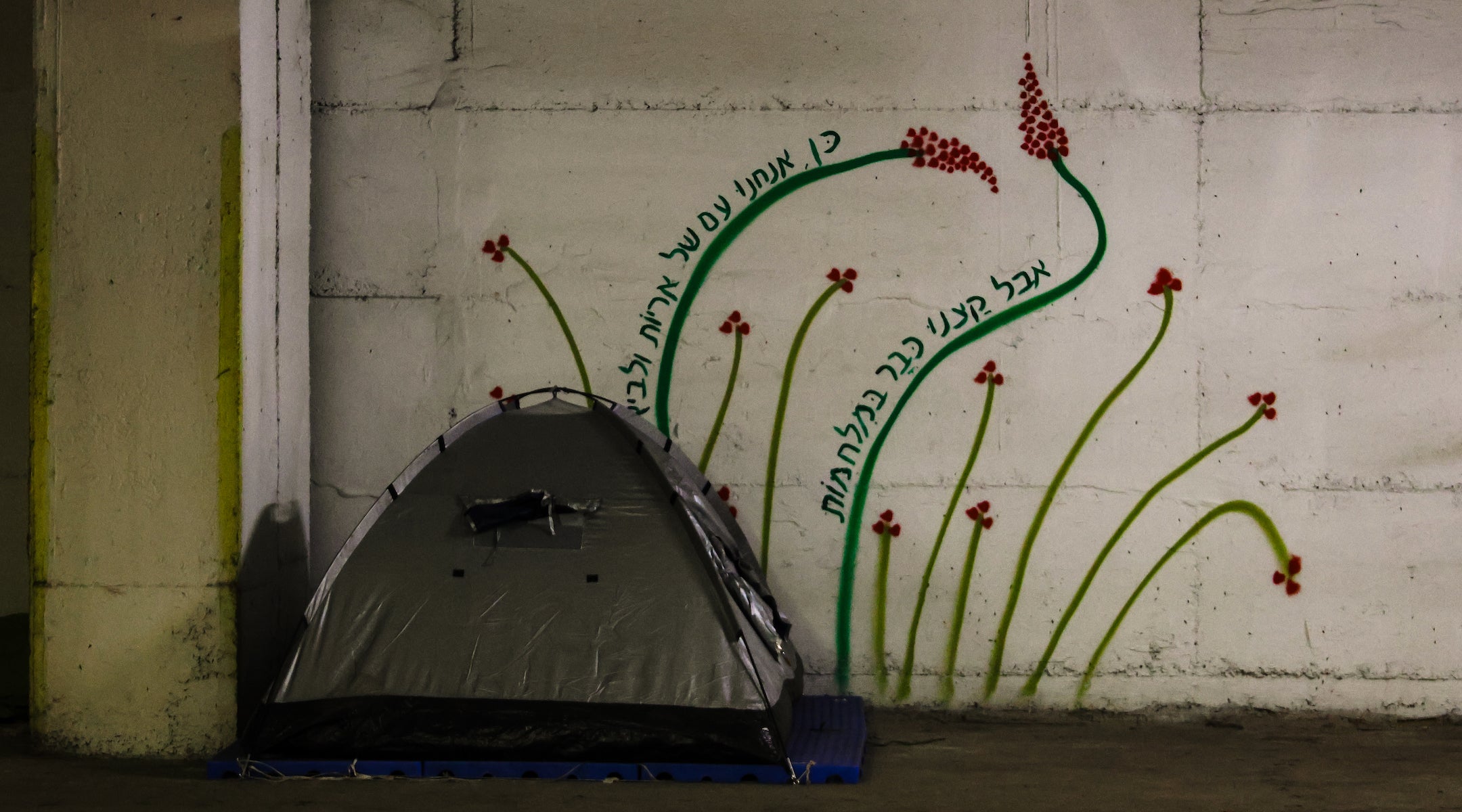
A tent stands in front of a mural on the minus-two level of the bus station. (Theia Chatelle)
During wartime, foreign workers are frequently exposed to Israel’s unique dangers in extreme ways. On Oct. 7, as sirens blared, foreign workers were slaughtered in the fields of kibbutzes near Gaza. During the most recent war, videos circulated online of construction workers from China who filmed themselves stranded high in the air during missile barrages, afraid and without protection.
The first death in the latest round of fighting with Iran was Mary Anne Velasquez de Vera, a foreign worker in Israel from the Philippines. At the end of March, two other foreign workers were killed by a Hezbollah rocket while working in a field in northern Israel after they were unable to reach shelter.
Feeling physically vulnerable is an experience many foreign workers in Israel know well. Evelyn, a migrant from the Philippines who slept in the bus station with her children during the war, described how, in an industry as intimate as caregiving, working with elderly people who struggle to make it to a shelter, workers can feel pressured to stay in the building during an attack.
“They can’t exactly tell their employer they left grandma in the building during a missile attack, because they’ll get fired and lose their visa,” Amar said.
Some of the risks are much less visible. Evelyn was out of work as a housekeeper for the duration of the war, when her employer, an elderly woman, left the country. She lived on donations from community members and civil society organizations.
“Here is still better than back home,” she said. “But we are all struggling, and not just because of the shelter. If I can’t start working soon, I really don’t know what I will do.”
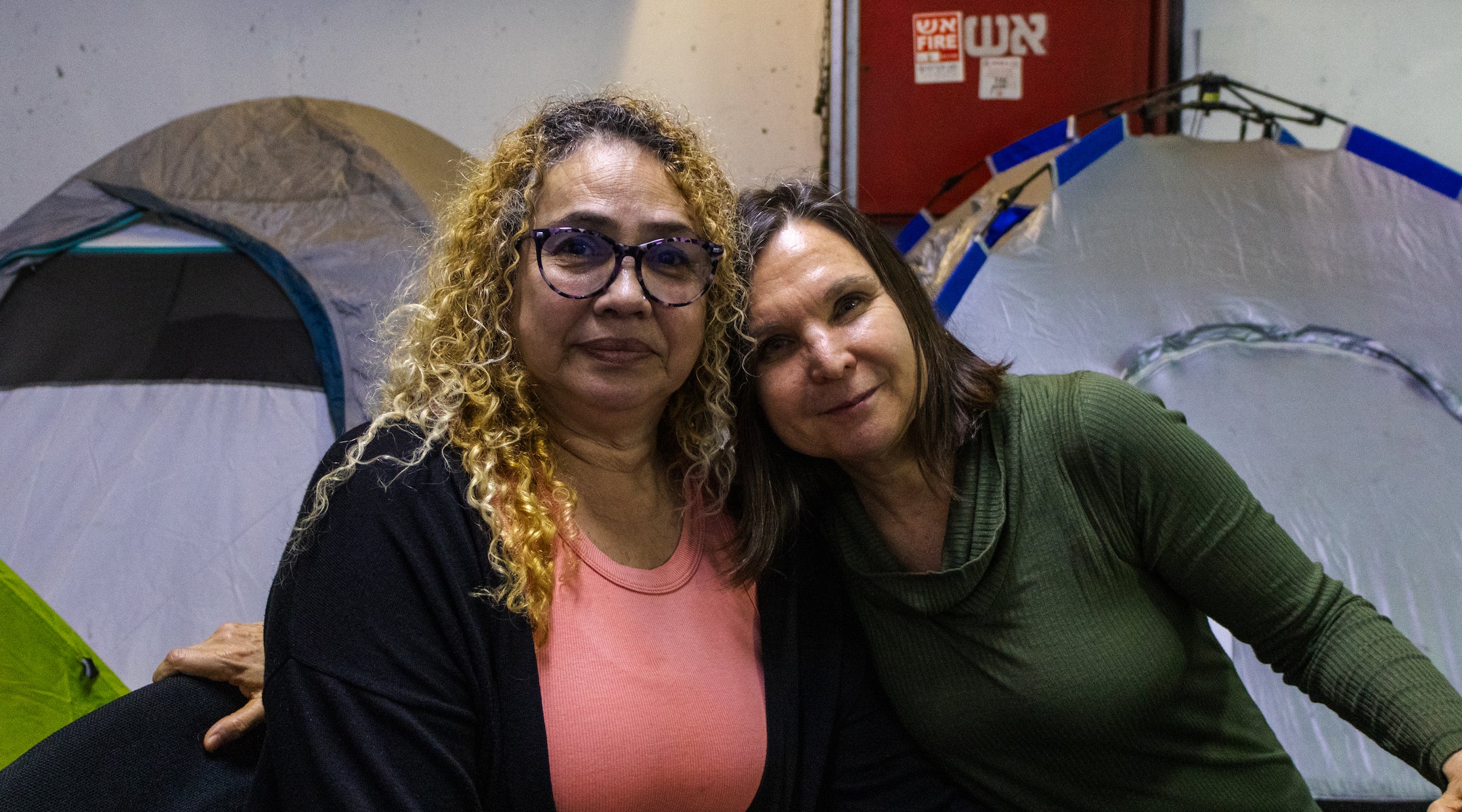
Gloria Arca sits with Sigal Rozen in a public shelter. (Theia Chatelle)
Workers like Evelyn who lack work visas must rely on informal employment, making them ineligible for compensation from Bituach Leumi, Israel’s national workers’ insurance, when they go unpaid. But having a visa did not solve the challenges of war, Rozen said.
The threat of losing their visa if they lose their employment hangs over the heads of the workers, forcing them into difficult decisions, like whether to leave their children with volunteers at the shelter or alone at home.
“Even those who still have work face a problem. If a single mother has children and there’s no school, where does she leave them? She can’t bring them along when there’s an alarm,” Rozen said. “So even when work exists, many can’t do it.”
She said the war had offered a glimpse into the as-yet-unaddressed challenges that come along with Israel’s increasing reliance on importing labor from abroad. The country’s labor market didn’t come to a standstill, as was the case in other countries in the region such as the United Arab Emirates where the vast majority of workers are migrants who tried to leave, but for Rozen, something new and troubling was laid bare.
“If you don’t want foreigners here, then don’t recruit them,” Rozen said. “But you can’t recruit them, triple their numbers, and then expect them to disappear when there’s a war.”
Passover may be over, but your chance to support independent Jewish journalism isn’t. Help (JEWISH REVIEW) keep reporting the stories that define our era.