

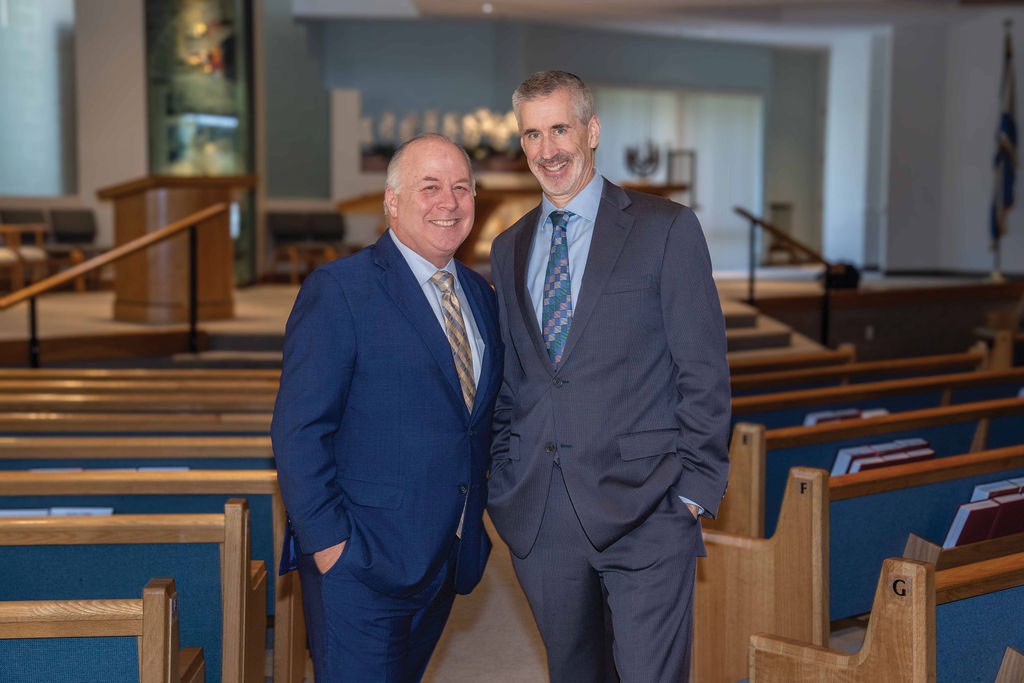
Talking to Rabbi Richard Camras, and Rabbi Stewart Vogel of HaMakom synagogue in West Hills, is like talking to identical twins. The two native Angelenos, longtime friends and professional colleagues, have strikingly similar career paths, present convictions and future intentions. They are so much in tune with each other, they practically finish each other’s sentences.
They are also retiring together; both will be stepping down at the end of June.
“We both had our own unique timelines,” Rabbi Vogel said. “They were similar. Neither of us felt we were being forced into early retirement. There was a timeline for both of us that happened to fit in.” And when Rabbi Camras’ Shomrei Torah and Rabbi Vogel’s Temple Aliyah merged, it was a way for both of them to go forward.
Rabbi Camras quickly picked up on the point. “When we began thinking about the process of merging our two communities, we raised the issue together that when we believed the synagogue was in a healthy place, it probably would be best for the community to hire a rabbi who would take the synagogue into the next decade.”
How did they both know when it is time to step into – or toward – retirement?
Part of it, Rabbi Camras said, is a feeling. “There’s no certainty,” he said. “Rabbi Vogel and I really wanted to begin to feel that when the congregation was settled enough in the merger that there was no crisis in response to coming together – but that there was excitement and steadiness about a future where we felt it was the appropriate time.”
It was three years ago this month when Shomrei Torah and Temple Aliyah– located one-and-a-half miles apart in the West Valley – joined forces became HaMakom. Turning to his friend, Rabbi Vogel said it was “so interesting that you and I perceived there were changes in synagogue life – this was prior to COVID, which really set the stage for all the changes we were already anticipating. … we already were seeing the writing on the walls about synagogue life, which had changed in terms of membership, of people coming into the synagogue, of how the synagogue would have to be revisioned.”
The changes are nationwide, Vogel said. “I think many synagogues are seeing a radical shift,” which has triggered long-lasting decisions. “By the way, rabbis are leaving the rabbinate as a result. It’s a long story about what I call The Unbundled Generation. We are dealing with a generation now that doesn’t see synagogue life. It’s a bundle: We are here when you need it. And those values of synagogue life were changing drastically.”
Rabbi Camras believes it is about a systematic change in American life where people historically belonged, and now they don’t. “Not just in synagogue life but in everything. Society changed. They want what they want when they want it, and they get it in a way that makes sense for them.”
Both were trained as rabbis in the ‘80s and ‘90s to think about synagogue life for the 1950s and ‘60s. But toward the latter part of their careers, Rabbi Camras said, they both suddenly realized “that the Jewish community is undergoing a rather significant transformation. What will the synagogue of the future look like? Not that it is going to look like the synagogue of our grandparents. Another question is, who best can serve the Jewish community going forward?
Rabbi Camras also pointed to the upheaval in rabbinic education, and in the decision of rabbis to serve or not serve in pulpits Rabbi Vogel noted there are far fewer pulpit-trained rabbis or rabbis serving in the pulpit today. In Rabbi Camras’ opinion, there is a logical explanation for the earthquake. “It’s a rather demanding profession,” he said. “I think young people today want to try to balance work with all sorts of other aspects of purposeful and meaningful living.”
“They are probably not wrong there,” said Rabbi Vogel.
The latest generation of rabbis, Rabbi Camras said “define themselves solely through their professional work. Pulpit work is incredibly demanding on the individual … and on the family. It’s all-encompassing. Rabbis today, young people today, will happily choose to serve the Jewish community in less all-encompassing, demanding ways.”
Quickly picking up on the topic, Rabbi Vogel said that both people and synagogues changed. “We saw this [broad change] prior to COVID. Recognizing that society and the religious life had changed, the synagogue model needed to change. It’s not about religion. It’s about a different focus of what the synagogue is about. I pride myself on having had a creative rabbinate, trying a lot of different things, changing the music in synagogue life years ago, in terms of bringing people in, of creating programing, as Rabbi Camras did as well, to bring people in.”
They both saw things were changing, and knew that the next iteration of synagogue life was going to be for the next generation. Their job, Rabbi Vogel said was “to prepare the moment. Many synagogues – when they look at themselves – are willing to say, ‘You know what? Things are changing, but we are going to remain how we are. We will just pray for the best.’”
Even Moses, Vogel said, had to be pushed “God said to him, suffer and move forward. We saw that as the model. Rabbi Camras and I started to talk. We had a timeline.”
Jewish Journal: Do you have any unfulfilled Jewish goals?
Rabbi Camras: One thing I have learned is that I know less than I would like to know in the vastness of Jewish literature and Jewish learning. I can’t wait to have more time to study.
J.J.: Your favorite hobby?
R.C.: Two. I love cycling (both mountain bike and road bike) and I love reading. I love going fast and going far, days at a time.
J.J.: What kind of books do you enjoy?
R.C.: Everything. I love history, fiction and nonfiction. Everything engages me.